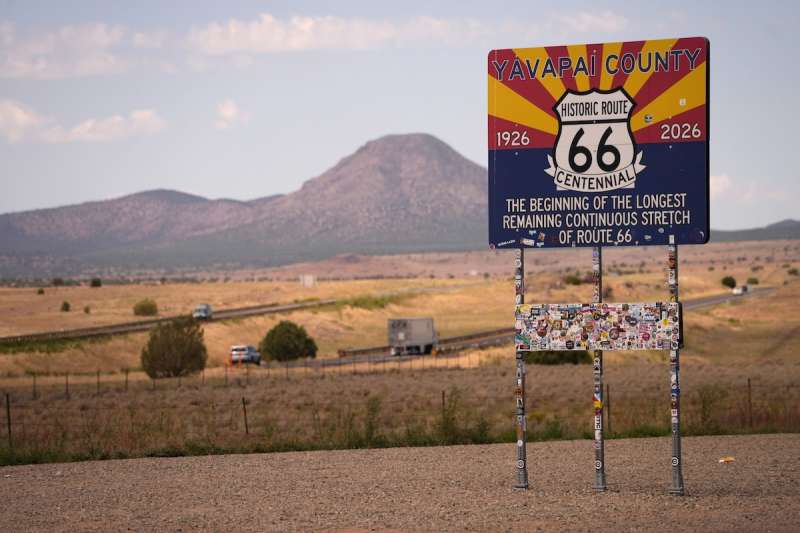
America’s most famous road hasn’t officially existed for more than 40 years, but millions of people worldwide continue to flock to Route 66 and soak up its mythology.
For a century, travelers crossed oceans to drive it. They photographed its cracked pavement. They bought souvenirs adorned with its iconic shield. And they still do.
They are drawn by what the road, particularly the 385-mile Arizona stretch, represents: freedom. Freedom of the open road. Freedom to move west, to start over. Freedom to escape hardship. Freedom to chase opportunity, economic independence and adventure.
MORE: Arizona’s oldest movie theater is still playing movies 111 years later
All of that got stamped onto the popular conscience by books, film and music.
But the pop culture myth eclipses the reality on the ground. There were limits to the freedom the road offered, and cracks in the history that couldn’t be paved over.
During the heyday of Route 66, Native American communities along Route 66 faced displacement and negative stereotypes depicted in the Westerns on the silver screen. Black travelers relied on guides that helped them avoid discrimination that couldn’t be drowned out by the neon glare.
Route 66 “helps us understand our national identity,” said Jim Hinckley, a world renowned Route 66 historian based in Kingman. “It’s part of the American story … Not all the chapters are glorious.”
“The American experience (lives) here on this road,” he added.
The road, the myth, the legend
Route 66 is a road. A famous road, but a road, nonetheless.
“It’s damn fascinating that so many people from all over the world are interested in Route 66,” Hinckley said. “First of all, it’s a road. Second of all, officially, it hasn’t existed since 1985.”
Other highways carried migrants, commerce and tourists. Other roads crossed deserts and mountain ranges. But Route 66 captured something they did not: it was mythologized over and over in literature, music, television and film.
“We have kind of episodically ‒ and maybe accidentally ‒ made Route 66 a backdrop to a lot of national events that maybe other roads could have fulfilled but didn’t … (It) worked in the background of a lot of our popular culture,” said Sean Evans, a Flagstaff-based Route 66 historian and author.
Each generation reinvented the legend to embody a different kind of freedom.
During the Dust Bowl, it became a road of flight from economic hardship and in search of economic opportunity. In John Steinbeck’s 1939 novel “The Grapes of Wrath,” families followed Route 66 west in search of work and survival. Steinbeck called it the Mother Road, a nickname that has stuck for decades.
Less than a decade later, Bobby Troup’s song made popular by Nat King Cole in 1946, “(Get Your Kicks) on Route 66,” brought a different vision of freedom to life, one of discovery and adventure. Popular culture recast the path to prosperity as a road of pleasure and leisure.
Hollywood reinforced that mythology.
“You think of the great road movies: ‘Easy Rider’ (and) ‘Two-Lane Blacktop,’” Evans said. “It becomes this kind of modern metaphorical backdrop to the buddy film or the ‘we’re lost on the road’ kind of film.”
The 1960 television series, “Route 66,” portrayed two young men traipsing across the country in a convertible searching for adventure. “It captured the spirit of the road: two young men, a sports car, discovering America,” Hinckley said.
Disney Pixar’s “Cars” in 2006 revived Route 66’s legend and reintroduced the freedom of the open road to a whole new generation.
In Arizona, the tale of Route 66 revolves around romanticism of the Southwest: gunfights and saloons, sheriffs and Native Americans, turquoise-laden jewelry and brightly patterned woven blankets. Hollywood Westerns, like 1962’s How the West was Won, helped turn Arizona’s desert landscapes into shorthand for an untamed frontier.
Route 66 symbolized adventure and exploration and brought cowboys and open highways to life.
Arizona towns still perpetuate the Route 66 tale
Each community in Arizona embraced different aspects of the Route 66 legend to distinguish themselves, Evans and Hinckley said.
“Route 66 has evolved into … America’s longest small town,” Hinckley said. “Towns like Kingman, Holbrook or Peach Springs, they’ve become just quirky neighborhoods in that community, kind of like Chinatown in Los Angeles.”
In Oatman, nestled in western Arizona’s rugged wilderness, the Route 66 myth takes the form of the untamed frontier. Burros roam the street and staged gunfights turn the dilapidated ghost town into a performance, selling a theatrical version of the Wild West.
Bikers, drawn by the freedom of the open road, ride across the country, but the route to Oatman offers something unique: an 8-mile narrow, serpentine road cutting through Mohave County’s Black Mountains that some have hailed as the “ultimate motorcycle ride.”
“Oatman definitely is the Wild West. It is very much its own place. Nobody tells Oatman what to do,” said Nikki Terlesky, the director of the Historic Route 66 Association of Arizona.
Winslow, 58 miles east of Flagstaff, shows how Route 66 reinvents a place through pop culture.
Tourists flock to the corner made famous by The Eagles because a song told them the place mattered. They snap photos during golden hour next to a statue of a generic troubadour posing with a guitar. Cracks mar the Route 66 shield painted on the intersection in front of the statue.
In Flagstaff, Route 66 remains part of a living city rather than existing in the past. Quaint, historic and sometimes haunted brick buildings frame a vibrant downtown. Restored neon signs sitting atop old hotels light up the night and coexist with the modern world. Route 66 remains a connection people use to reach work, businesses and each other.
But the history of Route 66 captures more than saloons, neon lights and haunted hotels ‒ it also witnessed massive cultural shifts over the century.
The fuller, often untold, American story of Route 66
Not everyone shared the freedom to move and chase the American dream equally.
“We think of Route 66 in the nostalgia frame: neon and tail fins and ‘I like Ike’ buttons,” Hinckley said. “But we forget the so-called heyday of Route 66 was also an era when African American travelers had to use the Green Book.”
Starting in 1936, The Green Book served as a guide for African American travelers. During the same decades remembered as Route 66’s golden age, Black travelers confronted segregation. Businesses refused them service. They couldn’t stop in some communities because it was too dangerous.
According to research by the Tougaloo College in Mississippi, Kingman on the western side of Route 66 was a sundown town, where non-white travelers needed to leave by nightfall. But other Arizona communities featured prominently in some editions of The Green Book as safe places to go, like the historic Motel DuBeau in Flagstaff and the La Posada Hotel in Winslow.
“The fact that we had … hotels that allowed Blacks to stay in the same rooms as white people prior to the Civil Rights Act is kind of radical,” Evans said. “It didn’t happen everywhere, but it did happen on 66.”
Route 66’s passage through tribal land exposed another limit to the freedom it promised. The road created new access points and economic opportunities while popularizing a romanticized West partly built from stereotypes of Indigenous people.
“It changed the way a lot of Native cultures work,” Evans said. “Their stories and their lives are impacted by the road, pretty much just like everybody else’s, and change in even more dramatic ways … because they lived in relative isolation for years.”
The tourist economy heavily drew on an idealized image of the rugged Southwest, presenting Native art and culture as part of the romance travelers came to experience. The Westerns often condensed Indigenous characters down to stereotypes and routinely portrayed them as violent.
Route 66 also opened tourists’ eyes to the reality of tribal communities. A recognition of chronic poverty, forced displacement, kids sent to boarding schools and shortened life spans slowly replaced the “noble savage” stereotype depicted in Western lore.
But, at the same time, Route 66 created economic freedom for the tribes touching the road, from trading posts to access to jobs. In Peach Springs, Route 66 not only served as a tourist corridor but also as a commuter route and business district for the Hualapai community.
“There were individuals, families, that actually just went out to the road because they could sell there,” said Gail Chehak, the community and partner relations director of the American Indigenous Tourism Association. “Some of them have developed trading posts and other kind of gift shops.”
Today, many Native communities along Route 66 wield greater control over how their cultures are represented and how visitors experience their homelands, she said.
“Tourism along the route has been reclaimed by the Native people and the tribal people,” Chehak said.
To historians, tourists and residents, Route 66, both fact and fiction, tells the story of America. Route 66 endures because the promise of freedom and the American dream still ring true, while the underlying history shows the full American story.
Evans said Route 66 is “a melting pot for America … That’s the kind of cool thing that I don’t know that all roads do, but this road did.”
Its surviving pavement carries stories of mobility and exclusion, economic opportunity and exploitation, prosperity and abandonment.
Whether the road and its legend survive another 100 years, Evans and Terlesky didn’t know. But Hinckley was optimistic.
“Route 66 is the American story made manifest,” he said. “As long as there’s interest in the American story, Route 66 will thrive and survive.”
Reporting by Lauren De Young, Arizona Republic