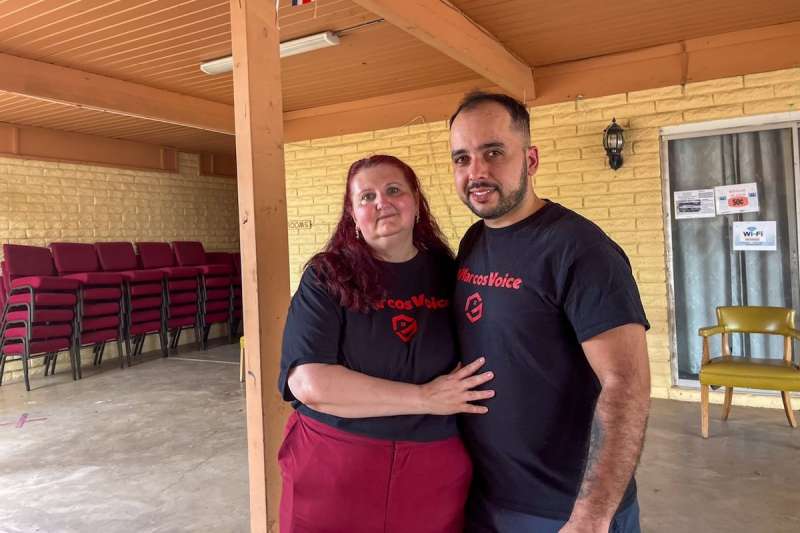
After about seven months in immigration detention, mostly in in Arizona, Marcos Gaspar-Da Silva, a Maine father, was freed on Aug. 13.
It all started in January, after US Immigration and Customs Enforcement (ICE) agents pulled Gaspar-Da Silva and his co-worker in Portland over while looking for someone else with active warrants, according to his wife, Alessia Gaspar-Da Silva, who was on a video call with Gaspar-Da Silva at the time. Gaspar-Da Silva was arrested, then bounced between detention facilities in Massachusetts, Louisiana, and, finally, Arizona. He was housed in “deplorable” conditions both at the Arizona Removal Operations Coordination Center (AROCC), a detention center at the Phoenix-Mesa Gateway Airport, and the Florence Correctional Center.
On Aug. 12, Gaspar-Da Silva was granted an adjustment of status to a lawful permanent resident at a court hearing and ordered released by Judge Victoria Levin of the Executive Office for Immigration Review. Alessia, who lives in Maine, flew to Phoenix to reunite with her husband at Phoenix Sky Harbor International Airport on Aug. 13.
Now released, Alessia and Gaspar-Da Silva have vowed to continue fighting for the more than 65,000 people housed in detention facilities across the country.
“ Marcos’ voice was stolen from him, so I had to become Marcos’ voice,” Alessia said at an Aug. 14 press conference. “ Nobody should have to have your loved one call you and tell you, ‘I just want to brush my teeth. I just want a meal. I am cold.’”
The toll
In detention at the AROCC, Gaspar-Da Silva and about 50 other detainees were crammed into a cell that had just one toilet, Alessia said in June, leaving no room to lie down, shower, or change clothing. Because the AROCC is designed for short-term stays of about 12 hours, the facility does not include proper bedding or showers. But an Arizona Mirror analysis found that ICE holds people at the center often for far longer than it’s supposed to—-leading to overcrowding like Gaspar-Da Silva experienced.
At Florence, the water was undrinkable and Gaspar-Da Silva experienced medical issues–including stomach aches, rashes, and tooth pain—that was largely ignored by guards, who only gave him an ibuprofen, until he fainted from the pain, according to The Copper Courier’s June reporting. His condition went untreated for weeks until he fainted twice and had the tooth finally removed on April 1.
Now released, Gaspar-Da Silva said he felt emotionally numb. The trauma, along with the guilt of leaving the others behind, has made it difficult for him to feel relief now that he is released.
“ I got a release, but I got trauma. I have a lot of trauma inside of the jail, and [seems] like outside the jail, the trauma [keeps] going,” Gaspar-Da Silva said at the Aug. 14 press conference.
Alessia said on Friday that the two plan on rebuilding their lives in Maine. The costs of the immigration battle have been a deep hit on the family—costing more than $25,000, Alessia said—and the two will have to find a new routine. Gaspar-Da Silva hopes to return to his contracting business soon, and Alessia, who’s had to put treatment for medical conditions on pause, might finally have the chance to see a doctor.
Gaspar-Da Silva’s case received national attention and received help from US Reps. Yassamin Ansari (D-Phoenix) and Adelita Grijalva (D-Tucson). Elizabeth Lee, a congressional candidate in Arizona’s 5th Congressional District, led the initiative to assist Alessia, who lives across the country in Maine.
Earlier this year, Alessia sought out assistance from Lee after seeing her advocate for the release of other detained individuals. A nurse, Lee told Maine Morning Star she was “absolutely astonished” after she looked at Marcos’ medical records while detained, including reported levels of high tooth pain, around the same time of the death of Emmanuel Damas, a Haitian asylum seeker who died from complications related to a tooth infection in the Florence center. Damas’ brother said his health was fine and that he did not have serious dental issues before he was detained, according to NBC News. The US Department of Homeland Security told the outlet he refused dental extraction.
Lee is urging Arizonans to use this as an opportunity to get involved with local networks pushing back against ICE, arguing community involvement and visibility makes all the difference for detained individuals.
“Marcos had a community that refused to let him disappear. Everyone deserves that. This is what community is supposed to look like,” Lee said in an Aug. 14 statement. “We show up when someone is scared. We help when a family cannot do it alone. We raise money. We make calls. We sit in courtrooms. We visit detention centers. We ask questions. We tell their stories. And we keep showing up until they come home.”