It’s certainly a sign of the times that vintage advertisements are all the rage. Tucson has the Ignite Sign Art Museum. Mesa has The Neon Garden. And in Pinal County, there’s the Casa Grande Neon Sign Park. These places have opened in response to the phenomenal success of the American Sign Museum in Cincinnati in 2005.
A powerful, unseen factor is influencing the evolution of vintage signs from marketing tools to an essential part of a community’s aesthetic.
“I think the common thread that runs through preserving vintage signs is emotional,” says Tod Swormstedt, founder of the American Sign Museum. “Signs are a proverbial walk down memory lane, and they almost always conjure up fond memories.”
MORE: Arizona’s oldest movie theater is still playing movies 111 years later
Unfortunately, Phoenix lacks an official venue to display vintage signs. But one individual has begun to fill that gap for countless drivers whizzing by on Interstate 17 at the Durango Curve.
The homespun exhibit roots date to 1921, when Samuel Christensen, a housepainter, accidentally painted over a business sign at a mercantile store in Fremont, Nebraska.
“Leonard ‘Christy’ Christensen, then 14 years old, was helping him and, amazingly, repainted the advertisement from memory,” says his son, Dane Christensen. “Christy soon became known as the ‘whiz kid’ sign painter in town.”
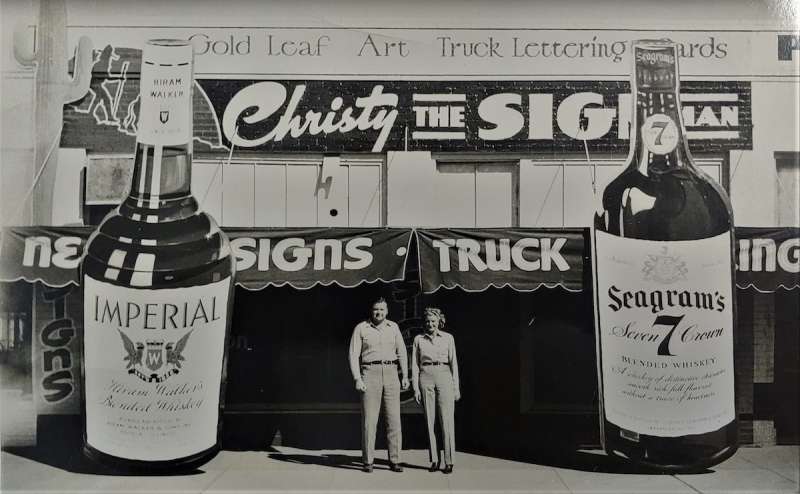
In 1929, Christy moved to Phoenix and opened a sign shop at 15 South 15th Avenue.
“My father was an exacting man,” recalls 84-year-old Dane Christensen. “I remember him preparing to paint a company’s logo on a truck door. He jacked up the vehicle and sat on a milk crate, about to go to work. But before he could start painting, he grabbed a newspaper, folded it three times, and placed it on the crate for a smidge of added height. ‘That’s more like it,’ he said and started doing the job.”
Dane says Christy was the best gold-leaf letterman in the Southwest, working for both business and government offices.
“He was friends with Governor Paul Fannin, Senator Barry Goldwater, and Congressman John Rhodes Jr., and created gold-leaf lettering on doors for legislators at the state capital for over 40 years.”
By 1988, after several moves, Christy Signs relocated to 1825 South Black Canyon Highway on the I-17 Durango Curve. In 2023, the company moved to 3345 North 33rd Avenue and sold most of the property.
But Dane Christensen kept a one-acre parcel that includes a billboard and a cell phone tower. He also added some of his favorite commercial signs, topped by a Mobil Pegasus, the flying red horse that once symbolized the oil company’s stations.
“We’re trying to keep these displays of antique advertising in the public eye,” he says. “It’s my place to go where I can show off all the items I’ve collected over the years.”
The site also features vintage buildings, vehicles, a windmill, and odds and ends. But the most poignant item is a message displayed beneath this parcel’s 1827 South Black Canyon Highway address sign, reading, “Christensen: Always Do Good by Your Fellow Man.”
“That was my dad’s favorite saying,” Dane says of his father, Christy, who died in 1979 at age 72. “He was known as ‘Christy the Sign Man,’ and everybody was his friend.”
Reporting by Douglas C. Towne, Special for The Republic