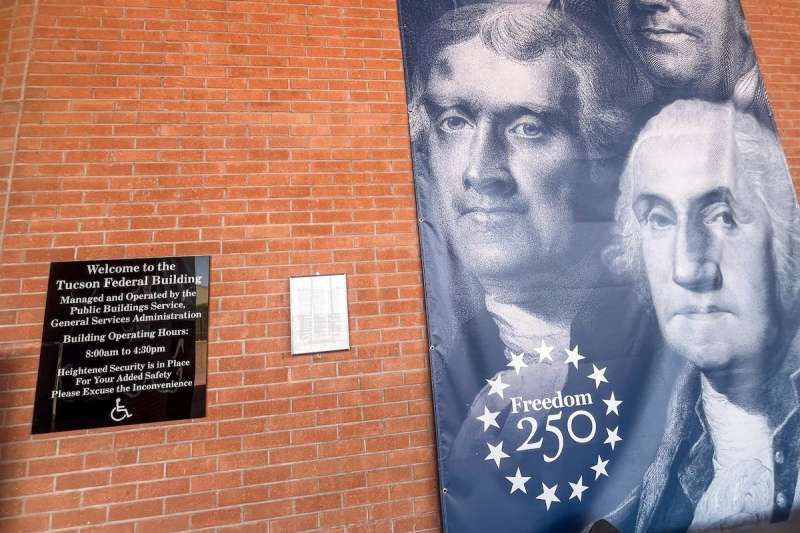
Two days after the United States celebrated the 250th anniversary of its independence—and the idea that “all people possess unalienable rights, including life, liberty, and the pursuit of happiness”—a dozen immigrant children showed up to the federal building in downtown Tucson on Monday to fight the Trump administration’s efforts to deport them from the country.
They walked past big red, white, and blue displays of the Founding Fathers and American flags commemorating the anniversary of American independence, and were packed into a fluorescent room on the third floor where President Donald Trump’s photo hung over them while they waited for security to usher them into immigration court.
In a fuzzy, black sweater and purple shirt, Karla, 11, sat in front of judge Irene C. Feldman without legal counsel as the federal government attempted to deport her. Mollie Kravitz, an attorney with the Florence Immigrant & Refugee Rights Project (FIRRP), a nonprofit providing legal services to immigrants, offered the judge information on Perez’s behalf, but wasn’t representing the child.
Karla, like all of the children present at the courthouse, is in the US as an unaccompanied minor. It’s unclear where Karla’s parents are.
“I know it’s hard because you’re young,” Feldman said to Karla. “But if you could find an attorney, that’d make it easier.”
Feldman pushed Karla’s next hearing to July 13, giving the child a week to find legal counsel. Otherwise, removal proceedings will continue as planned, with Karla serving as her own attorney.
Five other unaccompanied minors without counsel were all granted additional time by the judge to obtain an attorney, but all are expected to come back to court by the end of July with legal representation, otherwise they’ll have to represent themselves.
Under the Trump administration, immigration hearings for migrant children have been sped up by weeks or months, giving children little time to prepare. Lawyers say the sped up timeline is resulting in some children appearing in immigration hearings without legal counsel.
“Children are being called into court more frequently, and are not being allowed the time needed to pursue the legal avenues available to them to protect themselves from deportation,” said Greer Millard, communications manager of FIRRP.
It leaves immigrant children like Karla caught in a battle against the federal government, with limited resources at their disposal. More than 751,000 children have pending removal cases, with 57% lacking legal representation.
Without legal counsel, immigrants have a higher chance of being deported. Undocumented children are especially vulnerable, struggling to navigate the complicated legal system on their own.
The accelerated timeline means faster deportations. A new analysis by ProPublica found that immigration judges now issue more than 10,000 removal and voluntary departure orders each month for immigrant minors, nearly four times higher than during Trump’s first term. Additionally, the analysis found that unaccompanied minors are being detained and removed at roughly three times the rate of Trump’s first presidency.
Even with the additional time granted to find counsel, it is unclear how the children, who are in the US without a parent or guardian, can obtain the money needed for an immigration attorney, which can range from $2,500 to $15,000 or more.
Millard said it is “near impossible” for children to find representation, pointing to high costs, lack of specialized attorneys, and limited abilities for them to research while detained. Unaccompanied children are placed in the care of the Office of Refugee Resettlement and then into shelters. In shelters, their days are monitored and structured, making it difficult to find attorneys.
Finding free legal aid has become increasingly harder, too.
Last year, FIRRP lost federal funding after the Trump administration cut contracts. As a result, the organization was unable to assist children with legal counsel for months. After FIRRP and partner organizations sued to challenge the termination of their funding, it was reinstated, but in three month increments, “creating tremendous amounts of uncertainty,” Millard said.
Millard added that the group was able to resume legal services this year, but the “significant attacks on due process” along with inconsistent funding means their services are stretched thin. It’s why they can help some, but not all, of the children.
The lack of resources left 17-year-old Wilder without legal counsel as he sat in front of Feldman in removal proceedings. While the judge gave him until the end of the month to find legal representation, it’s not clear how he will.
“I need you to come back to court. I’ll give you a little more time to find an attorney,” Feldman told Wilder. “I do need to proceed at the next hearing, with or without an attorney.”
Where counsel makes a difference
For the children with counsel, attorneys were able to push back against the federal government’s claims.
Naveena Khattri, an attorney with FIRRP, represented 16-year-old Ronaldo. Khattri objected to the removal order, arguing it was filed late and while Ronaldo was unrepresented, but the objection was overruled. Feldman then asked Department of Homeland Security (DHS) attorney Carlos Velazquez where the government wanted Ronaldo sent. After Velazquez answered Honduras, Ronaldo’s home country, Khattri requested a 30-day continuance to file an asylum application for the teenager, potentially giving him a better chance of staying in the US.
That’s where legal representation makes the difference.
Without a lawyer to navigate the bureaucratic paperwork, unrepresented children are at risk of missing vital legal pathways to boost their chances of remaining in the US, including filing for asylum or for Special Immigrant Juvenile Status (SIJS), a federal program for children who have been abused, abandoned, or neglected by a parent.
Last year, 7% of children with an attorney in completed cases were allowed to stay in the country with some form of legal relief, compared with less than 1% of children without legal representation.
Thirteen-year-old Fernando faced a similar outcome. His attorney, Ana Islas of FIRRP, argued the government improperly delivered Fernando’s Notice to Appear and coerced information from him.
“Law enforcement had weapons on their waistband, which is especially coercive to a 12-year-old,” Islas said.
Feldman rejected the argument, ruling the child never indicated he was coerced and that the information was “inherently reliable.” After Velazquez requested Fernando be removed to Guatemala, Islas informed the judge they are in the process of applying for Special Immigrant Juvenile Status, and Feldman postponed the case.
The presence of a family member in the US can also make a difference.
Bleky, 15, appeared without representation and told the judge he could go through proceedings in English. While most children used an interpreter due to limited English fluency, Bleky told Feldman he learned the language while attending school in Memphis, Tennessee, through the eighth grade.
Because he has an uncle living in the country, Feldman granted Bleky until July 27 to find an attorney and begin the family reunification process.
Through reunification, undocumented children can live with a vetted US sponsor or relative while their immigration case proceeds. Once approved, the child’s legal team can request a venue change to transfer the court case to the sponsor’s home area.
“Kids should be kids, not lawyers,” Millard said. “No one, especially not a child, should have to represent themselves in immigration court proceedings, and the ongoing threats to funding for legal services for children are just the beginning of the escalating threats this administration has made to the rights, dignity, and safety of unaccompanied children.”