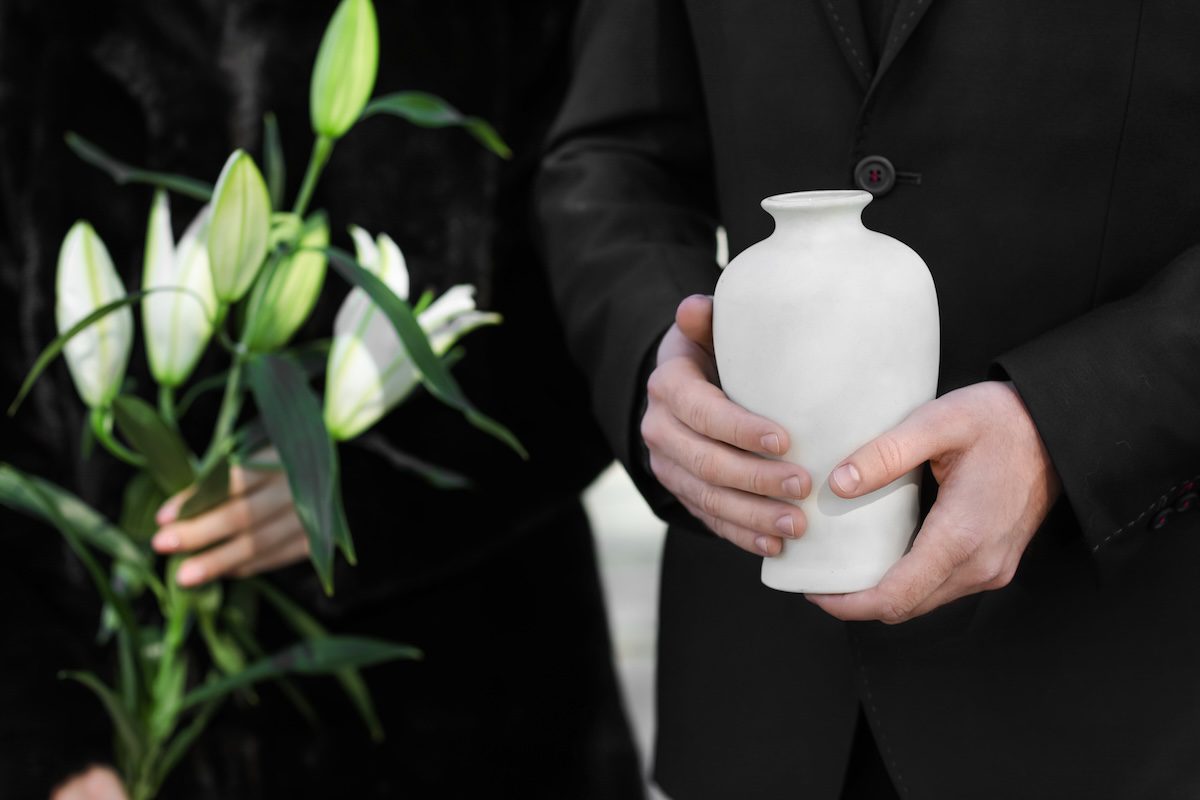
A couple with a mortuary urn and flowers at a funeral. (Pixel-Shot/Shutterstock)
Cremation has surpassed burial as the most used method of disposition in the United States and is estimated to increase by more than 80% by 2045, according to a report by the National Funeral Directors Association (NFDA).
This phenomenon is not just a future projection, but the confirmation of a developing trend. While the rest of the country gradually adapts, Arizona is among the nine states leading this evolution.
Arizona is projected to be one of the national epicenters of growth in cremations, with an estimated increase of 91.3% by 2045, according to NFDA’s report. The desert state is among the nine that lead this transition, along with Alaska, Hawaii, Washington, Oregon, Nevada, Montana, Wyoming, and Maine.
Nationally, the turning point came in 2015, when for the first time in U.S. History, cremation surpassed the casketed-burial rate.
“As more families choose cremation and other emerging options, the heart of funeral service remains the same: helping people honor lives with dignity and meaning,” said NFDA President Christopher Robinson in a statement. “This report shows how our profession continues to evolve while keeping families and communities at the center of all we do.”
Currently, the cremation rate in the nation is 63.4%, while the burial rate is 31.6%, according to the NFDA report.
Additionally, between 2021 and 2023, there was a 5.2% increase in licensed crematories in the United States, and 57 locations were reported inArizona.
A ‘cost-effective and simpler’ method
But what are the reasons behind this increase?
Robinson told La Voz Arizona/The Arizona Republic that much of the reason we’re experiencing a boom in cremation is because Americans find it a “cost-effective and simpler” method.
“I think it’s just evolved as society has evolved. I think part of it is, as people have spread out,” Robinson said. “Families used to all live in kind of the same house and there would be multiple generations, but now that there’s so much mobility and people are spread out all over the country and sometimes, they can’t get to where they’re going, so an impetus for more cremation.”
The NFDA report supports Robinson’s statements. But in addition to “cost considerations and changing consumer preferences, such as the desire for simpler, less-ritualized funeral ceremonies,” Americans are increasingly turning to cremation for other reasons related to “environmental concerns; an increasingly transient population; and fewer religious prohibitions against the practice,” — the last reason being a key one.
According to the report, the percentage of Americans who identify as Christians decreased from 78% to 60% between 2007 and 2023, while religiously unaffiliated adults grew from 16% to 28%.
“Cremation has become socially acceptable as a growing number of Americans think and talk about death in new ways,” the report reads. “Cremation will only continue to gain acceptance going forward because an increasing number of consumers will have relatives and/or friends who opted for it.”
The future of the death care industry
Robinson said that the death care industry is constantly evolving, and the NFDA report highlights some services and trends that possibly suggest future adjustments for the industry.
Services such as funeral live streaming have been incorporated — an option that more than half of NFDA member funeral homes now offer.
Additionally, 36.3% of NFDA member funeral homes offer online cremation arrangements, while an estimated 25% plan to incorporate this service.
Also, 61.4% of consumers express interest in exploring “green” funeral options, demonstrating a shift in consumer preferences toward more sustainable practices.
But for Robinson, a fourth-generation funeral director in his family’s 150-year-old business, despite the industry’s evolution and its yet unknown future, there are two constants he hopes will never change: the choice by loved ones of a deceased individual to opt for a funeral service in addition to the disposition of the corpse, and the empathy and compassion of funeral personnel.
“Regardless of the disposition, whether it’s green burial or cremation or whatever the family wants, it is still important to have a meaningful service,” Robinson said. “Sometimes people don’t realize that, or they want to do it later, but we know that the sooner you do it the better it helps with the grief journey.”
“I think that we as funeral professionals need to make sure that we are good listeners. We listen to the family when we’re making the arrangements,” he added. “Tell us about their loved one so we can customize a service to suit their needs and fit what made their loved one special to them.”
Reporting by Paula Soria, Arizona Republic
MORE: Counties with the oldest homes in Arizona
Author


Harkins to unveil 4D movie theater in Arizona this summer
Harkins Theatres is bringing a whole new movie-watching experience to its theaters later this summer. The Arizona theater chain is partnering up...
We asked about Arizona’s worst roads. Readers had plenty to say
This story was first published in The Copper Courier’s daily newsletter. Want to join the conversation? Sign up here. I really don't like driving,...
This metro Phoenix freeway is the worst in Arizona, drivers say
Arizonans continuously complain that their state has the worst drivers, but some roads in particular make drivers angriest. A study from Munley Law...

Why are allergies so bad in Arizona right now? What’s behind the surge
Allergy season in the U.S. was expected to be longer and more intense in 2026, with high pollen levels forecast in 29 states. Tree pollen has...