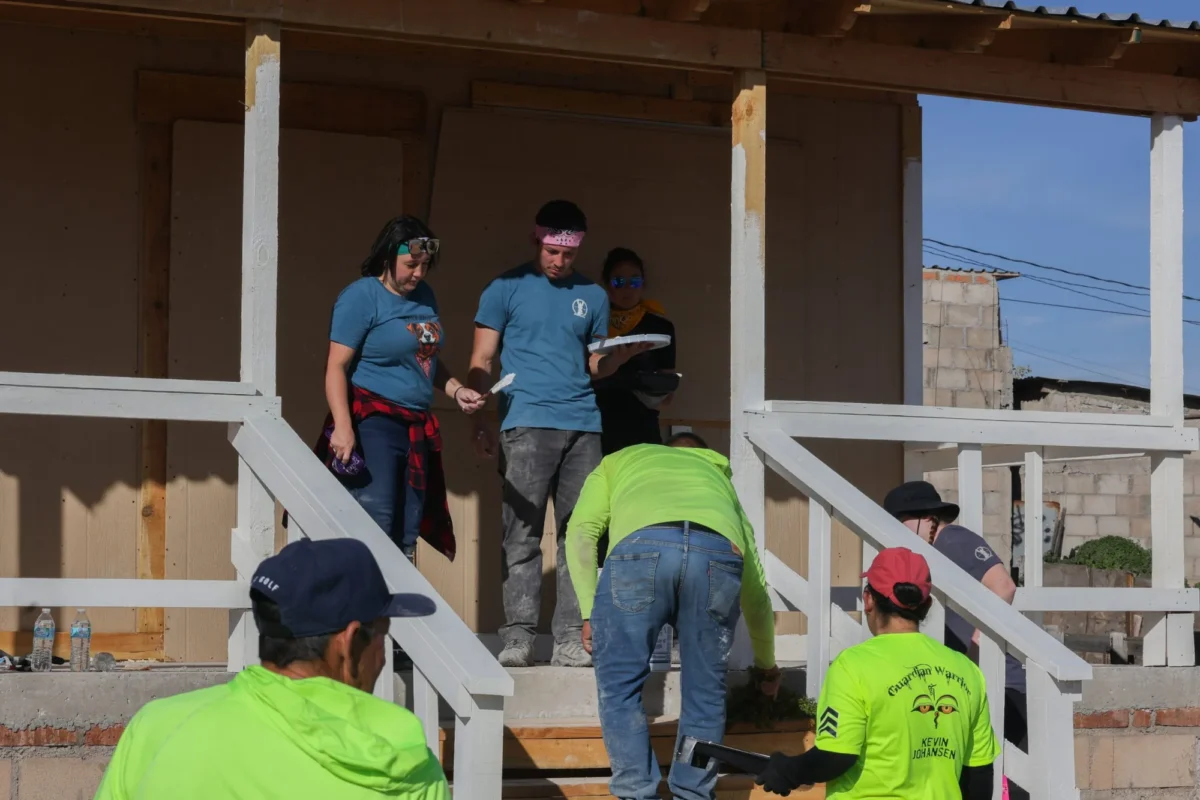
Volunteers work on one of Rancho Feliz’s newly constructed homes on Nov. 15, 2025, in Agua Prieta, Sonora. (Photo by Lorenzo Gomez/Cronkite News)
AGUA PRIETA, Mexico – It was Thanksgiving Day in 1987, and Gil Gillenwater sat comfortably in his home, preparing to stuff himself with food, drink beer and watch football. But that year, he decided he’d had enough of the uniquely American holiday routine. It was like watching the movie “Groundhog Day,” he said – like living the same day over and over again. He grew uncomfortable in his own comfort.
“How many times can you do that when you know that a mere four-hour drive from your home in Scottsdale, Arizona, there are people without the basic needs of the human condition?” he asked.
This time, he didn’t ignore it. Gillenwater and his brother, Troy, loaded $2,000 worth of food into their truck and set out for Nogales, Arizona. A wrong turn near Tucson sent them east instead of south, through Benson and Tombstone, then on to Douglas. The seemingly endless road led them into a place neither had heard of – Agua Prieta, Sonora, Mexico. There, the brothers confronted the poverty that would change their lives.
“One step over that border were people who had the same feelings that I do, the same hopes, dreams,” he said. “They look at the same moon, but they don’t have access to any opportunities.”

Over 30 years later, that wrong turn transformed into Rancho Feliz, a nonprofit organization based in Douglas, Arizona, that builds sustainable communities in its sister city, Agua Prieta.
Its goal is audacious: to build up the Mexican working class and provide them with a comfortable life in their home country. For more than 30 years, Rancho Feliz has led with that goal in mind.
For decades, the town of Agua Prieta served as the final stop before the U.S. border for migrants on their journey to the U.S. or seeking employment in maquiladoras, or foreign-owned factories. Now, strict immigration crackdowns have resulted in a drastic decrease in border encounters.
Customs and Border Protection recorded just over 11,700 encounters at the U.S.-Mexico border in October. That is nearly 100,000 fewer than this time last year, and over 200,000 less than in 2023. The statistics further guide the organization’s mission.
“How do you solve this border problem?” Gillenwater asked. “You solve it by providing people the opportunity to live and raise their families with dignity in their home country of Mexico.”
According to Mexico’s National Survey of Occupation and Employment, the average monthly income for a working resident of Agua Prieta totals a mere 7,000 pesos, or $380.
Its location also makes it a prime corridor for cartel operations.
The combination of migrant flow, illegal trafficking and overall economic instability has made life difficult for many locals. In 2022, Mexico’s Ministry of Welfare reported over 30,000 Agua Prieta residents living in poverty, with many lacking access to a social safety net, quality education and basic household services such as electricity and running water.
An additional 40,000 residents were considered vulnerable to poverty – that leaves only a quarter of the population who were not actively experiencing or at risk of poverty.
Although lower than the state average for Sonora, Gillenwater still finds the numbers alarming.
“They have the same hopes and dreams that you and I do,” he said, “The only difference is that Gil Gillenwater lucked out because he was born in the land of opportunity, and they weren’t.”
The organization and its donors have invested over $20 million in local infrastructure, Gillenwater said. The investment has manifested in major food distribution, thousands of dollars in scholarships for children and most notably, the Vecinos Neighborhood — a community of 42 duplex-style homes.

Gillenwater says they follow a model of “reciprocal giving,” meaning residents contribute a designated amount of community service and a monthly, no-interest payment of 1,500 to 1,700 pesos. After five years, it is deeded over to the family.
The organization has transferred all but nine deeds and generated over $2 million in equity in US currency for residents, Gillenwater said.
“We’ve literally created a Mexican middle class,” he said.
His ambitious goals have led to visible changes for families in Agua Prieta.
Each child in a household that qualifies for housing receives a $3,000 scholarship, contingent upon completing community service hours and a small contribution from their parents.
‘A world outside of here’
When Rancho Feliz volunteers walk across the border into Agua Prieta, they are often met with a white sprinter van. Waiting for them outside of it is one of those parents.
His name is Reyes Zagaste Sr., the manager of La Hacienda Feliz, the dormitory for volunteers. He spends his days helping to coordinate volunteers and driving around town, assisting with whatever comes up. Neighbors smiled and waved as he drove around town.
He walked with a sense of ease and belonging in a town he once had no intention of staying in.
In 2003, he and his family fled violence in Caborca, Sonora, for a better life.
“I knew that I was ready for very big things, but I didn’t know what the path was,” he said.
Their upheaval landed them in Agua Prieta, where he faced the decision to find work or immigrate to the U.S. On a whim, he applied and was accepted into the Vecinos Neighborhood. Zagaste ended up on a path that he couldn’t have imagined.
“With Rancho Feliz, my path was shorter, it was faster, it was simpler and above all, it was more viable and palpable,” he said.
Amid it all, his children were always at the front of his mind. He said making the trek to Agua Prieta was always about them.
“I am a very proud father,” Zagaste said.
After being the first Mexican national to attend Brophy College Preparatory School in Phoenix, his eldest son, Reyes Jr., studied abroad in Germany, where he now works as a project manager for Rolls-Royce.
Zagaste’s middle daughter, Aylin, is a doctor for a local clinic in Agua Prieta, where she’s also raising her 2-year-old son, Luca.

The youngest, Maria, graduated from law school and now lives in Los Angeles working as a medical interpreter – a job Zagaste said was her calling from a young age.
Over 20 years since he first arrived in Agua Prieta, Zagaste has never been more confident in his decision.
“At the end of the day, I made my American dream in my country, in Mexico, where I was able to obtain what I was looking for my children,” he said proudly. “A better living condition, better opportunities to study and, above all, that they can see that there is a world outside of here.”
‘The best opportunity’
Olivia Escalante and her family – her husband, Luis, and two sons, Ángel and Santiago – have lived in the Vecinos Neighborhood since 2009. It’s a modest two-bedroom house, decorated with family portraits, graduation pictures and a certificate of recognition Luis earned for 15 years of work at Agua Prieta’s water sanitation company.
The affordable housing community where they live also has a daycare facility, a public education center, gardens and recreation areas. Moving to the community marked a turning point in her family’s life, especially for her children.
“I have great children, thank god. They’ve had the best opportunity living here, truly,” Escalante said with tears in her eyes.

Both of her sons have excelled in their education. Ángel is now studying civil engineering in Hermosillo, while her younger son, Santiago, is finishing high school and hopes to study medicine.
Though Agua Prieta sits just across the border from Douglas, Escalante said she has never been tempted to move north. Now a homeowner herself, Escalante said Agua Prieta is her home, and she has no plans of leaving.
“Honestly, I don’t think about selling it because it’s something very special for my husband, for me, and my children,” she said.
The Vecinos Neighborhood is intimate, with each house facing toward one another, joined by a courtyard and playground for families to gather. Gillenwater said the horseshoe design is purposeful – straying away from the seclusion he sees in U.S. suburban neighborhoods.
“We are social animals,” he said. “You have porches where you meet and interact with your neighbors and take advantage of that sense of community.”
Escalante agreed.
“Whenever we run into each other, we greet each other and chat,” she said, “We even get together sometimes – we have breakfast with other neighbors, and when it’s someone’s birthday, we celebrate them. We have a great relationship with each other.”
‘Little by little’
Rancho Feliz’s mission is expanding, with a steady flow of volunteers constructing homes for new residents outside of the Vecinos Neighborhood, Gillenwater said.
On a recent weekend in November, volunteers traveled to take part in the work. They spent hours putting together what will soon be home for another family. The air was fragrant with fresh paint and watermelon served by a future resident. It was a personal gesture of gratitude for those contributing to the construction.

The work was emotional for Aleaha Anderson. It is her second year volunteering with Rancho Feliz. Before that, she said she had never been to another country. As an American, she said, personally confronting issues at the border and in communities like Agua Prieta are necessary for people to understand how they can help.
“I personally don’t turn away because it’s not something I necessarily want to see, but sometimes you have to see it to realize that the world needs change,” Anderson said.

The day came to an end with a party and, of course, a piñata.
“¡Dale, dale, dale, no pierdas el tino!” the crowd called.
This one was a mix of bright colors and frilly, and dangled from a tree on a dirt road. The small crowd chanted the party classic as each took their turn, dizzy from spinning around.
Digging his feet into the ground, a little boy in blue steadied the plastic bat. He reared back. With eyes closed, he took a swing with a force that could only come from a child fighting for candy. It swayed just out of reach, taunting him as the crowd’s chant rose and fell.
“¡Dale, dale, dale, no pierdas el tino!”
Each hit loosened the cardboard and papier-mâché cradling the sweets inside, with pieces of colorful crepe paper falling to the ground.
“¡Porque si lo pierdes, pierdes el camino!”
His final blow sent candy flying in all directions. Children scrambled to stuff their pockets. One little boy approached a visitor and, in English, insisted they take a share of his candy. He happily handed over a fun-size package of gummy bears, leaving him with only one piece of candy. He was eager to share despite his family living in conditions many of the volunteers could never fathom.

Watching over the kids was Agua Prieta resident Rosario García. Her family lives in the small, cinder block house behind the tree where the piñata was hung. The inside was insulated with cardboard and duct tape. She built it herself, with the assistance of her father and brothers.
“Little by little, we added,” she said, “I didn’t do it in a week; it took me several months to be able to finish it.”
Garcia has known Gillenwater since she was 6. Her story mimicked that of the piñata song. After losing her way for some time, she said she eventually found her way back to Rancho Feliz. Now, she and her children are set to move into one of the newly constructed houses in the area.
“I love him very much,” García said of Gillenwater, “And I’m very thankful for my house and for help with my children and everything.”
Gillenwater acknowledged that the issues he is tackling extend far past Agua Prieta and the border.“I do have hope because I may not solve the world’s problem,” he said, “But that little kid who’s going to be able to get in school, I solved his problem, you know?”
This article first appeared on Cronkite News and is republished here under a Creative Commons Attribution-NoDerivatives 4.0 International License.
Author


ICE is operating 170 unofficial detention centers in the US, including four in Arizona
Four unofficial and undisclosed long-term detention sites have been operating in Arizona, with some detainees spending over three months in “hold...

Haitian man dies in US immigration custody with untreated toothache, brother says
PHOENIX (AP) — A Haitian man confined at an Arizona immigration detention center for months died at a hospital Monday after a tooth infection was...

Arizonans are carrying more documents to prove citizenship to avoid detention
PHOENIX - Every morning, Raul Piña wakes up before dawn to take his Rottweiler, Beau, out for a walk near his home in Buckeye. He has a routine. He...

Arizona senators challenge Surprise ICE center on environmental grounds
Arizona's U.S. senators and the state's top prosecutor are joining bipartisan calls for answers about an ICE facility in Surprise, including whether...