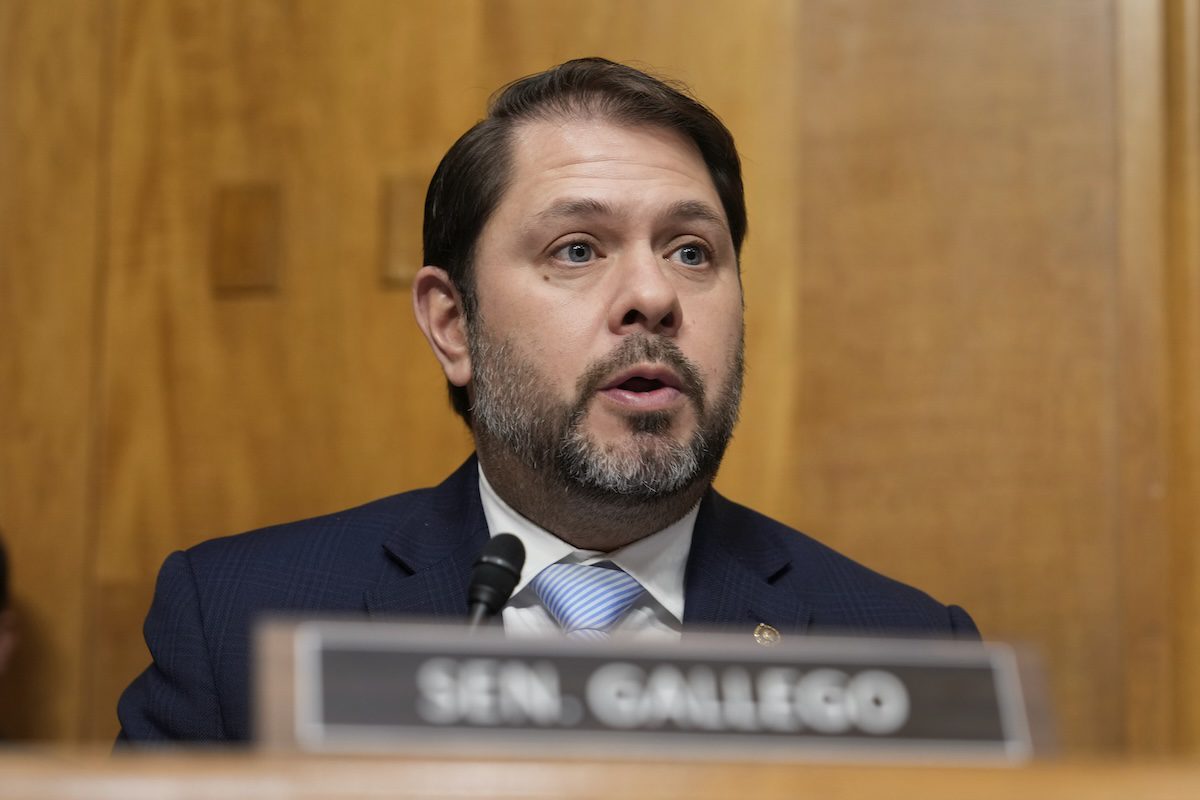
Sen. Ruben Gallego, D-Ariz., speaks at the Capitol in Washington, Jan. 17, 2025. (AP Photo/Ben Curtis, File)
Artificial intelligence is making it increasingly easy for companies to track and target consumers, causing price discrepancies among online services. The practice is commonly referred to as “surveillance pricing.”
In the first bill to ban surveillance pricing, Sen. Ruben Gallego (D-Ariz.) seeks to prevent companies from using customers’ personal data to set variable prices for different people.
Using artificial intelligence, corporations have been compiling personal data like a consumer’s location, the type of device they are using to shop, and even their mouse movements on a website to charge different amounts to people for the same products—creating individualized prices for different consumers.
Gallego’s “One Fair Price Act” would ban businesses from the practice of collecting consumers’ personal data in order to price gouge.
“Greedy corporations are compiling Americans’ personal data and using AI to find their ‘pain point’ – the maximum they’re willing to pay. That’s not fair pricing, that’s predatory pricing. My bill puts an end to it,” Gallego said in a press release.
The bill would also give the Federal Trade Commission (FTC) the right to shut down practices using surveillance technology, and let consumers, as well as state attorneys generals and the FTC, sue directly to enforce the ban.
READ MORE: Arizona attorney general sues Chinese online retailer Temu over data theft claims
An early January study from the FTC found that retail businesses use the personal data of consumers to set varied prices for products—anything from airlines, to chain restaurants like Starbucks, and grocery delivery apps like Instacart.
An investigation by Consumer Reports found that Instacart is experimenting with AI-driven pricing, and charges different consumers different prices for the same product.
According to the study, almost three quarters of grocery items in the experiment were offered to shoppers at multiple price points on Instacart. The platform offered as many as five different sales prices for the exact same grocery item, in the exact same store, at the exact same time.
“When you go to the grocery store, you expect to pay the exact same price for milk as the person in line behind you. But imagine if they charged you more for milk because they know you have growing kids at home and that you need it more than the person behind you. You’d be outraged,” Gallego said in a press release. “It may seem far-fetched, but increasingly that’s exactly what’s happening, especially when shopping online.”
Gallego’s legislation will need to pass the Republican-controlled Congress and gain the signature of President Donald Trump to become law.
Author

Support Our Cause
Thank you for taking the time to read our work. Before you go, we hope you'll consider supporting our values-driven journalism, which has always strived to make clear what's really at stake for Arizonans and our future.
Since day one, our goal here at The Copper Courier has always been to empower people across the state with fact-based news and information. We believe that when people are armed with knowledge about what's happening in their local, state, and federal governments—including who is working on their behalf and who is actively trying to block efforts aimed at improving the daily lives of Arizona families—they will be inspired to become civically engaged.


How to watch Trump’s 2026 State of the Union speech in Arizona
President Donald Trump is getting ready to deliver the first State of the Union address of his second term. The nationally televised primetime...

Trump nominates a hospitality executive to lead the National Park Service
President Donald Trump has nominated for director of the National Park Service an executive from a hospitality company that holds extensive...

Judge sees Hegseth bid to demote Sen. Mark Kelly as assault on free speech of veterans
WASHINGTON – At a hearing Tuesday, a federal judge cast Defense Secretary Pete Hegseth’s effort to demote Sen. Mark Kelly in retirement as an...

Gun rights extend to protests, advocates say, rejecting Trump aides’ stance after Pretti killing
WASHINGTON – Gun rights groups are fiercely disputing the Trump administration’s efforts to justify the killing of Alex Pretti by Border Patrol...