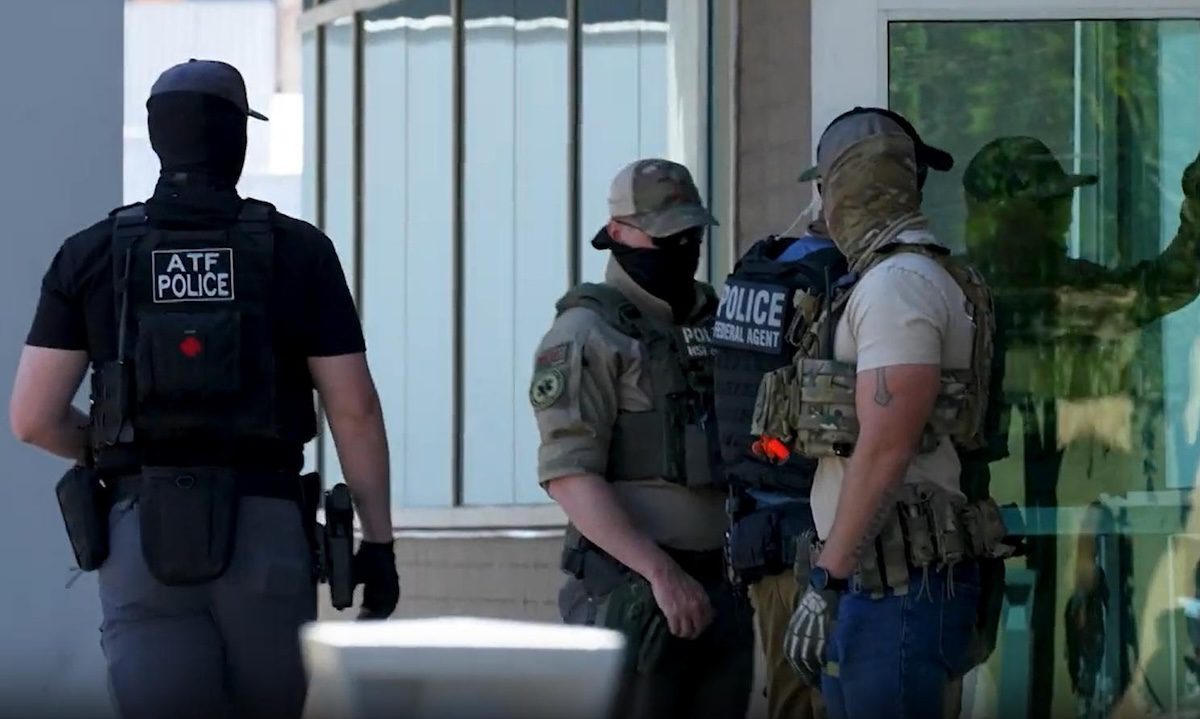
Masked ICE agents waiting for people as they leave immigration hearings in Phoenix on May 21, 2025. (Megan Mendoza/The Republic via Reuters Connect)
Gila River Indian Community Gov. Stephen Roe Lewis said a tribal member was stopped recently under the pretext of a traffic violation and was harassed about her status, even after informing the officer that she was a tribal citizen of the community.
She did not have her tribal identification card on her, which Lewis said “would’ve helped her establish her identity more easily.”
“I am going to be following up aggressively to ensure that ICE or other law enforcement officers off the reservation respect our members and their tribal identity,” said Lewis in a Jan. 16 message, posted on the tribe’s Facebook page. “If they are approached at a traffic stop or other locations. We, as a community and our leaders, will not abide any harassment of any of our community members, and I will make sure the appropriate authorities know that.”
The Gila River Indian Community is one of Arizona’s 22 federally recognized tribes, and as reports spread of tribal citizens being detained and harassed by ICE agents in Minnesota, concerns among tribal communities in Arizona have intensified. The Arizona Republic first reported on the four-hour detention of a Native American man who is Navajo and Laguna Pueblo following an encounter with ICE, whose presence in Phoenix has expanded.
RELATED: Immigration officers assert sweeping power to enter homes without a judge’s warrant, memo says
Like Lewis, tribal leaders have addressed their citizens to offer reassurance, saying they are working with authorities and pressing the federal government and Immigration and Customs Enforcement to fully respect and recognize valid tribal identification during ICE operations — especially in urban areas where many Native Americans live, work and travel.
“The Navajo Nation continues to gather facts regarding reports of unlawful detainment of Navajo citizens. Profiling people based on their appearance is unacceptable, and we’re working hard to ensure that our citizens are informed and protected,” said Navajo Nation Speaker Crystalyne Curley.
“Our people should not have to look over their shoulder or endure mental distress and physical aggression at the hands of ICE personnel. Indigenous people are the first people of this country and hold inherent rights. Any enforcement action that disregards valid tribal identification places Navajo citizens at risk of wrongful questioning, detention, or separation from their families,” Curley said.
Navajo President Buu Nygren said, “There is no Immigration and Customs Enforcement presence physically operating on the Navajo Reservation. If I am notified at any point that ICE is present within the Navajo Nation, I will immediately inform our communities.”
Verlon Jose, chairman of the Tohono O’odham Nation, said his tribe is familiar with interactions between tribal members and federal authorities. The Tohono O’odham Nation, the second-largest tribe in the United States by land holdings, occupies roughly 2.7 million acres in Arizona’s Sonoran Desert. Its ancestral territory extends across the U.S.-Mexico border into the state of Sonora.
“Our proximity to the U.S.-Mexico border puts our land and our communities at the center of immigration enforcement actions,” Jose said. “I have met with the leadership of multiple tribes, the Arizona Governor’s Office and others to discuss best practices for Nation members if such situations occur.”
The Arizona Republic reached out to U.S. Immigration and Customs Enforcement seeking information on how ICE is collaborating with the Native American population in Phoenix, and whether certificates of Indian blood or tribal ID cards are still considered valid. An ICE spokesperson has not yet provided that information.
Tribal member recounts harrowing experience
Lourdes Escalante, a citizen of the Pascua Yaqui Tribe of Arizona and a member of the Tucson-based group Indigenous Alliance Without Borders, read an account submitted to the organization describing a January 2025 encounter with ICE involving an enrolled member of the Pascua Yaqui Tribe of Arizona.
Nearly 30 years ago, the Indigenous Alliance Without Borders was formed in response to persistent law enforcement abuse against Indigenous peoples along the U.S.-Mexico border and has worked intertribally from California to Texas to address ongoing human rights violations affecting Indigenous mobility.
The U.S.-Mexico border has long disrupted the Pascua Yaqui Tribe’s way of life, with culturally affiliated Indigenous peoples living on both sides. Indigenous Alliance Without Borders has worked to secure safe passage for Indigenous peoples, a right protected by international human rights instruments, including the United Nations Declaration on the Rights of Indigenous Peoples.
The incident Escalante described occurred shortly after President Donald Trump’s inauguration and soon after he signed an executive order targeting the deportation of migrants in the country illegally. Even then, incidents had already emerged suggesting that Indigenous individuals were being targeted by Immigration and Customs Enforcement.
She said that due to safety concerns, the individual asked for anonymity but wanted to share their experience to raise awareness. Escalante said the group will host a Know Your Rights workshop at the end of the month for Tohono O’odham and Pascua Yaqui Tribe of Arizona tribal members.
Escalante said the author of the account wrote that while they were walking near the San Xavier District of the Tohono O’odham Nation, they noticed a van creeping slowly behind them. Out of fear, the person began to run, and that is when the van sped up in front of the person and tackled them.
“They told me they were police, but I noticed their vests and realized it was ICE,” the person wrote. “And they told me I was under arrest for suspicious activity.”
The author said they were taken to a detention center and waited five hours to be questioned, during which they heard others screaming while agents shouted profanities, ordering those inside to be quiet.
“The entire place felt hostile and frightening,” Escalante read.
Once the agents came into question the author, they asked them if they were a U.S. citizen. The author not only confirmed their citizenship but stated they were a member of the Pascua Yaqui Tribe of Arizona, showing their driver’s license, state ID and tribal ID.
“They told me my tribal ID was not a valid form of identification and that my other two IDs seemed fake,” Escalante read. “I explained they were real and that a tribal ID is valid because it identifies me as a citizen of a federally recognized tribe.”
The agents, accusing the person of being an undocumented migrant, became hostile and told the person not “to get smart” with them, and that they could do anything they wanted to them.
“They also told me they would ‘do anything in our power to have illegals like you deported, and if not, killed,'” read Escalante, who said the author of the testimony was released about eight hours after this interaction.
As they were being escorted out, the author could hear agents make comments such as “I can’t wait to get rid of them all,” and “I am going to turn them into my slaves.” They said that during the whole time inside, they weren’t given food or water.
Indigenous members of the Arizona House Democratic Caucus spoke out on Jan. 16 about the recent ICE activities among the Indigenous community.
“ICE agents continue to show a complete disregard for the rule of law and have absolutely no justifiable reason to go after Indigenous Tribal members,” stated Reps. Brian Garcia, a member of the Pasqua Yaqui Tribe, and Myron Tsosie and Mae Peshlakai, who are members of the Navajo Nation.
“In case they need a history lesson, tribal members are United States citizens. The policy of Republican-supported ICE terrorizing communities is making everyone less safe. Instead of focusing on an Arizona we can afford, they’re focused on violating the law, violating basic rights and human dignity, and trying to stoke civil unrest. It has to stop.”
Tribal leaders’ advice: Stay calm
Lewis and other tribal leaders have been telling tribal members to be careful, and if traveling, carry valid forms of identification such as a valid tribal enrollment card or Certificate of Degree of Indian Blood CDIB, a valid Arizona driver’s license, or a valid U.S. federal, state or local government-issued identification.
“It’s important to know that some jurisdictions, including some counties in Arizona, have contracts with the Department of Homeland Security to perform the functions normally carried out by ICE officials,” Lewis said. “So, whether you are approached by an ICE official or another police official … carry both state-issued identification … and your tribal documentation. Keep in touch with family members and be alert when traveling alone.”
Jose said it is understandable that interactions can create animosity between members and authorities, but “behave calmly and respectfully; if stopped, clearly state you are a member of a federally recognized tribe and present identification. Ask if you are free to leave, and if not, remain silent and do not sign any documents without consulting an attorney.”
Any Tohono O’odham member who has concerns or believes they have been wrongfully detained is asked to reach out to local authorities or contact the Nation’s Office of Attorney General at 520-383-3410 for assistance.
“These issues will likely persist during President Trump’s administration, so everyone needs to remain vigilant and look out for our families, friends, and neighbors,” Jose said.
Curley said the Navajo Nation is communicating with federal and state officials, legal counsel, and other tribes to strengthen coordination, share information, and proactively address potential impacts of federal enforcement actions on tribal citizens. These efforts are focused on preventing wrongful detainments and ensuring Navajo citizens are treated lawfully and with respect.
“The protection of our citizens is a top priority,” Curley said. “We will continue to engage with our federal partners and assert our authority to safeguard the rights, dignity, and sovereignty of the Navajo people, wherever our citizens reside.”
Navajo citizens may call 855-435-7672 if they encounter issues related to ICE operations or if they have questions or concerns.
Enrolled members of federally recognized tribal nations in Arizona can now also obtain driver licenses, instruction permits and ID cards with a Native American designation. The Arizona Department of Transportation’s Motor Vehicle Division added the option under a state law that took effect Jan. 1.
Reporting by Arlyssa D. Becenti, Arizona Republic
Author


Uproar over Surprise ICE facility prompts Gosar to demand transparency from Noem
WASHINGTON – The uproar over an immigration detention center planned for a converted warehouse in Surprise, Ariz., continues to mount. More than a...

ICE is placing a detention facility in Surprise. Here’s what our readers think
This story was first published in The Copper Courier’s daily newsletter. Sign up here. ICE announced last week that it is placing a 1,500-bed...
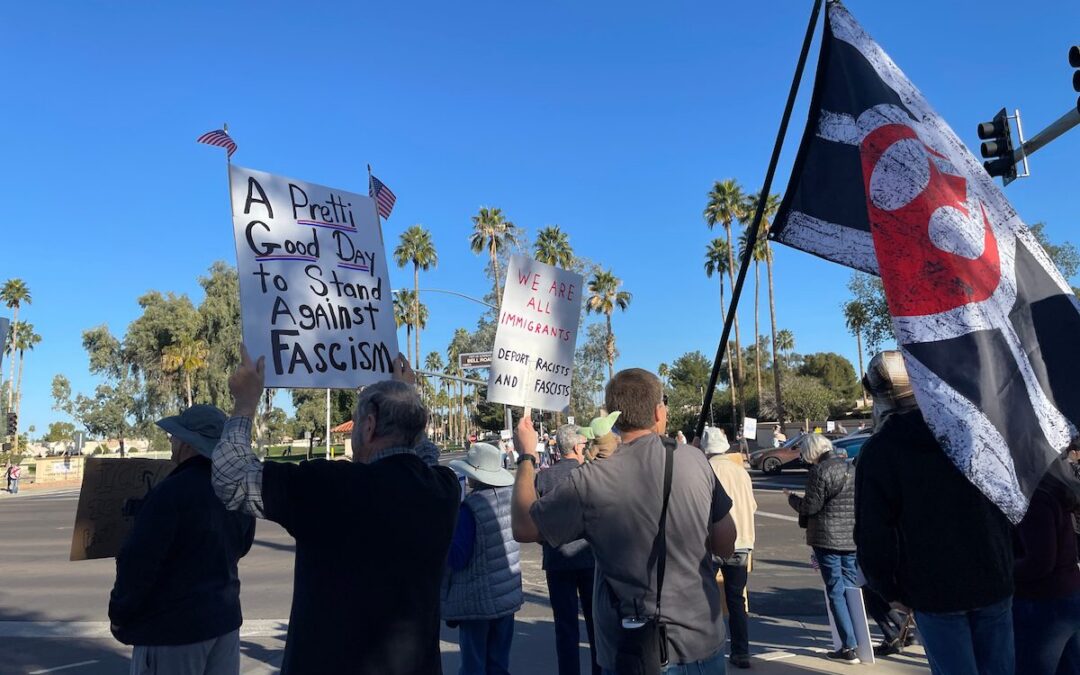
Nearly 1,000 demonstrators gather against planned ICE facility in Surprise
Nearly 1,000 people protested on the sidewalks in Surprise against ICE and its planned facility in the city. Northwest Valley Indivisible, a...

ICE confirms it will add 1,500-bed detention facility in Surprise
U.S. Immigration and Customs Enforcement said it would add a processing facility with approximately 1,500 beds in Surprise as part of the agency's...