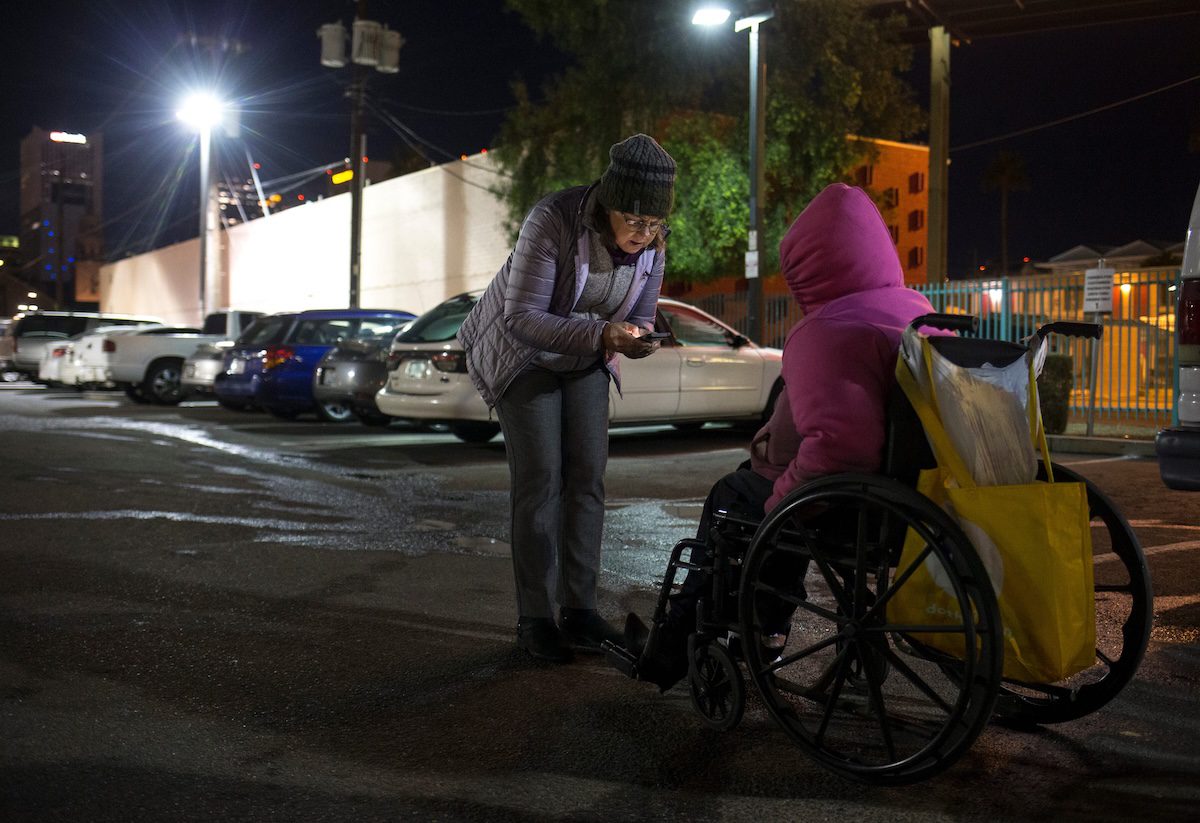
Anne Scott of the Maricopa Association of Governments talks with a person during Maricopa County’s annual Point-in-Time Count of homelessness on Jan. 22, 2019, in the parking lot at McDonald’s in downtown Phoenix. The count includes a survey that Scott is completing on her phone. (Mark Henle/The Republic via Reuters Connect)
Maricopa County’s homeless population is rising as federal funding for shelter services is drying up. Now, four of Arizona‘s major homeless service providers are plotting a new course for combatting the crisis.
Keys to Change, A New Leaf, Central Arizona Shelter Services and UMOM New Day Centers announced the formation of the Arizona Shelter Network, a formal coalition that will collaborate to strengthen Maricopa County’s homeless shelter system.
The core group will share data and pool resources to better coordinate services, communicate shelter capacities and advocate for their work.
The network will bring together over a dozen service providers to sit on subcommittees to share best practices and other tools.
MORE: Amid rise in homelessness in Phoenix, resources drop as COVID-19 era funding ends
By pooling resources and sharing data, the organizations are seeking to maintain Maricopa County’s homeless shelter capacity as federal funding from the Trump administration has become unpredictable.
The unique shelter network is a first-of-its-kind collaboration in the state, according to Monique Lopez, CEO of UMOM New Days Center, because it is composed of direct service providers.
“These groups are electing to partner and share best practices and make a larger impact versus just doing it individually,” said Lopez.
“This feels different from anything I’ve experienced, at least in this state, and from what I’m hearing, it’s not a normal practice in other communities.”
The network has four primary objectives: reduce the number of people turned away from shelters, increase the use of shelters, decrease how long people are staying in shelters and promote positive exits from them.
“I think this is unique in that it puts shelter providers who are experts in what they’re doing and know exactly what they need to move the needle for someone staying in a shelter. And to put those goals front and center,” said Tanner Swanson, a spokesperson for A New Leaf.
Federal funding for homeless solutions in limbo
Shelter organizations have informally shared best practices for years, but the creation of Arizona Shelter Network comes at a time when federal funding for long-term housing solutions is uncertain.
Last year, millions of funding from COVID-19 recovery legislation dried up, and future funding under the Trump administration is uncertain.
In November 2025, the Trump-led U.S. Housing and Urban Development Department announced federal funding cuts to permanent supportive housing programs that threatened to impact 1,400 households in Maricopa County, according to U.S. Rep. Greg Stanton.
After a slew of lawsuits from government and nonprofit stakeholders, the HUD Department instead temporarily froze $4 billion in federal grants while officials consider future reforms.
At the same time, the last of the funding from the American Rescue Plan Act expired in 2025. Over the past four years, the COVID-19 recovery legislation invested hundreds of millions in homeless and housing programs in the Maricopa County area.
While the intention of the Arizona Shelter Network was not to directly respond to funding changes, it will provide an added level of support for struggling programs, according to Lopez.
“A year ago, I don’t know that any of us thought there would be conversations around significant reduction in funds for permanent supportive housing and other housing programs at the federal level,” said Lopez.
“I think it will be even more important, if there is a lack of support for housing, to get people into shelter to try to resolve their homelessness.”
The number of unsheltered people in Maricopa County is growing
As federal funding for shelters dwindles, the number of unsheltered people is growing across Arizona’s most populous counties.
In January 2025, the Maricopa Association of Governments recorded 9,734 people experiencing homelessness in the county as a part of the annual Point-In-Time count.
The count is conducted by volunteers on a single morning and includes both people who are in shelters and those outside.
The 2025 count was the highest number recorded to date, and the number of homeless people without any shelter grew by almost a third when compared with 2024, an increase of about 1,000 individuals.
This year’s count will take place on Jan. 27, 2026, but experts say it will only capture a fraction of the problem.
“It’s a gross undercount, it’s just whoever we can find with a bunch of volunteers,” said Swanson. “The issue is usually a lot more extreme than what people really think it is.”
Reporting by John Leos, Arizona Republic
Author


Zillow roundup: Phoenix rentals that caught our eye this week (March 25)
Whether you’re seriously searching or just looking for fun, here are some Phoenix rentals that grabbed our attention on Zillow this week. This...

7 news stories and resources for Phoenix renters this week (March 18)
This section appears in Rent Check PHX, a free biweekly newsletter made for Phoenix renters, written by someone who’s lived it. Sign up here. From...

How I scored cheap produce from a mobile market in my Phoenix neighborhood
Farm Express mobile markets bring affordable produce to neighborhoods around the Phoenix area. Here's how to find one. This story first appeared in...
Here’s where metro Phoenix home prices climbed the most in 2025
Median home prices in metro Phoenix were flat overall in 2025, but some areas — including Apache Junction and central Phoenix — saw double-digit...