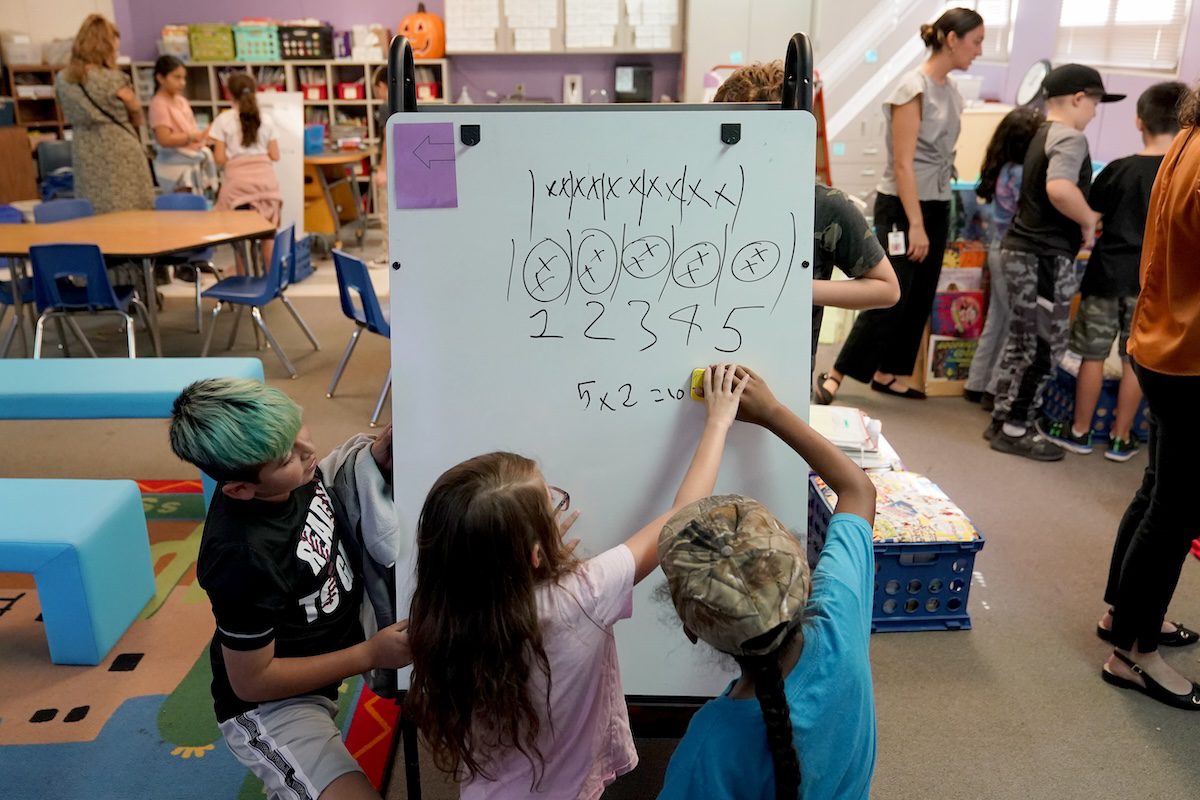
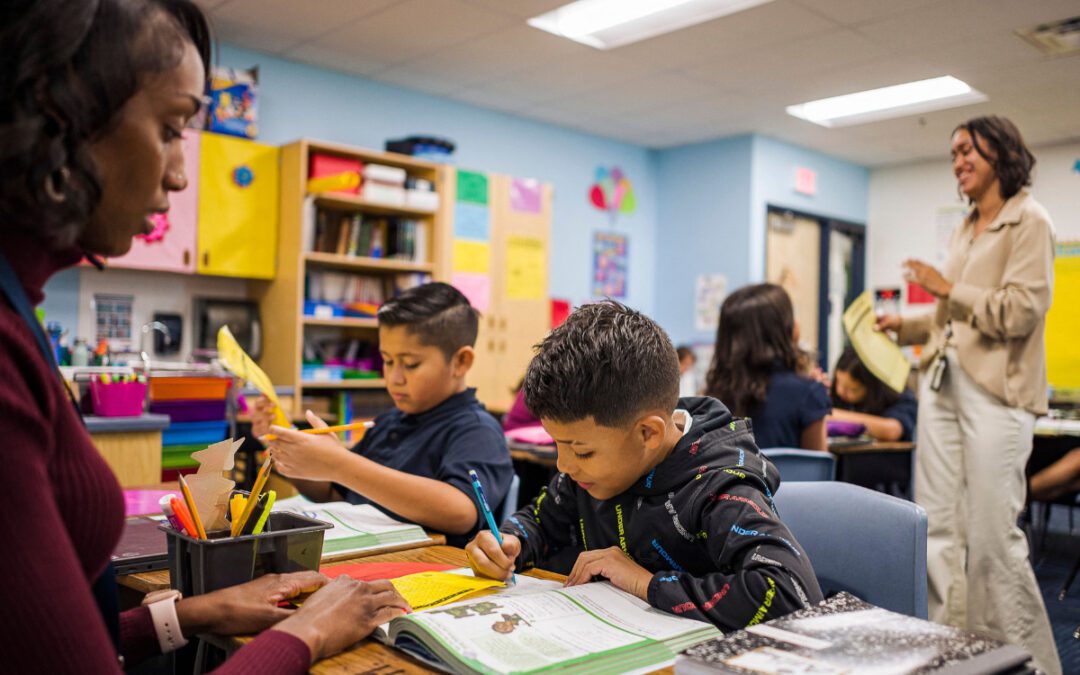
Students at Whittier Elementary School work in groups and independently, Tuesday, Oct. 18, 2022 in Mesa, Ariz. (AP Photo/Matt York)
Arizonans could have the chance to impose greater accountability and transparency requirements on the state’s controversial and unchecked universal school voucher program, also known as Empowerment Scholarship Accounts (ESAs), this November.
On Feb. 6, the Arizona Education Association, the state’s largest teacher’s union, and public education advocacy group Save Our Schools Arizona filed a ballot measure that would limit the program to families who make $150,000 a year or less, require voucher-funded schools to follow public school safety rules, and curb wasteful spending in the program.
The intention of the ballot initiative is not to eliminate the school voucher program, but instead eliminate the fraud and prioritize fiscal accountability for how taxpayer money is spent, said Marisol Garcia, president of the Arizona Education Association.
“The cornerstone of this [ballot initiative] is really to bring accountability and transparency to this program that just has no guardrails at all,” Garcia said. “Bringing this reform to the ballot is about making sure that every child in Arizona gets a high-quality education, no matter what kind of school they attend.”
If approved by voters in November, the measure would introduce several major restrictions to curb the ballooning costs of the vouchers program.
READ MORE: Universal school vouchers are destroying Arizona’s budget, but it doesn’t need to stay this way
The income cap limit would go into effect starting in the 2027-2028 school year. The measure does not cap income eligibility for students with disabilities or students who qualify under other parameters that existed before the universal expansion of the voucher program in 2022, and it does not change eligibility for the vast majority of Arizona students.
It would also ban the use of ESA voucher funds for non-educational and luxury items and require all unused ESA voucher funds to be returned, redirecting millions of dollars per year back to Arizona’s public schools. It would further require the Arizona Department of Education to report how much funding is received by voucher-funded schools each quarter.
“This is not an attack on parents,” said Beth Lewis, executive director of Save Our School Arizona.
Rather, it’s intended to level the playing field and recover more money to fund the state’s public schools, she said.
Organizers still need to collect over 255,000 signatures by July 2 to place the initiative on the November ballot, but Garcia and Lewis, who are both public school teachers, are confident voters will support the measure.
The ballot language filed on Feb. 6 is subject to a bipartisan Legislative Council review period and could be revised based on the review.
Why is voucher reform needed?
The ESA school voucher program originally began in 2011 and was intended to help students with disabilities get extra educational support.
In 2018, Arizonans voted down an attempt to expand the program to all students, and public polling conducted by the Arizona Education Association shows that nearly three in four Arizona voters approve of core accountability measures proposed in the ballot language.
But in 2022, former Republican Gov. Doug Ducey and the Republican-led legislature expanded the program to all students, regardless of their family’s income.
Since then, 12News investigations have found that ESA vouchers have primarily benefitted wealthy families, and taxpayer money has been used for purchases like kitchen appliances and diamond rings.
“The legislature could pass these desperately needed reforms tomorrow to keep kids safe, ensure they’re learning, and improve the financial accountability of our taxpayer dollars. However, the legislature has obstinately refused to add any guardrails to the program for three years, leading to massive fraud, waste, and unsafe situations for kids,” Lewis said.
The voucher program has surpassed $1 billion in annual costs and more than 100,000 enrolled students, while public schools across the state close and experience a mass exodus of teachers.
“It’s heartbreaking to see my colleagues leave this profession, especially really great ones, with no future in sight to have a comprehensive investment in public schools,” Garcia said.
For years, Gov. Katie Hobbs and Democratic legislators have attempted to reign in the ESA voucher system, pointing to the ballooning costs of the program that siphon money away from struggling public schools. But Republican lawmakers—the majority party in the legislature—have consistently shot down their attempts to implement any reforms on the program.
Last month, Hobbs introduced a proposal that would place a $250,000 income cap on ESA voucher recipients—higher than the ballot initiative’s proposal of $150,000—and return unused voucher funds back to the state.
Tom Horne, Arizona’s Republican Superintendent of Public Instruction has long supported and defended the school voucher program, and said the program has operated securely and efficiently—despite news reports finding rampant fraud and misuse of the program.
Horne’s office did not respond to a request for comment.
What else is in the ballot initiative?
The initiative, named “Protect Education, Accountability Now” would require all voucher-funded schools to comply with basic safety standards. This includes adhering to local fire and safety codes; conducting background checks for educators and school staff; keeping safe storage of heavy machinery and weapons on school premises; and implementing protections to stop youth access to drugs and alcohol.
While the ballot initiative places accountability measures on the voucher program, it would not impact access to educational therapies, goods, or services for students with disabilities—the population originally intended to benefit from the program—and it would not decrease the amount of an annual ESA voucher.
It would require all voucher-funded schools to follow the same academic accountability standards as public schools, requiring private schools to have their students take similar assessments as public school students, or be accredited by a nationally recognized accrediting organization.
Voucher-funded schools would also be required to investigate allegations of misconduct and maintain fingerprint clearance cards for all employees who have unsupervised contact with children.
The ballot initiative would require the state Attorney General to investigate and prosecute fraud and abuse tied to the ESA voucher program, and authorize the Attorney General to issue civil investigative demands and file civil actions.
“As parents and educators, we care deeply about our kids, this is a chance that we would have to end waste, fraud and abuse—and then the money that is going to…this program would allow us to invest back in public schools,” Garcia said.
Author

Support Our Cause
Thank you for taking the time to read our work. Before you go, we hope you'll consider supporting our values-driven journalism, which has always strived to make clear what's really at stake for Arizonans and our future.
Since day one, our goal here at The Copper Courier has always been to empower people across the state with fact-based news and information. We believe that when people are armed with knowledge about what's happening in their local, state, and federal governments—including who is working on their behalf and who is actively trying to block efforts aimed at improving the daily lives of Arizona families—they will be inspired to become civically engaged.

Here’s what readers think about tightening school voucher rules
This story was first published in The Copper Courier’s daily newsletter. Sign up here. On Friday, we talked about a possible ballot measure that...
Explained: Universal school vouchers are destroying Arizona’s budget, but it doesn’t need to stay this way
In 2022, former Gov. Doug Ducey signed a bill into law that set the stage for the current state of education funding in Arizona. House Bill 2853...
Kyrene School District to close 6 schools by 2027-28 school year
Kyrene School District will close six schools, marking the first time the district has closed a school in its 137-year history. The district...

Arizona has a teacher shortage. The state’s top education officials say this fueled it
A survey from the Arizona Department of Education shows over 4,200 teacher positions are filled by long-term substitutes, student teachers,...