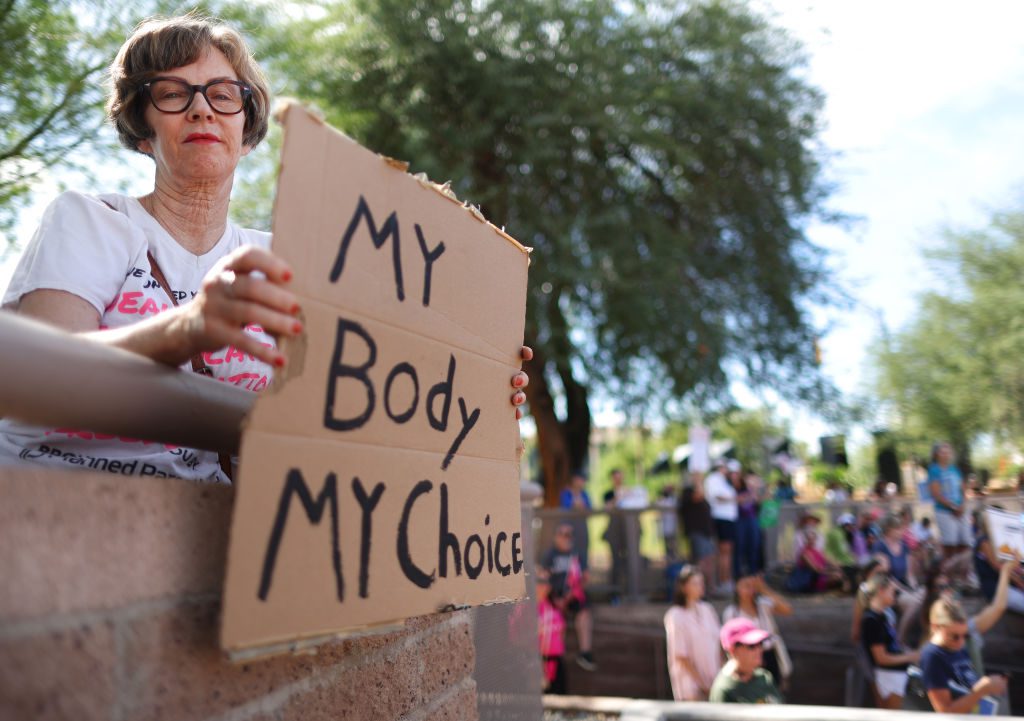
PHOENIX, ARIZONA - OCTOBER 08: A protestor holds a sign reading 'My Body My Choice' at a Women's March rally where Arizona Secretary of State and Democratic gubernatorial candidate Katie Hobbs spoke outside the State Capitol on October 8, 2022 in Phoenix, Arizona. Hobbs faces Trump-endorsed Arizona Republican nominee for governor Kari Lake in the midterm elections on November 8. (Photo by Mario Tama/Getty Images)
The Maricopa County Superior Court ruled last week that several long-standing Arizona abortion restrictions are unconstitutional, striking down laws that limited women’s ability to make private medical decisions with their doctors.
Judge Greg Como’s ruling found that the laws, which make getting an abortion far more difficult for certain women in Arizona, violated the constitutional right to abortion that Arizona voters approved through Proposition 139 in 2024. Together, these laws operated on the assumption that women needed additional oversight and time to reconsider their medical choices—an approach the court found inconsistent with the rights guaranteed under the new amendment
When over 60% of Arizona voters backed Prop 139, they affirmed that decisions about whether and when to continue a pregnancy belong to patients in consultation with their health care providers, not the state. But a number of pre-Prop 139 restrictions created confusion about whether lawmakers could still limit how and under what circumstances abortion care could be provided.
The constitutional amendment explicitly bars the state from “implementing or enforcing any policy that interferes with a person’s right to abortion before fetal viability.” Como’s decision reinforces that intent, making clear that Arizona voters did not just protect the procedure itself—they protected the presumption that women are capable of making informed, rational choices about their own reproductive health.
Under the constitutional framework established by Prop 139, restrictions on abortion can only stand if they do not interfere with a woman’s autonomous decision-making, are based on evidence-based medical standards, and demonstrably protect or maintain the woman’s health. Even in those narrow circumstances, they must be implemented in the least restrictive way possible.
The case was brought to Judge Como’s court by Dr. Paul Isaacson, a Phoenix OB-GYN and abortion provider who argued that several outdated laws replaced medical judgement with political mandates. Arizona Attorney General Kris Mayes had the opportunity to defend the state’s pre-Prop 139 laws. However, citing the 2024 constitutional amendment, she declined.
Instead, attorneys representing Republican politicians in the state Legislature—Sen. Warren Petersen and Rep. Steve Montenegro— defended the laws in court.
The court ultimately rejected their arguments, striking down three major restrictions:
- A 24-hour waiting period between a patient’s consultation and the abortion.
- A ban on performing abortions if the reason involved a fetal genetic or health diagnosis.
- A ban on using telemedicine to prescribe or provide abortion medication.
EXPLAINED: Why AZ doctors are fighting these abortion rules in court right now
Como wrote that the laws imposed a “universal suppression of medical judgement and choice,” finding that they substituted state control for the expertise of doctors and the autonomy of patients.
In his decision, he stated that the restrictions “infringe on a woman’s autonomous decision-making by mandating medical procedures and disclosure of information regardless of the patient’s needs or wishes.”
Mayes supported Como’s decision, praising it as a reaffirmation of the protections voters intended to establish through Prop 139.
“Today’s ruling is a major victory for Arizona women, families, and their doctors,” Mayes said in a statement. “The court has affirmed what we’ve known all along: the abortion restrictions challenged in this case are unconstitutional.”
The ruling can still be appealed, but for now, it represents a decisive affirmation that Arizona law cannot treat women’s decisions about their health care as suspect.
Author

Support Our Cause
Thank you for taking the time to read our work. Before you go, we hope you'll consider supporting our values-driven journalism, which has always strived to make clear what's really at stake for Arizonans and our future.
Since day one, our goal here at The Copper Courier has always been to empower people across the state with fact-based news and information. We believe that when people are armed with knowledge about what's happening in their local, state, and federal governments—including who is working on their behalf and who is actively trying to block efforts aimed at improving the daily lives of Arizona families—they will be inspired to become civically engaged.


Petersen wants a promotion: The AZ Senate president who voted to jail doctors is running for AG
Arizona’s Senate President, Republican Warren Petersen, is running to be the state’s next attorney general. The attorney general is the state’s top...

Explained: Why AZ doctors are fighting these abortion rules in court right now
You may remember that last November, Arizona voters approved Prop 139 to protect abortion rights in the state constitution. But a year later,...

Planned Parenthood suspends Medicaid services, citing ‘Big Beautiful Bill’ restrictions
Planned Parenthood Arizona (PPAZ) announced on Sept. 29 that as of Oct. 1 it can’t accept patients who rely on the Arizona Health Care Cost...

Trump’s VA abortion ban is a step backwards for Arizona veterans
In August, the US Department of Veterans Affairs (VA) announced that it would no longer allow veterans to access abortion care or counseling through...