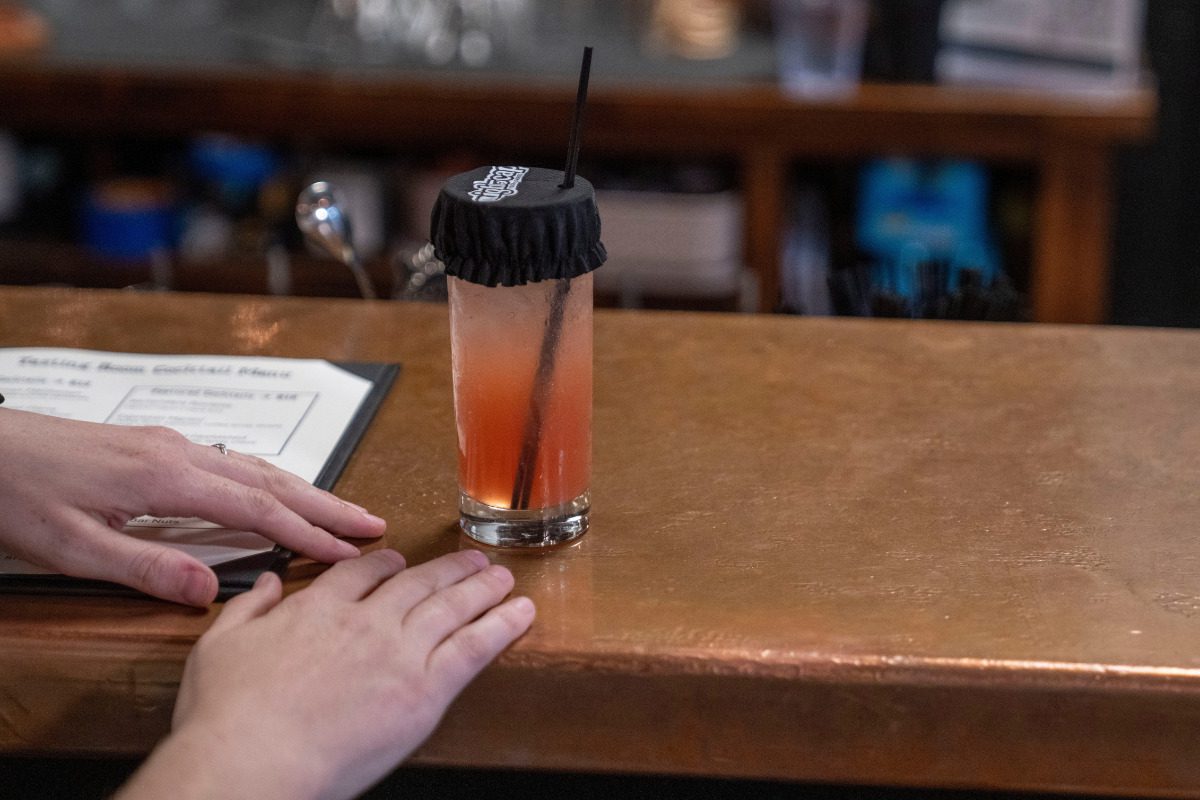
As part of the Tempe drink spiking prevention program, business owners may provide lids or drink covers and receive a 25% fee rebate on their liquor license. (Provided by the City of Tempe via Reuters Connect)
Lea Patrick and Marco McCray were out at a bar on Mill Avenue for a friend’s birthday. It was an average night, McCray said.
They grabbed shots from the bartender, then walked through the bar. The couple found out later that they were drugged.
“I don’t know how it happened,” Patrick said, sharing how she was always the vigilant one of the friend group. “But the reality is no matter how careful you are, it’s not always careful enough.”
Patrick had wanted to go home earlier in the night but stayed since her friends wanted her to have a good time. She had another drink. “I felt weird at that point,” she said. “In that moment, I would have tested my drink had I had a kit.”
MORE: Uber rape case in Arizona reveals over 500K sexual violence reports
Police later found Patrick outside, a couple blocks away from the bar. She was bruised, with her pants ripped and blood underneath her fingernails.
McCray had tried to walk home after being separated from Patrick, he said, unable to use his phone to call an Uber. The police were at their apartment when he arrived.
Patrick went to the hospital, where McCray found her “unconscious, disoriented and bruised,” he said. When she was released and went home, Patrick slept for two days straight.
“The second I go to the bathroom, I know,” Patrick told the Tempe City Council on Feb. 5, her voice shaking. “The second I see the bruises, there were hand marks on my legs, I knew.”
The couple shared their stories while testifying in support of a proposed law aimed at preventing drink spiking at bars and restaurants in Tempe.
“This is not a hypothetical situation,” McCray said. “These would-be predators are out there, unchecked.”
That ordinance was approved unanimously by the Tempe City Council Feb. 5 after facing early hurdles from the business community and concerns from some council members. But after rounds of revisions, representatives from various organizations, such as the Arizona Restaurant Association, came out in support of the law.
“To spike someone’s drink … is to take their agency,” said Councilmember Randy Keating, who championed the ordinance.
“Preventing this stuff and doing this is one of the most impactful things you could do to prevent somebody else from going through what I went through,” Patrick said.
Arizona‘s ‘first’ drink spiking prevention ordinance
The law mandates that bars and restaurants serving alcohol after midnight must carry drink spiking test kits, which are typically a test strip that indicates the presence of drugs. It also requires signage in the bathroom to publicize the availability of such kits.
City spokesperson Kris Baxter said it is the state’s first ordinance aimed at preventing drink spiking.
According to the city, businesses with certain types of liquor licenses that serve alcohol past midnight at least three times a month will be impacted, accounting for about 60 to 70 businesses. That’s down from the nearly 140 affected businesses when the ordinance was first introduced.
There are exemptions for bowling alleys, sports arenas or similar venues. Exemptions will be approved by the police chief.
Though business owners must now offer testing kits, they can also provide lids or some drink cover. In return, they may receive a 25% liquor license fee rebate. Business owners can sell the drink covers or drink spiking test kits.
According to city estimates, the rebates could cost the city anywhere from $5,000 to $21,000, a drop in the bucket in the billion-dollar budget.
The ordinance goes into effect Aug. 1, timed for when students go back to school.
According to Tempe, Chandler and Phoenix are beginning to explore similar drink spiking prevention policies and a Mesa city council member expressed interest.
How do the drink-spiking kits work?
Typically, a test strip has some combination of chemical reagents that interacts with a drink and would show a positive or negative reaction to indicate the presence of drugs. The indicators may be different depending on what test strip a person uses.
The city, throughout the process, used the company Knope as an example. Knope’s kit tests for the 12 most common drugs in spiking, including rohypnol, diazepam and ketamine.
Rohypnol, GHB, diazepam and ketamine are also known as date rape drugs or “roofies” and can cause a slew of symptoms, including dizziness, nausea, sleepiness and issues with body control, according to the U.S. Department of Health and Human Services. Mixing drugs with alcohol only amplifies these symptoms, causing issues with thinking, making decisions and remembering what happened.
Knope’s test result takes around 3 to 5 minutes to develop. Three lines indicates no drug presence, whereas one or two lines indicates some drug present.
Under Tempe’s ordinance, a person would request a testing kit and test the drink themselves.
But the efficacy of these immediate drug tests have been questioned in scientific literature. Knope is not specifically named.
Still, just having the option to have a drink tested brought comfort to people like Patrick.
“I would have loved having a testing kit there that would have helped me out and could have shown me, hey, this is something to walk away from,” she said.
Reporting by Lauren De Young, Arizona Republic
Author


Readers react to baffling disappearance of Savannah Guthrie’s mother
This story was first published in The Copper Courier’s daily newsletter. Want to join the conversation? Sign up here. One of the biggest stories so...

Savannah Guthrie to return to ‘Today’ on April 6 after mother’s disappearance
After a two-month absence sparked by her 84-year-old mother’s apparent abduction, Savannah Guthrie will return to NBC's “Today” show next month,...

15 years after Giffords shooting, Democrats call for gun measures
House Democrats, joined by former U.S. Rep. Gabrielle Giffords, marked 15 years since the deadly mass shooting near Tucson that ended her political...
Arizona jury sentences man to death in string of killings in metro Phoenix during 2017
PHOENIX (AP) — An Arizona jury on Thursday sentenced a man to death in a string of killings in metro Phoenix during a three-week span in 2017,...