Photo: Nuva Frames/Shutterstock
Consuming political news isn’t the same as building political power. From Minneapolis to small-town America, rural organizer Gwen Frisbie-Fulton writes that real change starts with local organizing and civic engagement.
Someone once told me this story: Anthropologists visiting an Aboriginal village showed them a newspaper clipping about an earthquake that destroyed a town halfway across the world. Seeing the images of destruction and devastation, the local villagers began to pack their bags. The anthropologists assured them that they were safe—the earthquake was very far away.
But the Aborigines were packing for a different reason. “Why would you share that news unless you were asking us to help?”
I have been thinking about this story as an earthquake-sized catastrophe has rocked through Minneapolis. Minnesotans have turned out en masse to protect their neighbors from the federal forces that tore through their neighborhoods; they formed community patrols and mutual aid networks to keep their neighbors safe. Speaking with a friend there, I commented that their round-the-clock efforts were nothing short of heroic. “Your town would do the same,” he said.
And it’s true: I think we would.
But most of us have largely watched the events in Minneapolis unfold from afar. We’ve kept the radio tuned to the news as we’ve driven to work, we’ve turned on the TV right after dinner, and—over and over again—we’ve refreshed the feeds on our phones.
Even when our cities are not under siege, we Americans have an insatiable desire for news and consume it in 24-hour cycles. Fox News is on at the mechanic shop, CNN plays quietly at the doctor’s office, New York Times alerts buzz on our phones. In 2020, cable news reached all-time viewership highs as we were glued to coverage of the pandemic, racial justice protests, and, later, the election. In 2025, social media surpassed television and news websites as our primary news source for the first time. Our feeds, which were once about family and friends, are increasingly about politics and breaking news. In a way, we are a very informed country.
But is being politically informed the same as being politically engaged? Is reading about the day’s event, sharing the viral video, knowing who in the administration said what about protestors—is knowing about the earthquake—enough? We often mistake knowing a lot about politics with doing politics. It is easy to confuse the energy of political drama and discussion with true political activity.
It’s not just Minneapolis. For the last decade, we have been overwhelmed by a long, grinding, relentless onslaught of chaotic breaking-news segments, forcing us into a constant state of high alert. We’ve often engaged with it exhaustively and emotionally, spilling our support or dissent on Reddit and Facebook, in think-pieces, and sometimes in the street or at the polls.
But emoting is not the same as building power and getting things done. Worse, it can leave us frustrated and feeling like things will never change. While posting on social media has given us a false sense of “doing something,” it actually limits us to merely demonstrating our ideologies instead of embracing true engagement with the processes, formations, and collectivity that could make us more powerful.
Right now, we sense that the people of Minneapolis are creating a blueprint for us; a way to non-violently stymie a federal incursion and keep our neighborhoods safe. We understand that we should be taking notes. But the same friend who assured me that my city would likewise show up also reminded me that Minneapolis has a long history and deep practice of civic engagement that preceded this herculean community response.
That’s worth paying attention to.
I think we should not wait for ICE to show up in our towns, but instead work now to build our civic muscles. To do this, we need to move beyond being political news consumers and commenters and pack our bags, so to speak, to dive into community work. We don’t have to reinvent the wheel because examples of how to do this surround us.
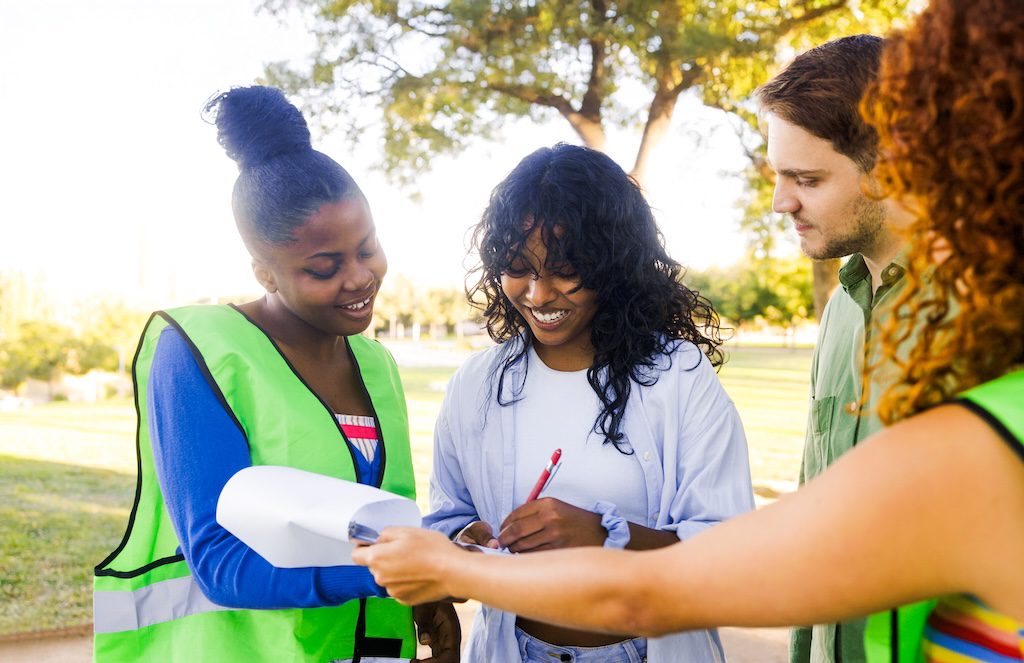
In a 2018 study, Tufts University political science professor Eitan Hersh found that college-educated Americans report spending more time on politics than other Americans, but only 2% of that time is actually spent engaging in their communities. It’s working-class people, especially women, Blacks, and Latinos, who are nearly twice as likely to outwardly engage with politics in their communities, specifically by volunteering or organizing, Hersh found. These folks might spend Tuesday evening at a city council meeting or set up tables at the community center on the weekend to circulate a petition and register neighbors to vote. This form of “doing politics”—rather than merely consuming politics—tends to be more local. It nearly always means connecting with neighbors, building affiliations, and moving, together, as a group.
So, to practice, we don’t have to drive to Minnesota. We can do politics in our hometowns and with the people we already know.
Along the way, we can secure real political wins. Recently in Soddy Daisy, Tennessee, residents coordinated outreach to pack a public hearing in opposition to an asphalt plant being built in town. The company withdrew its proposal a few weeks later. In Greeley, Colorado, locals have taken on a millionaire who wants to fund his next development with taxpayer dollars. Through door-knocking and petition drives, they’ve secured a ballot measure and special election later this month that could overturn the zoning for his development.
In Alamogordo, New Mexico, residents have organized to turn the town’s many blighted lots into thriving community food gardens. In Charlottesville, Virginia, neighborhoods are hosting social gatherings to engage in civic conversation with each other. In Baltimore, Maryland, communities are experimenting with a gift exchange to help meet each other’s needs.
These communities are stepping outside the paralyzing buzz of national news cycles and focusing on where they can make the most impact: at home. They are becoming politically engaged in ways that mean showing up and building power, not just reading the paper or watching the news.
Politics aren’t for watching; politics are for power. People everywhere are getting the news they need and immediately stepping toward one another. In doing so, they are building the muscle, connections, and strength that will serve us well when the next earthquake comes. We can all be like Minneapolis, but practice starts now.
Author

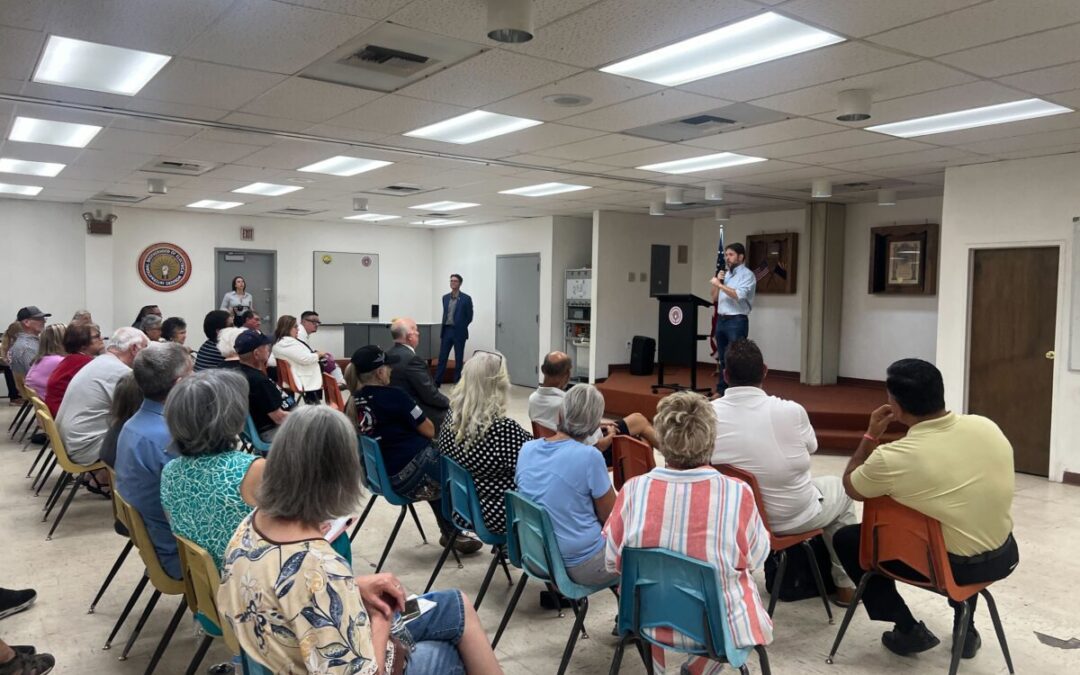
At Arizona town halls, veterans, tribal leaders, and immigrants share fears with Gallego over Trump policies
US Sen. Ruben Gallego met with voters in Globe and Apache Junction to discuss how the Trump administration is harming Arizonans. In rural Arizona,...

Opinion: Our homes are at risk, so why are lawmakers protecting corporations?
While the devastating wildfires in California earlier this year made national headlines, it is important to remember that Arizona is just as...

Gwen Frisbie-Fulton: ‘The people closest to the problem are often the ones who can find the solution’
About two years ago, tents started to show up in my neighborhood along the creek beds and in small stands of trees. Most only became visible when...

A love letter to the working class, from Gwen Frisbie-Fulton
It started in the back seat of my family’s Jeep Cherokee, the one with the broken AC and vinyl seats that stuck to my thighs in the late summer...