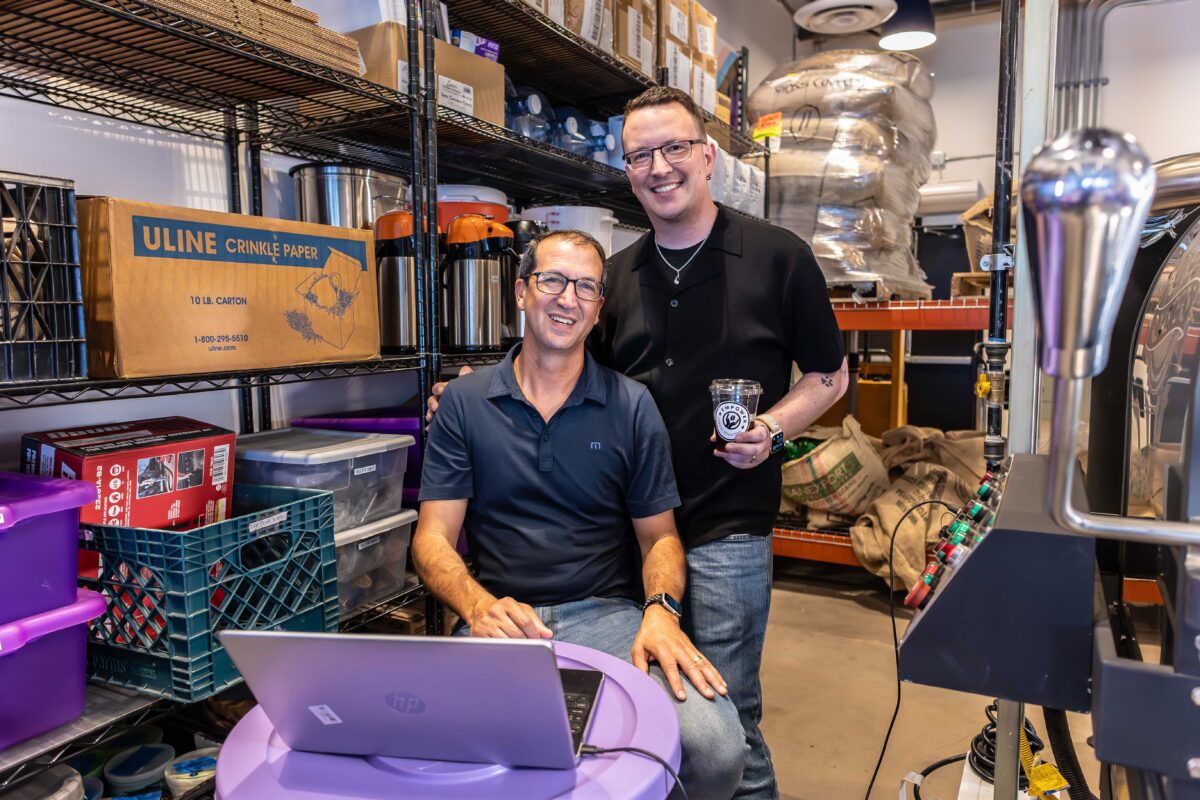
Jesse Shank and Gabe Hagen at Brick Road Coffee Mesa. Kathleen Dreier Photography.
Brick Road Coffee has struggled with its expansion as a result of Trump’s tariff policies, even months after the policies were eased.
When Gabe Hagen left his corporate job during the COVID-19 pandemic, he noticed that the world had grown increasingly isolated. Looking for ways to find community, he and his husband opened Brick Road Coffee in Tempe in 2021.
“I knew community would be more important than ever,” Hagen said.
Brick Road quickly became a community hub, hosting events and existing as a safe space for LGBTQ+ people and other marginalized groups, hosting Drag Story Hour, crochet nights, and other community-led events. After years of success in Tempe, Hagen decided to expand his coffee business by opening a new shop and roastery in Mesa.
Then came President Donald Trump’s tariffs.
In April, Trump unleashed sweeping new tariffs against more than 90 countries, including major trading partners such as China, Canada, and Mexico. Trump claims his tariffs—which are taxes on imported goods—are “great” for the country, and that foreign companies end up paying the cost, but studies show the domestic economy pays the bills instead, with businesses often passing the cost of tariffs on to consumers.
While the up and coming roastery was closed for construction, Hagen watched anxiously as Trump unveiled the new tariff policies.
“We’re just sitting here watching a train barrel towards us,” Hagen said.
Once he began buying new equipment, like espresso machines that are often made by Italian manufacturers, he noticed they were too costly under Trump’s tariff regime. Hagen began calling around for the equipment he wanted domestically to see if companies had the machines he needed. Ultimately, he ended up downsizing a lot of equipment in order to save money and ensure he could still follow his dreams of opening the roastery.
The economic disarray is what prompted Hagen to join the Small Businesses Against Tariffs initiative in February, a new campaign highlighting business owners from across the country who have been impacted by tariffs.
“When you can get people that are in their community to be able to be those messengers and help educate people [about] our realities, that’s really a powerful tool, and so I wanted to do that,” Hagen said. “I wanted to feel like I’m creating something that can be positive [and] hopefully help other business owners that may not have the privilege to speak out.”
Launching a new business amid Trump’s tariffs
From January to June 2025, the new roastery remained closed during construction. After Trump implemented his tariffs, Hagen had to figure out where to cut costs, which ultimately led to hiring less staff, buying different and cheaper equipment, and even putting his home as collateral to obtain a bank loan.
“We just didn’t sit on our hands and wait, [we tried] to be as proactive as possible. But at the end of the day, it’s a numbers game. We’re just trying to get enough so we have enough cash left in the account so I can hit payroll,” Hagen said.
Hagen first purchased a bulk order of coffee beans for the new shop about a year before Trump announced his tariffs, in June 2024. When he formally opened the roastery in June 2025, he did not immediately feel the impact of tariffs. But by the time he began a new round of purchases months later, prices had dramatically increased.
“It was extremely expensive compared to what we had forecasted,” Hagen said.
The tariffs that affected local coffee shops like Hagen’s were placed against countries like Brazil, Colombia, and Vietnam, which make up more than 60% of America’s coffee supply. Hagen also saw an increase in the cost of cups, lids, and straws.
Coffee beans cannot be grown in the US due to a lack of tropical conditions. Only Hawaii, Puerto Rico, and parts of California have the proper climate for coffee beans, meaning most coffee must be imported into the US from across the globe. Hagen works with coffee importers and with coffee farms directly.
Before tariffs, Hagen said he paid about $4.25 for a pound of green coffee beans. Once tariffs were implemented, the cost nearly doubled.
In November, Trump lifted tariffs on coffee beans, but Hagen said it will take some time for the business to feel the relief. Because the importers already paid the tariffs, business owners like Hagen still have to pay for that warehoused coffee. Recently, Hagen said, he purchased tariff-free coffee, which was still above the average price.
It can be difficult for business owners like Hagen to plan around the general uncertainty of the tariff policies which are constantly shifting. Hagen worries especially for younger people who could be discouraged from starting their own small businesses due to the instability of the economic policies.
“I get worried, I feel more and more these things keep compounding onto the younger generations. They can’t buy a house, they can’t start a business,” Hagen said. “What can they do but work for these mega corporations? That’s what worries me, because I see so much joy come from the people that come into Brick Road and are crocheting for crochet meetup, and then they go and sell those. That’s what I think is so powerful. I didn’t realize how powerful it was until I started Brick Road.”
The US Supreme Court last week struck down many of Trump’s tariffs in a 6-3 decision, prompting the president to implement another tariff of 10% on all trading partners.
In a follow-up text, Hagen said while he is cautiously optimistic about the new ruling, he still worries about how it—and Trump’s constantly shifting tariff policy—will impact small businesses like his.
“As a small business owner, I don’t have the luxury of waiting things out. I have employees to pay and a community that relies on us. The ruling is a positive step, but the administration’s response hasn’t yet provided the clarity or stability small businesses need. It’s hard to feel fully at ease.”
Hagen hopes that by joining the new Small Businesses Against Tariffs campaign, he can help Arizonans get a sense of how Trump’s tariff policies have affected the local community and uniquely hurt small businesses across the state. He hopes the campaign will shine a much needed light on the topic and underscore the importance of supporting local businesses in the face of such economic uncertainty.
“Support local businesses, local vintage shops, local restaurants. We really are a network,” Hagen said. “That type of local economy is so important right now, when we’re just struggling.”
Author

Why Phoenix airport security lines are so bad this spring break
Airports nationwide on Tuesday, March 10 continued to experience higher-than-normal wait times for security from a combination of spring break...

Is a campaign Cybertruck a good idea? Arizonans weigh in
This story was first published in The Copper Courier’s daily newsletter. Want to join the conversation? Sign up here. Have you seen a navy blue...
How are Arizonans faring under Trump? New report shows higher costs for food, health care, and energy
More than a year into President Donald Trump’s second term, a new report from Defend America Action and Progress Arizona reveals that thousands of...
Republicans are using custom electric Cybertrucks to get political
Barreling down State Route 101 on a recent Sunday afternoon, the Jay Feely campaign Cybertruck was hard to miss. No space on the navy blue behemoth...