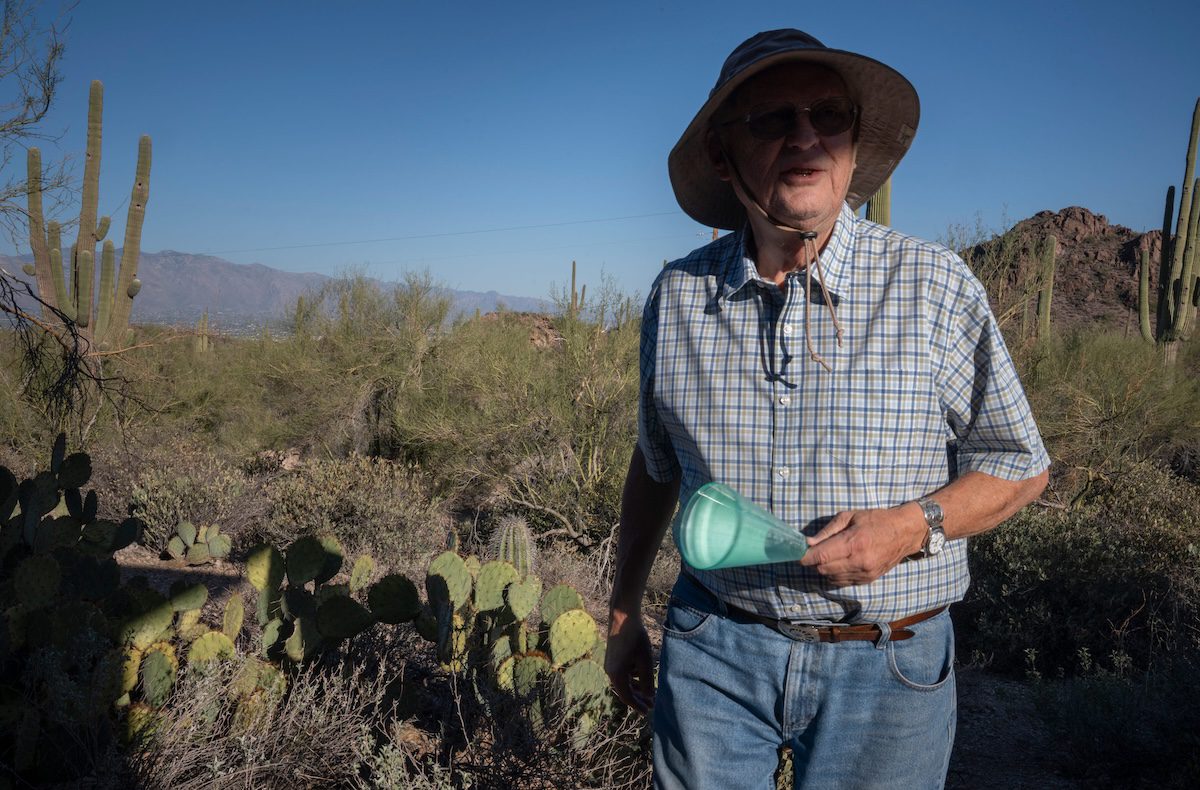
A portrait of Charles Cole with his rain gauge at his west Tucson home on Nov. 14, 2025. (Mark Henle/The Republic via Reuters Connect)
TUCSON — The desert rains usually deliver about a foot of water in a year, give or take. Perfect for growing a saguaro cactus or topping off a gardener’s rain barrel.
Or, as one couple has proved for more than 20 years, supplying a home’s year-round household needs, with enough to spare for a 12,000-gallon backyard swimming pool.
Charles J. “Jay” Cole and Carol Townsend knew they wanted to retire to southern Arizona, the region where Cole had attended graduate school and where both had worked on field studies during careers with the American Museum of Natural History.
In 1997, they bought the west Tucson property where they would build their hillside retreat among the cactuses and ocotillos, with a view sweeping back across the city toward towering Mount Lemmon. One thing it lacked: water.
Cole and Townsend had long needed to be in tune with nature, having worked winters in Latin America and summers at the Southwest Research Station in Arizona’s Chiricahua Range. They had drunk rainwater from a rooftop in Guyana, and believed they could do the same in Arizona despite its much drier climate. They would need better technology and sanitation to satisfy health inspectors, though. Their contractor installed a collection system on their metal roof, a 26,000-gallon underground cistern in the yard, and treatment modes including filtration, ultraviolet light and reverse osmosis.
“We were pretty sure it would work, but we weren’t sure,” Cole said, “so we put in a well too.”
But boy did it work. And the groundwater that the well pumped from under those hills sort of didn’t, as it churned out a mineralized, discolored flow that they decided was worthy only for watering some of their xeriscaped plants. “All of our underwear turned orange,” Townsend said. “It really was not acceptable.”
But the cistern water, which they have tested routinely, is comparable to or better than even public drinking water systems around the region, they said. With the exception of a few delivered truckloads during drought — one in 2022 and some more last year — it’s all they’ve needed.
The couple has kept meticulous rainfall, consumption, water quality and maintenance cost records since 2007, and last summer published a 17-page pamphlet explaining their system. They share it with people who want to learn from them, including visitors who sometimes visit on tours arranged by University of Arizona hydrologists or the Pima Association of Governments. They view it as a small public service they can provide as centralized water sources such as the Colorado River and Arizona’s aquifers are stressed by growth and climate change.
“Arizona has problems,” Cole said. “We really thought we could help.”
The couple uses an average of 90 gallons a day, 45 per person. The household total ranges from 61 gallons a day in winter to 121 in the hottest part of summer, due to pool evaporation.
The system cost them $35,000 in 2003 dollars, they said, which at the time was roughly what it would have cost a homeowner to add a room or a pool. Maintenance has averaged $898 a year, swinging between as low as $342 and as high as $2,346, depending on the schedule for replacing parts. Professionals handled all maintenance, including filter changes.
“We’re also not handyman people,” Cole said.
He checks the cistern occasionally, though, to be sure he won’t need to call ahead for a water delivery in the rare case that it’s going dry. That’s why he requested the truckload during a 2022 dry spell, when the 10-foot-diameter tank dropped as low as 2 feet, or about 5,200 gallons. A 2,000-gallon load costs $165, he said. Turned out it rained before they would have run out anyway.
In November he demonstrated his technique, sliding a long pole into the cistern like a dipstick checking an underground fuel tank.
Water dampened 5 feet, 11 ¼ inches of the pole, the remnants of Tucson’s monsoon season rainfall. The household might pull just half a foot from the cistern per month.
“That’s gonna last a good time,” Cole said, “and we hope to get some winter rains.”
Reporting by Brandon Loomis, Arizona Republic
Author


Arizona Dreamers fear being abducted by ICE as Trump administration delays DACA renewals
Arizona DACA recipients sound the alarm about their fears of becoming bait for immigration authorities as USCIS fails to process work-permit...

Hey Labubu fans, Pop Mart is opening its 1st Arizona store. What to know
Pop Mart is a global toy and entertainment company known for its collectible designer toys and “blind box” figures. The company started in China and...

Why Phoenix airport security lines are so bad this spring break
Airports nationwide on Tuesday, March 10 continued to experience higher-than-normal wait times for security from a combination of spring break...

Is a campaign Cybertruck a good idea? Arizonans weigh in
This story was first published in The Copper Courier’s daily newsletter. Want to join the conversation? Sign up here. Have you seen a navy blue...