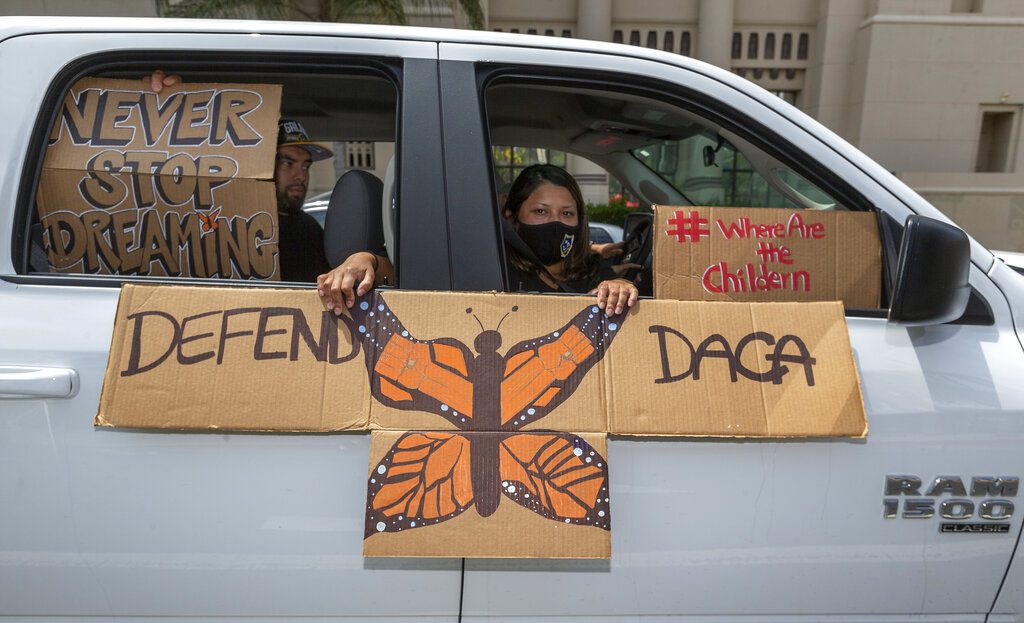
FILE - In this June 18, 2020, file photo, an immigrant family joins members of Coalition for Humane Immigrant Rights of Los Angeles, CHIRLA, on a vehicle caravan rally to support the Deferred Action for Childhood Arrivals Program (DACA), around MacArthur Park in Los Angeles. On Monday, Sept. 27, 2021, the Biden administration renewed efforts to shield hundreds of thousands of immigrants who came to the United States as young children from deportation, the latest maneuver in a long-running drama over the policy's legality. (AP Photo/Damian Dovarganes, File)
Arizona DACA recipients sound the alarm about their fears of becoming bait for immigration authorities as USCIS fails to process work-permit applications.
Luis has lived in Arizona for nearly his entire life.
After arriving from Mexico with his family as a one year old, he grew up in Phoenix, attended Constitution Elementary school, and studied at Arizona State University.
But Luis, whose last name is being withheld for safety reasons, always knew that life could be taken away at any moment.
As an undocumented immigrant, he knew that one small mistake could upend everything. He never took any chances and was constantly aware of his surroundings to avoid any run-ins with law enforcement for fear of being arrested and deported.
In 2013, however, Luis got some much needed relief. A year after then-President Barack Obama created the Deferred Action for Childhood Arrivals (DACA) program, Luis applied and was approved.
DACA provided temporary relief, work authorization, driver’s licenses, and Social Security numbers for some undocumented immigrants who were brought to the US as children. The program effectively gave Luis and other “Dreamers,” as they came to be known, renewable two-year periods of protection from deportation.
After he was approved for DACA, Luis was able to live without the constant fear of being targeted by immigration officials. He could breathe easier.
“DACA changed my life because it gave me protection from this uncertainty. I could live my life unafraid and could properly plan for a future in the United States,” Luis said. “It’s not a permanent solution, but the program provided me the much needed security to go and graduate college. And for that, I will forever be grateful for the program.”
After becoming a DACA recipient, Luis understood his fate was largely in the hands of the federal government. He could live normally so long as he had the means to renew his status every two years, which costs between $500 to $600.
While the cost of renewal was high, and the process could be time consuming and bureaucratic, it was the price Luis was willing to pay to maintain good standing, especially under President Donald Trump’s administration, which has cracked down on immigrants, even targeting DACA recipients.
For a lot of DACA recipients, the time of renewal can be a stressful one. Luis said he was extremely busy with daily life and a new job, but still managed to submit his renewal paperwork in November, a few days before the deadline.
“Being a DACA recipient, it’s kind of strange where this renewal process doesn’t cross your mind until it comes really close to your expiration date. Then it starts overwhelming you,” Luis said.
Despite his anxiety, he waited for his status to be renewed as usual.
Come January, when he hadn’t heard anything from United States Citizenship and Immigration Services (USCIS), the agency that oversees DACA, Luis grew increasingly concerned. He had read about others who experienced delays, but didn’t think it applied to him given that he met the deadline. The only correspondence he received from USCIS informed him that he’d need to provide new biometrics before the agency could process his DACA renewal as part of new rules for Dreamers.
Luis’s biometrics appointment was set for January 21, but he feared the biometrics wouldn’t process in time before his status expired on Feb. 14.
He was right.
As of March 17, Luis is still waiting to hear back from the agency regarding his application. Because of the delay, Luis fell out of status.
“It’s a lot of things at once that unfortunately have been screwed up because of my lack of renewal—my job, my driver’s license, the lack of an ID, the fact that I can’t drive. All this stuff unfortunately accumulated because of this delay,” Luis said. “I’m in a very weird, awkward position, and I’m uncertain about what’s going to happen.”
DACA recipients are eligible to get a driver’s license, but the expiration date of their licenses is often tied to their status. Now that Luis’ DACA expired, he no longer has a valid license.
Luis is living on savings to stay afloat, but worries how much longer he can go on without any clarity.
He avoids leaving his house as much as possible to prevent a run in with Immigrations and Customs Enforcement (ICE) agents. He worries he could get caught at the wrong place at the wrong time and land in detention as part of Trump’s mass deportation efforts.
“I am unprotected. I don’t have DACA, I don’t have a legal status. At this point, I can’t be in the country legally,” Luis said. “It’s really difficult to surmise how much this has affected me personally. It’s been a stressful past few weeks and I’ve been going through all the emotions.”
‘I am afraid’
Laura, who asked her full name be withheld out of fear of retaliation, is in the same boat.
She has lived in Arizona since she was 12 years old after arriving with her family from Mexico. She never had any issues renewing her DACA until her most recent renewal attempt in December 2025. After Laura sent in her application, she received correspondence stating she must attend her biometrics appointment in February. She went to her appointment, but fell out of status on March 6 after USCIS failed to process her application in time.
Since then, Laura has had to leave her job as a social worker and cannot earn income or try to get her job back until her application is processed. For now, her family members are helping pay her bills, but she knows that cannot last forever.
“I just feel the clock ticking because money goes by fast and there’s a lot of expenses to be paid—vehicle insurance, health care expenses, medications,” Laura said.
As a result of losing her job, she lost her only form of health insurance, too.
The worst part, Laura said, is the fear. Like Luis, she is laying low and scarcely leaving the house in order to prevent a run in with ICE.
In order to renew DACA, recipients must provide their most updated home address. Now, Laura feels like she is a sitting duck.
“I have anxiety around being preyed upon now that I don’t have status. [It] makes me a bit vulnerable, or a target. I am afraid,” Laura said.
It’s not an unreasonable fear. Between Jan. 1 and Nov. 19, 2025, 261 Dreamers were detained by the Department of Homeland Security (DHS) and 86 were deported, according to a February letter by former DHS Secretary Kristi Noem.
In a statement, a spokesperson for USCIS said that DACA processing times were lengthened under President Trump’s leadership to allow for more rigorous review of applicants.
“USCIS is safeguarding the American people by more thoroughly screening and vetting all aliens, which can lengthen processing time. DACA does not confer any form of legal status in this country. Illegal aliens claiming to be recipients of DACA are not automatically protected from deportation. Any illegal alien who is a DACA recipient may be subject to arrest and deportation for a number of reasons—including if they committed a crime.”
José Patiño, Vice President of Education and external affairs at Aliento, an immigration advocacy group, and a Dreamer himself, said the delays come as a result of Trump’s policies, even dating back to his first administration. He said a number of case adjudicators were pushed out, leaving fewer staff members to process applications. The updated biometrics requirements have also slowed down processing times, he said.
Trump has been a critic of DACA for years and even attempted to axe the program during his first term before the effort was halted by the US Supreme Court. Still, the Trump administration no longer accepts new applicants, and just last year, then-assistant press secretary at DHS Tricia McLaughlin urged DACA recipients to self deport.
Patiño argued that Dreamers are stuck in such a precarious position because the federal government is currently run by Republicans who, he said, echo white supremacist and anti-immigrant views and oppose DACA.
“It will be very difficult for us to be able to get us powerful legislation while [Trump] is in power, because people like Stephen Miller, or the Heritage Foundation folks, who believe in this replacement theory.”
Patiño is referring to the “Great Replacement theory,” a far-right and white nationalist conspiracy theory that claims white people are intentionally being replaced by immigrants to undermine and “replace” white people’s political power and culture in the West. Trump has previously echoed the claim, as have other top Trump officials.
“The Republican Party is not a functioning party … they follow Donald Trump,” Patiño said. “And the Democratic Party is not necessarily well organized right now.”
The failure for Republicans to act leaves Dreamers like Luis and Laura stuck in legal limbo.
Both Luis and Laura have devised plans in the event they are targeted by ICE, including getting in touch with immigration advocacy groups, memorizing lawyers’ phone numbers, and mentally preparing for the possibilities.
“[It’s] not a great way to live, and it’s just unfortunate because now it feels like I have to live that way, be overly cautious and think twice about what steps I want to take,” Luis said.
Patiño is urging Arizona’s nearly 20,000 DACA recipients to submit applications far earlier than usual, at least 150 days before their work permit expires, stating that while the delays aren’t their fault, it’s one way to remain proactive and ensure they don’t get caught up in the Trump administration’s delays.
Until a real solution is offered, however, DACA recipients are left in a tough position, unable to do much and waiting for relief from an administration that has no love for the program.
“You don’t want to live like there’s someone watching you behind your shoulder. That’s not a great way to live, and it’s just unfortunate because now it feels like I have to live that way, be overly cautious and think twice about what steps I want to take,” Luis said. “I always feared this day would come where I just wasn’t protected.”
Author


Is a campaign Cybertruck a good idea? Arizonans weigh in
This story was first published in The Copper Courier’s daily newsletter. Want to join the conversation? Sign up here. Have you seen a navy blue...
Rainwater fills most of these Arizonans’ household needs. Here’s how
TUCSON — The desert rains usually deliver about a foot of water in a year, give or take. Perfect for growing a saguaro cactus or topping off a...
Republicans are using custom electric Cybertrucks to get political
Barreling down State Route 101 on a recent Sunday afternoon, the Jay Feely campaign Cybertruck was hard to miss. No space on the navy blue behemoth...
‘Be brave’: Analise Ortiz on why it’s critical to stand up to ICE and Trump
Despite being targeted by the right for warning her constituents about ICE raids, Ortiz continues to push back against the agency’s violent...