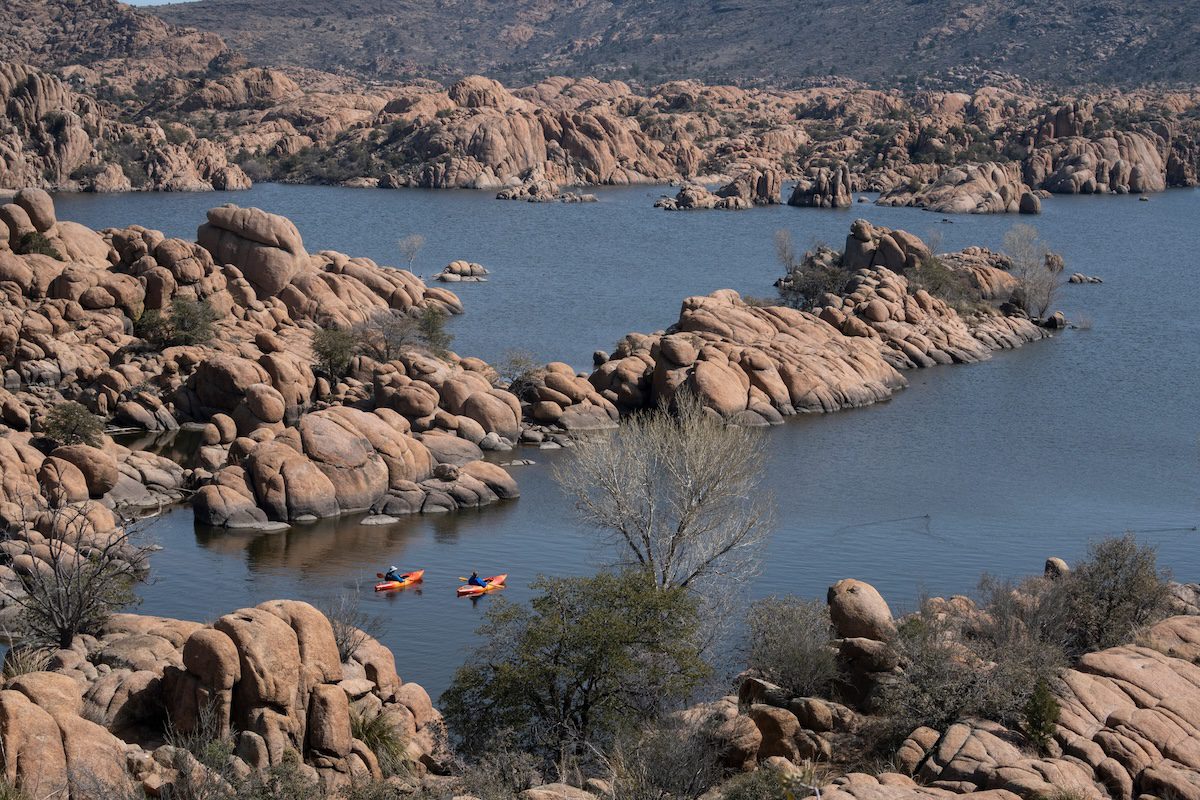
Steve Anderson (left) and Mike Merrill (right) kayak on Watson Lake in the Granite Dells, Prescott, Arizona, on February 24, 2026. (Mark Henle/The Republic via Reuters Connect)
PRESCOTT — Five miles northeast of downtown Prescott lie the Granite Dells, a 3,000-acre craggy wonderland and gem of open space that butts up against stretches of urbanization.
The Dells were part of the draw that brought Joe Trudeau to this corner of the country. After he moved from New Hampshire to Prescott in 2010, he started exploring the park and its surroundings in his backyard. Even then, he noticed a ring of development that was encroaching. Pavement and real estate were snaking into the boulder fields, across meadows and up the hill slopes, squeezing the Dells like a noose.
Development had been knocking on the Dells’ door for decades, despite the overwhelming desire to preserve public spaces for outdoor recreation. Residents had all but shouted this wish. They formed advisory committees, voted for relevant bills in legislation, crafted land management plans and, at one point, resorted to a lawsuit to force local government’s hand.
MORE: A guide to visiting Monument Valley’s iconic rock formations
But the city had repeatedly favored growth over open space conservation in its spending decisions, leaving long-time residents and advocacy groups feeling disappointed and disillusioned.
Then in 2016, Trudeau caught a whiff of a land development proposal at the Dells’ doorstep. Hundreds of residential and commercial units were going up on its northern edge, overlapping the area’s most trafficked hiking trail, the Peavine. In the future, visitors would have to cut through dense housing to enjoy their neighborhood park.
Trudeau was alarmed. To stop the city’s most iconic landmark from being razed over, the public needed to organize, but differently. It was time to try a new tactic.
Residents had enough of the city’s inaction
The Granite Dells can’t compete with the Grand Canyon or the red rocks of Sedona, but they draw plenty of fans for their own rugged beauty.
The defining geologic features are the rocky outcrops that look like haphazard piles of boulders, but that are actually 1.4-billion-year-old magma plumes that emerged out of the ground then weathered into lumpy, cracked masses — ramparts made of dragon scales.
Two artificial lakes, Watson and Willow, nestle among the Dell’s reticulated rockpiles, formed after dams were built on tributaries to the Verde River. The rest of the landscape is a patchwork of meadows, cottonwood groves and gently sloping mesas. Glassford Hill rises to the east, a remnant volcano that threw its last fit around 12 million years ago.
“It’s the backdrop to our lives,” Trudeau, an environmental consultant, said. “Driving by on Highway 89 in the morning, you catch a glimpse of the sun coming over the hill, and it’s just a profoundly awesome way to start your day.”
In 2006, a 16,000-acre crescent of private land east of Watson Lake appeared on the market. Advisory committees had already identified the area as a top-priority parcel for the city to acquire, as it could be integrated with the rest of the Dells — then a mere 2,100 acres owned by Prescott — to boost outdoor recreation. The city needed to act quickly.
Valarie Isley was working for Prescott as an administrative assistant at that time, overseeing the City Council’s to-do list, which included items such as speedy land acquisitions. But the mayor’s office bided its time.
“Three days later, that land was sold out underneath us,” Isley said. “It was such a betrayal to the citizens.” In large part for this reason, Isley would also eventually leave her position.
It would be one in a string of missed opportunities and misplaced priorities that defined the city’s attitude toward open space conservation. Over the years, the city council rejected appeals to set aside land for recreation — in one case in 2003, from a willing seller.
The city had the money but not the will. Voters had approved a 1% sales tax for road improvements and open space acquisitions, twin goals that the public had assumed the city would balance equally.
In the first six years the tax was in effect, less than a tenth of the revenue went to securing under 200 acres of Dells territory.
Meanwhile, the acreage price of land would also jump in the following years — in the next nine years until the tax expired, the city would fork out three times its initial spending to expand the Dells by the same acreage.
Residents were furious. Months after the city passed on the 16,000-acre sale, a resident named Meredith Marder sued the city for skimping on open space purchases against the wishes of the public. But the superior court judge presiding over the case ruled in favor of Prescott, agreeing that the city had full discretion over spending.
Back then, “the city was made up of people of like minds — all about money and development,” Isley said.
As public anger smoldered, a spark came in the form of the 2016 development proposal that Trudeau caught wind of — the tipping point for action after years of low morale.
Of the 16,000 acres that Prescott had passed on in 2006, 474 acres had resurfaced on the city’s docket 10 years later, and was on the verge of development. This time, the Dells’ advocates wouldn’t let the piece slip through their fingers again.
There was much work to do.
An advocacy group is born
On the surface, it looked like a casual hangout between neighbors at a popular joint. In the back room of the red-and-white Victorian facade of Cuppers Coffee, Trudeau assembled half a dozen concerned citizens to discuss the 2016 proposal to smother a corner of the Dells with high-density real estate, and, more urgently, how to stop it.
From all appearances, the city was going to greenlight the developer’s plan, no questions asked.
Out of the meeting and others over the next two years, a new advocacy group was born. Save the Dells was going to deliver what its name promised, to preserve Prescott’s beloved park — rocky outcrops, water, hills, meadows and all.
As momentum for the cause grew, attendance outgrew the coffee shop, and meetings moved to public libraries, at people’s homes, other larger cafes, whichever informal setting that could accommodate the attendees du jour.
Save the Dells works closely with the nonprofit Granite Dells Preservation Foundation, which shares a common purpose. The latter came out of a dissolved — and disgruntled — committee that was tasked with advising the city — often in vain — on open space acquisitions.
But Save the Dells differs from the foundation and other environmental advocacy groups — it’s a political action committee. The founders decided that raising hell outside city hall wouldn’t be enough.
“The public wanted this open space, and yet the leadership in the city was resistant for one reason or another,” said Joanne Oellers, an early organizer with Save the Dells and its current chair. “The leadership was the problem.”
They needed to get the right people elected into government, those who valued open space and restrained development, not growth above all. Notably, Save the Dells bills itself as apolitical and has endorsed candidates across party lines.
Save the Dells ratcheted up the pressure. The organization rallied over a thousand people outside City Hall for a hearing of AED’s proposal, then several more over the years. To spread the message of the threat of development, the group distributed flyers, plastered billboards with advertisements and published opinion letters in the local newspaper.
All that campaigning was for good reason — many residents hadn’t realized that their local landmark, especially some of the most picturesque sections of rock and rippling water, could one day be subdivided and fenced off for good. The public had assumed that the undeveloped grounds belonged to the city, not the private holdings that were simply waiting for developers to flick the switch on bulldozing.
“Kids that grew up here were shooting their guns out there, they were trespassing like crazy all of their lives and never realized it,” Oeller said.
Public support crescendoed. In 2018, a hike-and-bike event by Save the Dells drew more than 600 people, some on pedicabs ferried by volunteers. The same year, Save the Dells organized a community forum that brought over 1,200 people to the Yavapai College Performing Arts Center, the most well-attended event to date. Residents clogged the streets as they drove up and down State Route 89 in search of parking.
The organization was making political waves, too. In 2019, Save the Dells endorsed its first political candidate for city council, Cathey Rusing, who ran on the vow of preserving open spaces, and won. According to her campaign bio, she was the only one who didn’t take campaign donations from developers. Prescott voters would reelect her to her seat in 2023 and then as mayor in 2025.
Last year, all three city council candidates that Save the Dells endorsed won their seats in a tight race that went to runoffs.
Save the Dells played a key role in reshaping Prescott’s political scene. But its first real test of influence would come in the early 2020s when it would engage head-to-head with developers in their own language: real estate.
‘They knew it was the right thing’
At the height of the COVID-19 pandemic, the city council, AED and various interest groups hunkered in the basement of Prescott City Hall to craft a new deal. In this discussion addressing the 2016 development proposal, Save The Dells convinced the city to let representatives have a seat at the table.
Representatives made it clear to the city that if they didn’t like the agreement, they would stir up a fuss among the public.
After several months of negotiations, “what we ended up with was a pretty darn good deal,” Trudeau said. “It wasn’t perfect, but it was a pretty good deal.”
What clinched the deal wasn’t the cash sum, but water. The public wanted the parkland’s skyline to stay free of rooftops. The developer needed city services, particularly water, for other sections of its 15,000-acre holdings across Yavapai County. Therein lay an opportunity to make a mutually beneficial compromise.
“We wouldn’t have agreed to it if we weren’t satisfied with the outcome and felt like it was a fair bargain,” recalled Jason Gisi, the CEO of AED and also a frequent user of the Dells’ trails. “I’ve lived in Prescott for 30 years, and I understand the sensitivity of that land to the public.”
In the past, the city would supply groundwater to development projects by default. In a first for the city, residents urged the council to use groundwater provisions as a bargaining chip.
On July 13, 2021, the city council unanimously approved the annexation of 474 acres from AED in a land-for-water agreement.
“It didn’t cost the city a single cent,” Trudeau said. “It proved that you can think outside the box and utilize systems that you haven’t used before.”
A major victory, but a stronger mark of success was the automatic way the city would snap up other open spaces thereafter. In 2022 and 2023, the city, working with Prescott Valley and Yavapai County, moved on its own to purchase thousands of acres of state-trust land on Glassford Hill.
“We didn’t have to put up a fight,” Trudeau said. “They just did it because they knew it was the right thing.”
How water figured into the fight
So successful has been Save the Dells’s political strategy that its opponents have borrowed the group’s playbook, forming their own PAC. Their goal? “Fighting us,” said Walt Anderson, activist and cofounder of the Granite Dells Preservation Foundation.
Still, Prescott residents can’t entirely prevent development from worming its way in. Along other parts of the Peavine Trail, construction for 250 houses is poised to break ground any day.
Keeping the Dells intact takes vigilance, especially as more private lands come on the market. A 220-acre plot is currently for sale, city-approved for 1,000 housing units. The owners are open to selling this parcel — called “the Diving Board” for being the last private holdings in a sea of state-trust land — to the city.
Its estimated price tag is between $22 million and $24.5 million, highly valued for the water rights for 1,150 units that come attached to the plot. Another 600 acres of state trust land, worth $5.5 million, will be up for grabs in an April auction — should the city sit on its hands, it would lose its iconic letter P on Badger Mountain two miles south of Watson Lake.
Defending the Dells is a never-ending task, for the threat of development hovers near in ways big and small.
To the supporters and opponents of the city’s public-space inclinations, balance in development is a matter of opinion. Ted Gambogi, a city council member, thinks Save the Dells and its supporters have gone too far, manufacturing “a crisis that didn’t exist.”
“If you don’t grow, you die,” Gambogi said. He highlighted Prescott’s slower economic growth compared with its neighbors, Prescott Valley and Chino Valley. He said he supports open space acquisitions, “but not at the expense of major issues” like housing affordability and efficient transportation.
Last year, Save the Dells and other environmental advocates campaigned for a ballot measure called Proposition 484 that would protect Prescott’s open spaces in perpetuity. Eagle-eyed citizens had caught a clause in the city charter that more than two thirds of the city’s public spaces, including the Dells, could be sold or leased any time with a simple majority vote among the council.
On the ballot, voters overwhelmingly rejected that loophole, maintaining that the city must steward all its recreational spaces until voters once again decided otherwise.
Then, in February, residents railed against another assault: a proposal to widen a stretch of Highway 89 passing through The Narrows, a highly popular section of the Dells with its knobby rock formations flanking the two-lane pavement. Public pressure pushed the city council to vote against the project — with Gambogi casting the lone “for” vote, citing concerns about effectiveness of emergency responses — that would have expanded the artery of traffic into five lanes.
The fight to preserve the Dells’ open spaces hasn’t been easy. When the organization was getting off the ground, Trudeau was spending up to 30 unpaid hours a week on Save the Dells, on top of his full-time job. In 2019, he and his wife finally stepped back from their co-chair positions to start a family.
Many of the leading voices for Dells’ protection are retirees, lured to Prescott for its mild weather and open skies. And they bring with them a lifetime of expertise on how the gears of a city’s real estate laws and water rights turn.
Local environmental groups are populated by university professors, geologists, former political campaign managers. According to census data, Prescott’s median age is 60 years.
Nevertheless, “retirement is the busiest place I’ve ever lived,” said Rod Moyer, Save the Dells’s treasurer.
“We don’t go to many movies,” echoed Anderson.
Environmental advocates aren’t slowing down anytime soon, because they’re aiming bigger. The vision is to grow the Dells into Yavapai County’s first regional park, a sweeping 7,000 acres to be jointly managed by Prescott and its sister city, Prescott Valley. It would stitch together a mosaic of federal lands, city parks and conservation easements to facilitate wildlife movement and restore nature’s ecological rhythms on an unfragmented landscape.
The campaign to pressure the city to acquire more open space rages on. There is still much work to do.
‘Local heroes’ building trails
On one balmy afternoon in February, Chris Hosking made his rounds in the Granite Dells, as he has always done for two decades. On some days, he can clock 13,000 steps. But his progress usually comes in fits and starts.
He paused to clear a strewn rock here, then answered wayfinding questions from a hiker there. On the summit of Captain’s trail, he guided several mountain bikers from Colorado down a technical section. He would know how to negotiate the tight turns and steep drop-offs — he designed the trail himself.
Recreational opportunities in the great outdoors don’t always come by on their own. Securing open space is just the first step. Next comes the work of managing those grounds.
In the 1990s, the Dells had only one trail, the Peavine, thanks to the Rails-to-Trails federal program. When Hosking first came to Prescott to work on its scattered trails in 2006, the city only had 24 miles of footpaths.
Two decades later, Hosking, as the trails and natural parklands manager, would lead the effort to put in 130-some new miles for hikers, bikers and birdwatchers to share. Their existence is thanks to the armies of volunteers that helped him etch these trails from rock and dirt.
Hosking’s job on Day 1 was complicated by the fact that the city had no budget to hire trail builders to open up newly acquired lands. So he tapped into Prescott’s culture of volunteerism. The trail builders call themselves the Over the Hill Gang, and they’re mostly retirees looking for ways to stay active and connected.
Twice a week, retirees swing shovels and haul rakes, enticed by the promises of cookies, swag and, most importantly, camaraderie. The group supplies 10,000 hours of free labor annually.
From four recruits in 2007, membership has expanded to 100 strong.
The paths they built have been crucial for getting the public to appreciate the beauty of the landscape they fought hard for, and to understand which pockets are under threat of urban erasure.
In the fight to preserve the city’s open spaces, Over the Hill Gang’s members are just as critical as the environmental advocates who wrested them from development, Hosking said.
“They’re really the local heroes,” he said. And the organization couldn’t just arise anywhere. “Just the amount of volunteerism that happens, Prescott is unique.”
Residents and tourists benefit from all that service. Prescott’s public trails receive over 1 million users every year, with over 100,000 people hitting the Peavine trail alone.
Hosking is nearing retirement age himself, and is hoping to keep at his job for another three years. After that, he’ll find his way back to trail work, he says, probably as a volunteer with the Over the Hill Gang. The trails that have sprung up all around the Dells mark the passage of his life, landscape-scale notches that also track the growth of his children. He can’t imagine giving all that up and loosening the reins on that progress.
“This regional park has not been completely realized yet,” he said. “I want to be part of that.”
New trails still need to be built, on new terrain that the city will one day acquire. For public space advocates like Trudeau and Hosking’s volunteers, there is still much work to do.
Reporting by Shi En Kim, Arizona Republic
Author

We asked about Arizona’s worst roads. Readers had plenty to say
This story was first published in The Copper Courier’s daily newsletter. Want to join the conversation? Sign up here. I really don't like driving,...
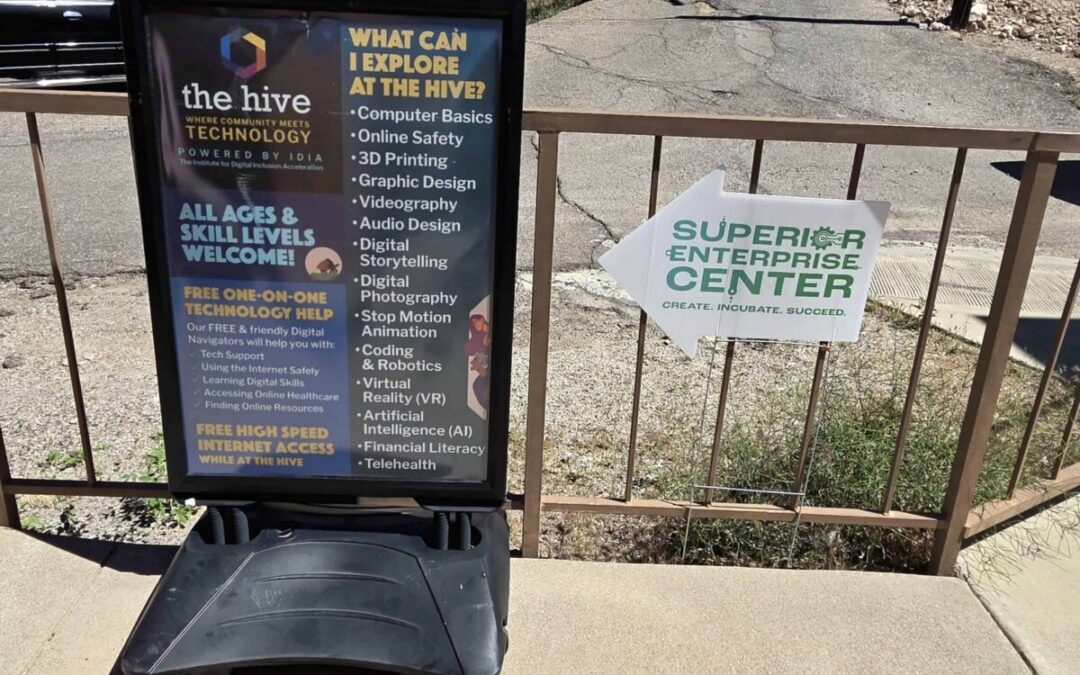
Free computers, internet, and 1-on-1 tech help: What to know about AZ’s Hive centers
The Hive, powered by I.D.I.A., provides free computers, internet, tech support, and more at locations across Arizona, helping bridge the state’s...

Why are allergies so bad in Arizona right now? What’s behind the surge
Allergy season in the U.S. was expected to be longer and more intense in 2026, with high pollen levels forecast in 29 states. Tree pollen has...

Chandler eighth grader wins Arizona Spelling Bee, heads to nationals
Esha Marupudi, a 14-year-old eighth grader at BASIS Chandler, won the Arizona Spelling Bee on Saturday at Phoenix’s Madison Center for the Arts,...