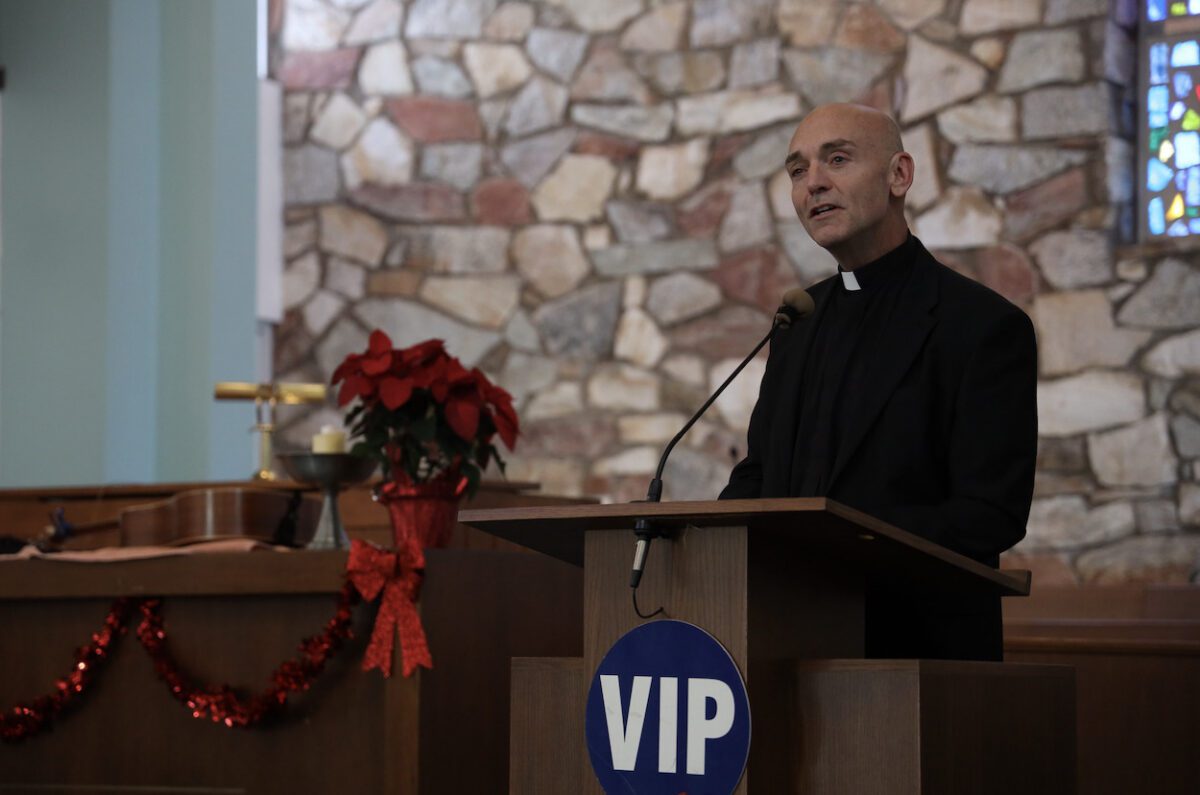
Pastor Rock Fremont speaking at an event the Valley Interfaith Project. Photo courtesy of Cameron Conner.
Religious leaders with Valley Interfaith Project are standing up for immigrant rights in the face of Trump’s mass deportation agenda.
Deacon Judy Eighmy stood in front of the podium at the Phoenix City Council chambers on March 25, looked directly at council members, and cited the shortest verse in the Bible: John 11:35, “Jesus wept.”
Eighmy, a leader with the Valley Interfaith Project (VIP), was one of dozens of Arizonans who showed up that day to implore the city to do more to protect immigrants in the face of President Donald Trump’s mass deportation agenda. As Immigration and Customs Enforcement (ICE) agents target Arizona grandmothers, mothers, and other longtime residents, Eighmy delivered a moving testimony, using scripture to defend immigrants from what she called the “trauma” imposed on them by ICE.
“Surely Christ would weep if he saw our families being traumatized by these inhumane experiences,” Eighmy said.
Eighmy is just one of 16,000 people across Maricopa County who are part of VIP, an interfaith coalition of about 25 member institutions that advocates for better living conditions for all Arizonans.
VIP leaders like Eighmy showed up to the Phoenix City Council hearing as city leaders considered passing the Community Transparency Initiative (CTI), a proposal to protect residents from ICE operations in Phoenix. The CTI would bar immigration officials from staging on city property, create a portal for residents to report immigration officials for civil rights violations, train all city employees on interacting with immigration officials, and create a “Know Your Rights” website.
“The Community Transparency Initiative you’re considering today is not a silver bullet for the issues facing Phoenix families, but it is a vital first step,” Eighmy said.
Religious leaders with VIP worked with the city of Phoenix and with community organizations to help craft the CTI’s final language. They also made sure to show up to testify to the entire city council to help push the proposal across the finish line.
After about five hours of hearing from city residents, the city council voted 8-1 to pass the proposal. Now that the CTI passed, the faith leaders are rolling up their sleeves to continue defending Arizona’s immigrant communities.
‘Living out the golden rule’
For Pastor Rock Fremont, Senior Pastor of Shepherd of the Hills United Church of Christ (UCC) in Arcadia, the fight to protect undocumented immigrants is not complicated—the scripture encourages people to love thy neighbor, he said.
“That’s part of living out the golden rule, which is a perennial truth—care for neighbor. How are we loving each other? How are we being forgiving, more merciful, more loving individuals? That’s what it means to be a person of faith, and that’s a perennial value.”
Fremont was introduced to VIP eight years ago when he became a pastor at UCC, a founding institution of the interfaith organization. Since joining the project, Fremont has been involved in a number of different local political initiatives across Arizona, including fighting for affordable housing, getting personal protective equipment and COVID-19 vaccines for Arizona inmates, and protecting immigrant communities.
Members of Fremont’s congregation have helped immigrants released from ICE detention move back home and reconnect with their families—offering transportation, meals, and sometimes even a place to stay. Fremont said he’s heard troubling stories when he’s worked with immigrants who’ve been detained by ICE.
“Just heart-wrenching stories about what these facilities are like—the extortion of money, needing to pay to get out of ICE detention, and the incredible cruelty as well,” Fremont said. “Many of these people picked up by ICE, they have identity documents, those identity documents and other personal property are destroyed, incinerated, and so they get out of ICE detention and they have no paperwork. It’s a system of punishment.”
Stories like this are why Fremont and other religious leaders began working with local immigration organizations like Puente Arizona to fight back against ICE.
How they help
Houses of worship are “microcosms” of the outside world, Fremont said, which is why VIP leaders host what they call “house meetings,” inviting members of their congregations and the community to sit together and talk about the issues affecting them.
At the house meetings, VIP leaders ask community members a very simple question: What keeps you up at night?
Veronica Ojeda, a VIP leader and parishioner at St. Francis Xavier, a Jesuit parish and school, said the concerns she hears the most relate to affordable housing, health care, and of course, immigration.
“We have roundtables and people get to share what their concerns are,” Ojeda said. “There’s people that were able to afford health care last year and now, this year, they’re debating, ‘do I cross the border to go get my healthcare?’ These are concerns that the communities are bringing up,” Ojeda said.
These roundtable discussions create a safe space for community members to voice their concerns to trusted faith leaders, who then take those concerns and form tangible plans to find solutions.
“The number one reason why we do house meetings is to build relationships and to share stories and listen to stories bringing us together to try to understand each other,” Fremont said. “Then uncovering what can lead to a common action, something we can do together.”
The religious leaders emphasized the congregation is nonpartisan and their grassroots approach of simply listening to one another invites dialogue and solution-oriented thinking rather than arguments.
“People are concerned about the same kitchen table issues, We do these in congregations where there often is a lot of political disagreement to say, what is that common self-interest that we can work together around to work for the common good of our community?” Fremont said.
It’s just one of many things the faith leaders do to protect their communities, and they say it’s not about politics—-it’s about humanity.
“We all share the ability to be on this planet together. It really is important for us to continue to develop opportunities for people to better themselves. We’re a nation of immigrants, it’s part of our DNA,” said Beatriz Arias-Cisneros, a member of the Valley Unitarian Universalist congregation and a leader with VIP.
While the Trump administration uses religious rhetoric to mask brutal policy decisions and to justify war, these religious leaders stress that the Bible teaches compassion above all else, not cruelty.
“I’m just wondering what Bible our president is reading because it just seems like he’s doing everything that’s on the opposite side,” Ojeda said. “Do unto others as you want it to be done unto you. If you were in an emergency or you needed a plate of food, would you want somebody to do that for you? The love that we have for our community, we know that everybody deserves a dignifiable life.”
Now that the CTI passed, Ojeda said they are looking to work directly with local police departments. The faith leaders said they plan to meet with the Phoenix Police Department to express concerns regarding arrest operations, as individuals arrested by Phoenix P.D. are often booked in Maricopa County Jails, where ICE has space in their Intake, Transfer and Release facility and screens all booked individuals. Some activists have called it a “collaboration” with ICE and have been pushing for a halt to it for years.
Ojeda said people may not feel safe calling the police if there’s even the slightest risk that ICE could be involved.
“They don’t know if the police department [and] ICE [are] working together,” Ojeda said. “If there’s people like us that can get that information for them so that they feel safer because they’re my neighbors, then I’m happy to do that.”
As the group continues its work to defend Arizona’s immigrant communities, Fremont reiterated these are not the values of one religious group or another; they’re the values of a shared religious framework, and every faith institution has a role to play in defending its neighbors.
“It’s incredibly important that we do this work and make sure that folks know that the church, synagogues, temples, congregations, are doing this work, because it’s important,” Fremont said.
He stressed that religious leaders who might support Trump’s anti-immigrant policies should know that loving your neighbor—regardless of nationality or status—is supposed to be a universal trait, not bound to any one particular party or religious group.
“Caring for our neighbor, that’s a conservative value,” Fremont said. “The immigrant, the foreigner is mentioned roughly 80 to 100 times in the Bible. From a Judeo-Christian perspective, this is what we’re commanded to do. We are on the right side. It’s important that we remind people that identify as Christians, we need to encourage them to read their Bible.”
Author

We asked about Arizona’s worst roads. Readers had plenty to say
This story was first published in The Copper Courier’s daily newsletter. Want to join the conversation? Sign up here. I really don't like driving,...
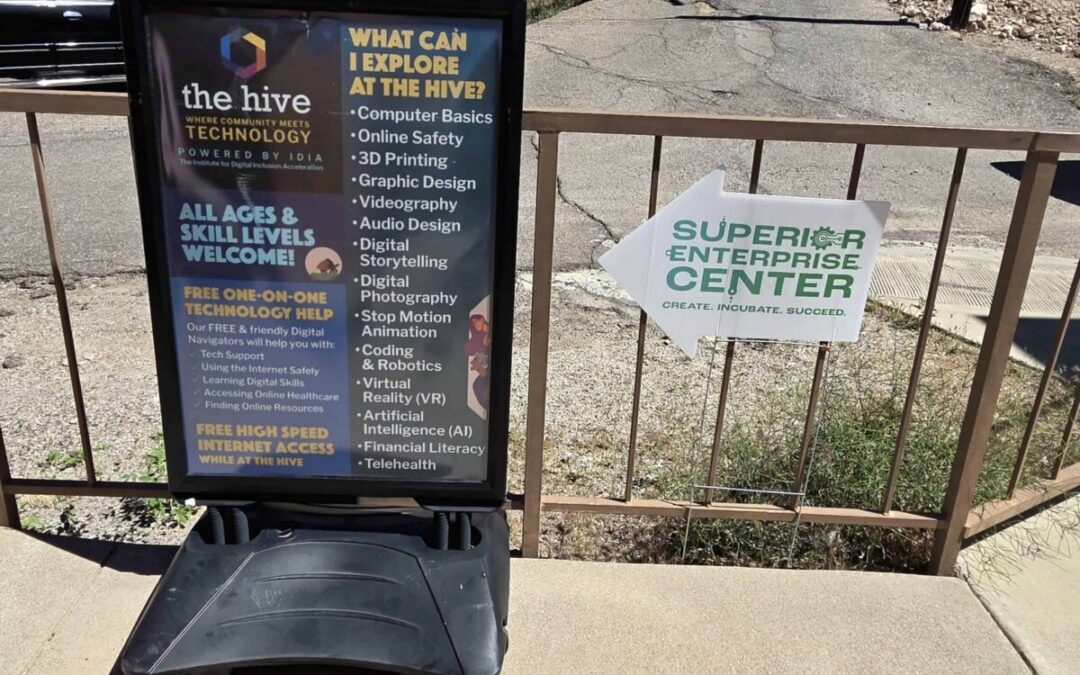
Free computers, internet, and 1-on-1 tech help: What to know about AZ’s Hive centers
The Hive, powered by I.D.I.A., provides free computers, internet, tech support, and more at locations across Arizona, helping bridge the state’s...

Why are allergies so bad in Arizona right now? What’s behind the surge
Allergy season in the U.S. was expected to be longer and more intense in 2026, with high pollen levels forecast in 29 states. Tree pollen has...

Chandler eighth grader wins Arizona Spelling Bee, heads to nationals
Esha Marupudi, a 14-year-old eighth grader at BASIS Chandler, won the Arizona Spelling Bee on Saturday at Phoenix’s Madison Center for the Arts,...