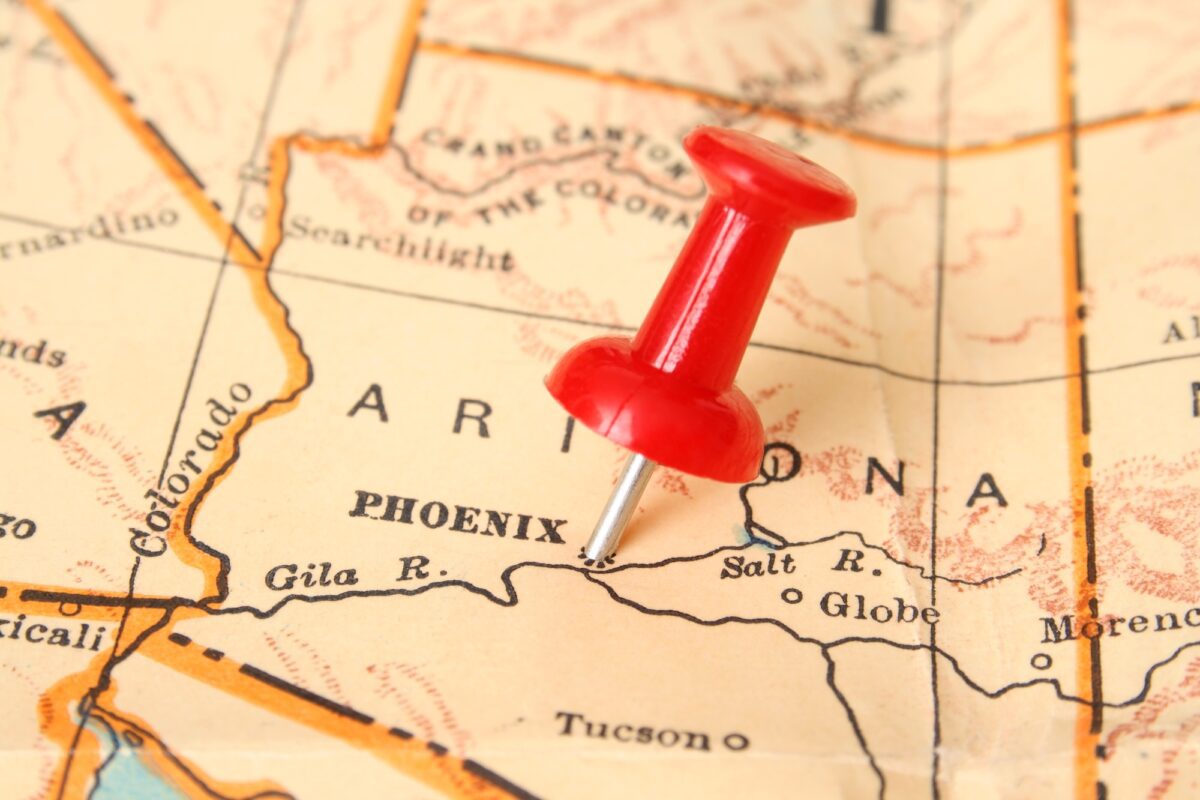
Red pushpin pointing to Phoenix city in more than fifty years old map. Getty Images
Most of Arizona’s vacancies were on school boards, water district boards, and fire district boards.
In more than 250 local races last year, Arizona voters had zero candidates appear on their general election ballot, leaving them no choice of who should represent them on school boards, water district boards, and other crucial roles, according to a new report by BallotReady, a nonpartisan organization that tracks election data.
Arizona was 6th in the nation in terms of having the most open seats with no candidates in the 2024 general election. The states with the highest numbers of seats with zero candidates were California, Texas, Florida, Arkansas, and Missouri.
In elections without candidates, Arizona voters are left without a choice. That means the seat could either end up vacant or be filled by appointment. While democracy depends on voters showing up, it also depends on candidates showing up.
“Democracy is not working the way it should,” Alex Niemczewski, chief executive of the BallotReady, told the New York Times last year. “Voters don’t have a choice.”
Nationwide, the report found that for over 10,000 open seats up for election across the country in 2024, zero candidates appeared on the ballot. And in about 70% of races across the country, only a single candidate filed to run—effectively leaving voters without a real decision to make.
Most of Arizona’s vacancies were on school boards, which oversee public education in a specific district; water district boards, which ensure the local community has access to clean and affordable water; and fire district boards, which oversee fire and emergency medical services.
In Yavapai County, nine elections were cancelled less than 100 days before the general election due to a lack of candidates. In one example, in Congress, a town of about 1,700 people with a high risk of wildfire over the next 30 years, just one person–George Wickholm–filed to run for the Fire District Board. The Yavapai County Board of Supervisors moved to appoint Wickholm to the role because no other candidates filed.
In Maricopa County, there was a vacancy for a school board position in the Buckeye Elementary School District Governing Board, which serves about 6,350 students about 35 miles west of Phoenix. No one ran for the seat, so then-Maricopa County Schools Superintendent Steve Watson appointed former Republican state Rep. Joel John to fill the position.
These hyper-local positions depend on candidates from the community who are committed to making decisions for the betterment of the area. Without strong candidates running, communities risk a lack of political representatives who will advocate for them.
Ally Boguhn, communications director for Run for Something (RFS), an organization dedicated to recruiting and supporting young candidates running for down-ballot races, argues that there isn’t a lack of qualified candidates, but rather many obstacles making it difficult to run.
“There is a lack of resources out there for first time candidates, and that can be a major hurdle for them,” Boguhn said. “Another piece is that some folks feel like they’re not ready to run yet. Young folks in particular feel like they have to wait their turn to run. But more and more we’re seeing that that’s not the case.”
The cost of running for office varies depending on the level of office. Running for school board, city council, or county commissions is less costly than state or federal races.
Most local races can be won with anywhere from $500 to $50,000 in campaign spending, depending on the size of the district and campaign needs, according to Good Party, a political organization encouraging grassroots campaigning.
The largest campaign costs can often include things like campaign literature, yard signs, websites, and digital tools.
That’s why organizations like RFS exist — to make it easier for community members to get the support they need and make the leap for elected office.
“The lived experience that people have, that is what you bring to office, that is what makes the difference,” Boguhn said. “We need more ordinary people to take the extraordinary step of running for office. These state and local positions, they’re really the ones that affect our day to day lives the most.”
RFS has helped over 3,500 candidates across all 50 states and D.C., including dozens of candidates in Arizona, ranging from school board to city council seats.
Since President Trump was sworn into office, over 60,000 people across the country have signed up with RFS to run for office, Boguhn said. That’s more than in the organization’s first three years combined. She is optimistic that this surge in interest will lead to more local leaders stepping up to run in the next election cycle.
“We really need those normal people to step up. We need moms, we need renters, we need young people, we need union members and LGBTQ folks to step up and change what leadership in our country looks like.”
Author
Ex-Arizona Republican lawmaker who questioned election integrity to be sentenced for using forged signatures
A former Republican lawmaker who questioned the integrity of Arizona’s elections and served as a leader for the conservative group Turning Point...
University of Arizona student shares details of ‘cruel’ experience in ICE detention
Yassine Halhoul came to the US to study at the University of Arizona on a student visa. The Trump administration detained him anyway. When Yassine...
Actor Morgan Freeman cancels Arizona music festival appearance
Morgan Freeman will no longer be on hand to take part in a pre-show Q&A when his Symphonic Blues Experience arrives at Highlands Church in...
In Tucson, Republican Juan Ciscomani is portrayed as a grinch “who stole healthcare”
Democrats are targeting the Republican Congressman for failing to protect Tucson residents' access to healthcare. Despite verbal commitments to...