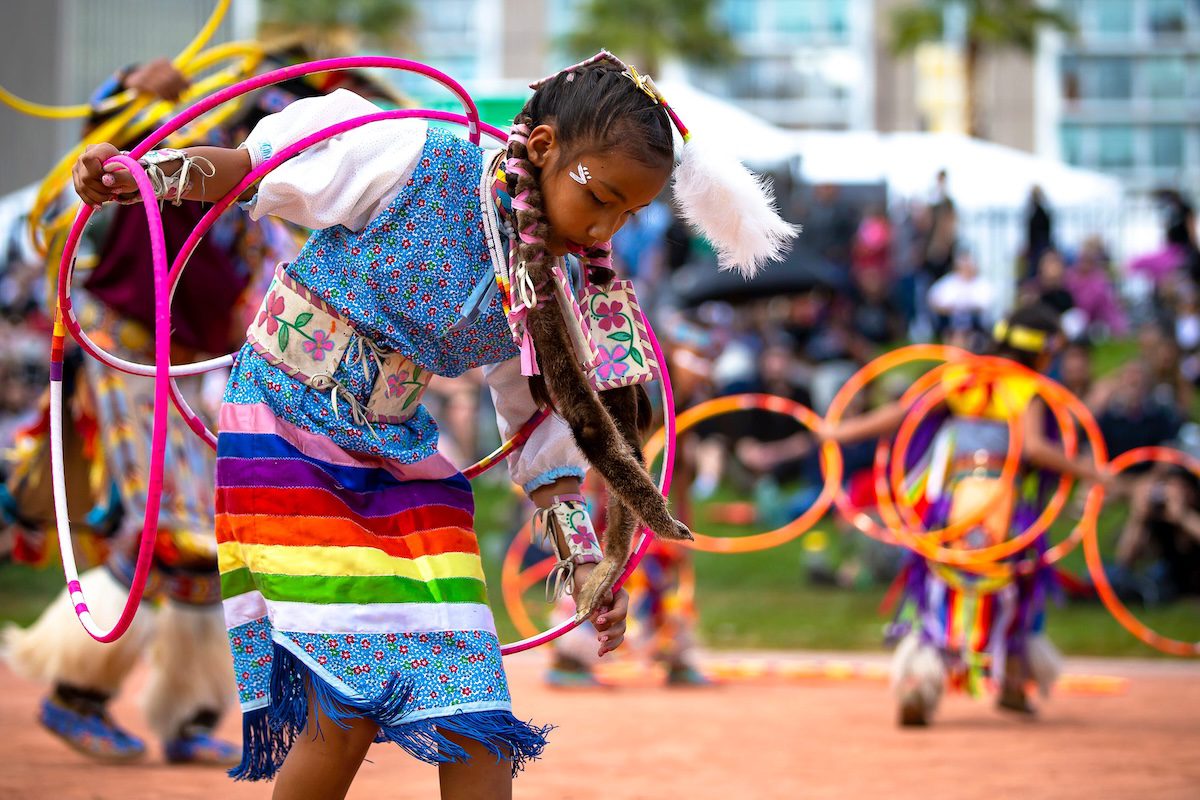
A girl hoop dances with her family during the 64th annual Heard Museum Indian Fair and Market in Phoenix on Mar. 5, 2022. (Monica D. Spencer/The Republic via Reuters Connect)
Since 1992, the World Championship Hoop Dance Competition has been held at the Heard Museum in downtown Phoenix, and 2026 will be no different.
Native American hoop dancing dates back so far that even the tribes themselves are uncertain of when it exactly began. What is obvious is that it’s more than a dance or a performance — it’s spiritual and personal.
The hoop is a symbol of completeness, wholeness and represents the never-ending circle of life and is an important tool in healing rituals. The hoop allows tribal holy men and women to see ailments while restoring balance and harmony.
MORE: 6 new things to see at the Arizona Renaissance Festival this year
According to Mike Webb, the Heard Museum’s public engagement manager, healing derives from what the hoop formations represent. Accompanied by drum music, the dancer uses hoops to tell a personal story by creating a variety of formations, each with a distinct meaning.
“Being able to tap into the rhythm of the drum, Dennis Bowen (arena master of ceremonies of the championship) says that when we’re in the womb, we could hear our mother’s heart and that was our first introduction to sounds, to rhythm,” Webb said.
“So, the drum recalls that and allows us to get into this space of being reverent and being mindful and being grateful for the new life we have.”
The modern hoop dance
In terms of the modern hoop dance, this practice is credited to Tony Whitecloud, who created a performance program in the 1930s for the tourism industry and then shared this art form with other young Native dancers as he traveled through North America. Whitecloud also introduced the practice of using multiple hoops and customizing regalia and hoops with personal designs to connect dancers to their culture and assist them in telling their stories.
Some of the formations include a globe, which represents the Earth, and various animals whose qualities and characteristics enable the dancer to weave their personal journey within the dance.
“Being able to view those formations, being able to listen to the drum and being able to view the hoop as this never-ending connection, whether it be with a cosmic divine, divinity, whatever it is, there’s so many symbols and actions within the hoop dance that we say in the context of healing is helpful to reflect on what these things mean for us,” Webb said.
2026 Heard Museum World Championship Hoop Dancing Competition
When: 9 a.m.-5 p.m. Saturday and Sunday, Feb. 14-15.
Where: Heard Museum, 2301 N. Central Ave., Phoenix.
Admission: Single-day admission is $26, $22 for ages 65 and older and military members with ID, $10 for college students with ID, American Indian adults and children with a tribal ID or CIB and children ages 6-17. Children 5 and under get in free.
Details: heard.org.
Reporting by Meredith G. White, Arizona Republic
Author

A guide to visiting Monument Valley’s iconic rock formations
The red and orange rock formations of Monument Valley are a work of art that could only be created by nature, and an Arizona site that is more than...
Your weekly guide to taking action in Arizona (April 10–16)
A weekly roundup of Arizona events, protests, and community gatherings happening across the state this weekend. From Tucson and Phoenix to Yuma and...

31 Arizona events to check out this weekend (April 10-12)
This events list was first published in The Copper Courier’s daily newsletter. Sign up here. Here's what's going on around Arizona this weekend—plus...

14 Arizona events to check out this weekend (April 3-5)
This events list was first published in The Copper Courier’s daily newsletter. Sign up here. This is an exciting weekend for downtown Phoenix! The...