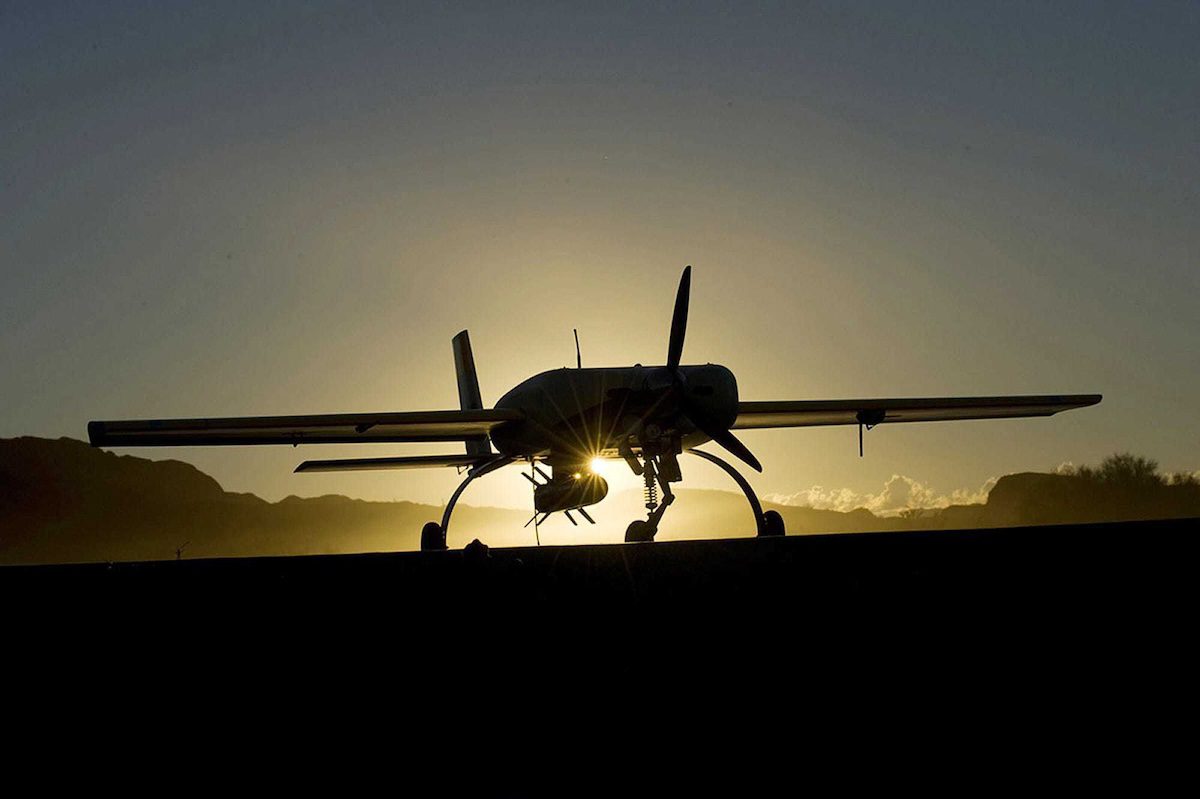
Raytheon is a company that specializes in defense, civil government and cybersecurity. (Provided by Raytheon Missile Systems via Reuters Connect)
More than 500 Tomahawk cruise missiles built at Raytheon’s Tucson plant were fired into Iran in the first 16 days of the war.
Those weapons are worth about $1.9 billion, according to estimates from the Payne Institute for Public Policy. Analysts say replacing them could take at least five years.
Raytheon makes the Tomahawk at its Tucson plant, where it employs 12,500 people, making it the city’s largest private employer. In February, the company reached a framework agreement with the Pentagon to sharply increase production.
But as of late March, no surge had begun because no new funded orders had been placed, according to the Payne Institute.
RELATED: Biggs, Schweikert back Trump on Iran conflict despite past war power stance
Raytheon’s Tucson factory now sits at the center of a larger question: Can the United States manufacture advanced weapons fast enough to sustain a long war?
The data behind that question comes from the Payne Institute, which tracked weapons use during Operation Epic Fury, the U.S.-Israeli attack on Iran that began Feb. 28. Its findings were published March 24 by the Royal United Services Institute, a London-based defense research group.
Of the more than 11,000 weapons the U.S. fired in the first 16 days, 535 were Tomahawk cruise missiles, according to the Payne analysis. At roughly $3.5 million each — a figure cited by the Center for Strategic and International Studies — that totals about $1.87 billion, or about $117 million in Tucson-built missiles per day during the war’s opening weeks.
The Tomahawk is roughly 20 feet long and can launch from ships, submarines or ground platforms. It can strike targets more than 1,000 miles away and fly through heavily defended airspace. Newer versions can change course mid-flight or loiter for hours before striking, according to Raytheon. The missile has been used more than 2,350 times in combat.
Tucson-built Tomahawks were also used in a U.S. strike on Iran in June 2025.
If the U.S. deepens its involvement in the Iran conflict, the challenge will shift from scale to survival of the supply chain.
Raytheon produces about 90 Tomahawks a year, according to defense industry estimates. In February, the company agreed with the Pentagon to increase that to more than 1,000 annually — more than ten times current production. But as of late March, no surge had started because no funded orders had been issued.
Even if production ramps up, Navy budget documents cited by CSIS show it typically takes two to four years from contract award to missile delivery.
The Payne Institute estimates replenishing the Tomahawks fired in the war’s first 16 days alone could take at least five years.
Replacing those weapons may also cost far more than building them did. The Payne Institute estimates the $26 billion worth of munitions fired in the first 16 days could cost more than $50 billion to replace, as wartime demand increases labor, materials and production costs.
RTX Corporation, Raytheon’s parent company, saw its stock surge to an intraday high of $212.82 on March 2, two days after the conflict began, up from $197.63 the day before the attack. As of April 1, it had pulled back to $194.72, according to Yahoo Finance historical data.
The use of Tomahawks in the conflict has also drawn scrutiny.
Video released by Iranian state media and reviewed by USA TODAY appears to show a Tomahawk strike near a girls’ school in the southern city of Minab on Feb. 28, where up to 175 people were reportedly killed, most of them children. The United States is the only country involved in the conflict known to operate Tomahawk missiles. Satellite imagery from Planet Labs confirmed damage to structures in the area.
At a March 4 briefing, Gen. Dan Caine, chairman of the Joint Chiefs of Staff, confirmed that the U.S. carried out strikes in the vicinity. President Trump has blamed Iran for the strike. The Pentagon has not publicly confirmed responsibility. Human rights groups have called for a war crimes investigation.
Production faces another constraint: supply chains.
Tomahawks require specialized components that depend on minerals such as gallium and germanium for guidance systems. China controls much of the global supply and has imposed export controls on both since 2023, according to the Payne Institute.
Expanding production in Tucson would not resolve those upstream constraints. The implications extend beyond Iran.
Mark Cancian, a retired Marine colonel and senior adviser at CSIS, warned in a March 25 analysis that the greater risk is not running out during this war, but weakening deterrence elsewhere.
“The major risk is not that we’re going to run out for this war, but that the inventories are inadequate for a possible conflict with China,” Cancian wrote.
Arizona‘s economy is tied to that outcome. The state’s aerospace and defense industries employ about 62,500 people, according to the Arizona Commerce Authority. At the end of 2025, 67 companies in those sectors were considering expanding or relocating to Arizona. Raytheon ranked as the state’s ninth-largest private employer.
Whether Tucson’s factory receives the orders, funding and materials needed to expand production is now as much a question for Washington as it is for southern Arizona.
The company did not respond to request for comment.
Reporting by Rey Covarrubias Jr., Arizona Republic. The Arizona Republic’s Corina Vanek contributed to this article.
Author


Biggs, Schweikert back Trump on Iran conflict despite past war power stance
WASHINGTON – Reps. Andy Biggs and David Schweikert, who have long argued that presidents lack the power to go to war without congressional approval,...
Watch, boycott, or tune out? Readers react to Trump’s State of the Union
This story was first published in The Copper Courier’s daily newsletter. Sign up here. On Tuesday, President Donald Trump will deliver the first...
How to watch Trump’s 2026 State of the Union speech in Arizona
President Donald Trump is getting ready to deliver the first State of the Union address of his second term. The nationally televised primetime...
Trump nominates a hospitality executive to lead the National Park Service
President Donald Trump has nominated for director of the National Park Service an executive from a hospitality company that holds extensive...