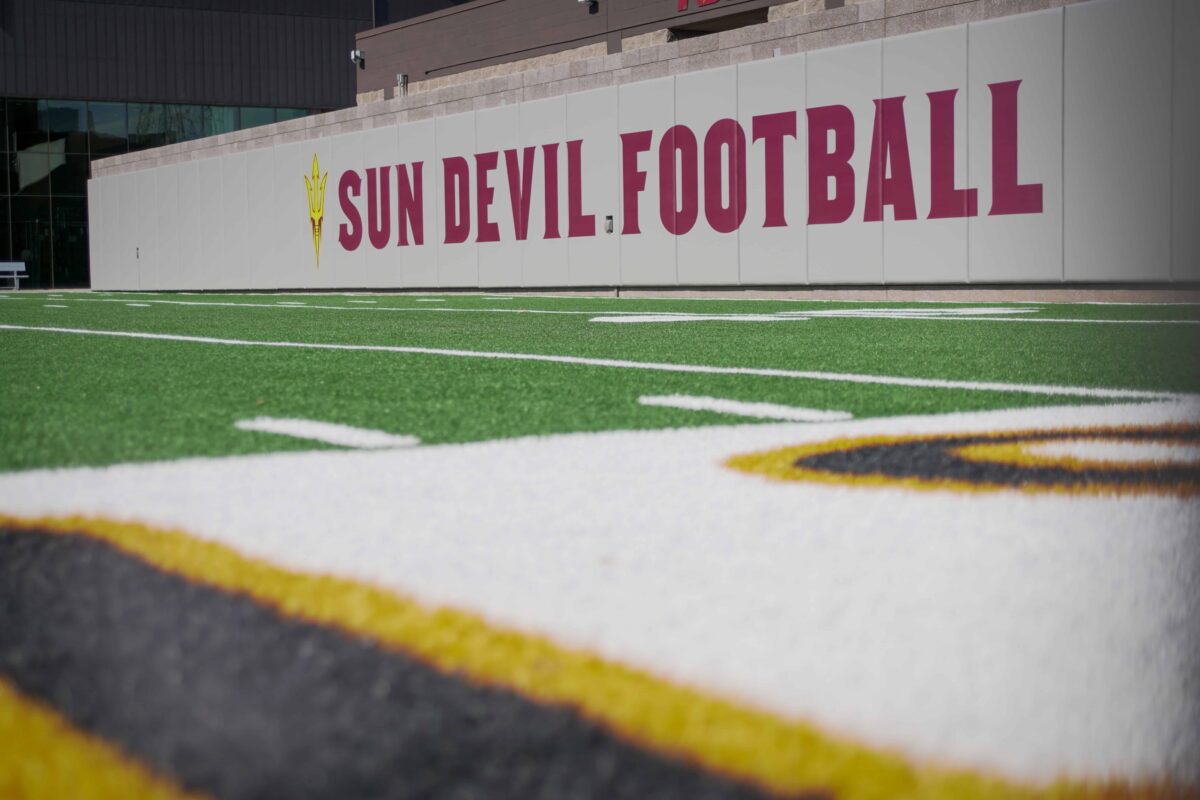
Learn all about the long-held rivalry between the Sun Devils and the Wildcats. (University of College/Shutterstock)
Explore the century-old rivalry between ASU and U of A, from the Territorial Cup to the Phoenix–Tucson divide.
Wildcat versus Sun Devil. Like “Beauty and the Beast,” it’s a tale as old as time, but this story isn’t just a fairy tale. It’s louder, fiercer, and fueled by more than a century of pride, grudges, and desert heat. Dubbed the “Duel of the Desert,” the showdown between Arizona State University and the University of Arizona is one of the most intense and historic in the country.
According to legend (and several reliable sources), the rivalry dates all the way back to 1899, before ASU was even, well, ASU. At the time, it was known as Tempe Normal School (later becoming Arizona State College), while the University of Arizona was still growing and shaping its identity. And while the rivalry burns hot today, it actually began on friendly terms, with a pregame Thanksgiving meal. Afterwards, Tempe’s team went on to defeat U of A 11–2, marking the first Territorial Football League championship and laying the foundation for what would become the annual clash for the Territorial Cup.
For decades, the rivalry remained relatively cordial. But all that changed in the 1950s, when Arizona State College pushed to become a full-fledged university. This change infuriated U of A leaders, who wanted to remain Arizona’s only state university. Regardless, in 1958, ASC officially became ASU, a milestone celebrated across much of the state, but not exactly welcomed in Tucson.
Of course, this rivalry goes far beyond football. It spills into other sports and the enduring divide between the cities of Phoenix and Tucson. But, before we get into the rivalry, here’s a little about each school first.
History of ASU
Arizona State University traces its roots back to 1885, long before ASU was ASU, and even before it was Arizona State College. In fact, the university has experienced many name changes. In the mid-1880s, the Territorial Normal School originally opened its doors to train teachers while also offering instruction in agriculture and the mechanical arts. Over time, it evolved into Arizona State Teachers College, then Arizona State College, and eventually Arizona State University. The school officially became a university in 1958 after a statewide vote.
What began with just 33 students has grown into one of the largest public research universities in the United States. Today, its main campus is in Tempe, but affiliated campuses and buildings stretch across Phoenix and beyond.
History of U of A
The University of Arizona was also founded in 1885. In fact, it was established by the Arizona Territorial Legislature as the first university in what would become the state of Arizona (yes, both ASU and U of A predate the state itself). At the time, residents of Tucson had hoped territorial funding would go toward building a mental hospital. Instead, they received $25,000 to establish a university. At first, no one was willing to donate land for the new school, and Tucson even considered returning the money. That changed when two gamblers and a saloon keeper stepped up and donated 40 acres. With that gift, construction began on Old Main: the university’s first building and still a campus classic today.
Since then, the university has grown into a major public research institution. Today, it serves more than 54,000 students and offers over 150 undergraduate degree programs across a wide range of disciplines.
Territorial Cup
Okay, now that we’ve started down the history pathway, let’s talk about the history behind the iconic Territorial Cup.
We’ll start with an easy one: What is it? Each year, on the Friday or Saturday after Thanksgiving, the two teams face off in what’s easily the biggest game of their season. The winner takes home the historic Cup, which dates back to the first game in 1899.
The matchup between the Arizona Wildcats and the Arizona State Sun Devils has been played nearly 100 times, making it one of the oldest rivalries in college football. In fact, the Territorial Cup itself is widely recognized as the oldest rivalry trophy in college football. To keep things fair, the game rotates between Tempe and Tucson, so the home-field advantage shifts every year.
As of November 2025, the Wildcats are leading the series 52–45.
Other cross-sports rivalries
Football’s Territorial Cup may be the biggest headline rivalry between the Arizona State Sun Devils and the Arizona Wildcats, but the competition doesn’t stop when football season ends. It actually spans the entire athletic year through the Territorial Cup Series, a year-long battle that tracks head-to-head matchups across almost every sport in which both schools compete.
The series officially began in 2009, when both teams decided to extend their long-standing rivalry beyond just football. Today, it spans 22 varsity sports, including both men’s and women’s programs. Each time the teams meet, the winner earns a point. If they split a matchup or tie, each school receives half a point.
At the end of the academic year, the school with the most points takes home a silver trophy featuring its school’s logo, and, of course, statewide bragging rights. As of the most recent completed seasons, the Wildcats hold the overall lead in the series by 10–6.
The capital on wheels
We’re done with the sports, but not quite done with the history lessons. To really understand the roots of the rivalry, we have to rewind to the moving of Arizona’s territorial capital, a saga often nicknamed “the capital on wheels.” Long before Phoenix vs. Tucson became the headline matchup, the competition between Prescott and Tucson was just as intense.
Let’s go back to 1862. At the time, during the American Civil War, the region that would become Arizona was politically and geographically divided. The southern portion aligned with the Confederacy, with its capital in Tucson for a time, while the US federal government established a separate Arizona Territory and later named Prescott its capital.
Prescott remained the recognized territorial capital until 1867, when lawmakers moved it to Tucson, which was more developed and had greater access to supplies and infrastructure. But the move didn’t settle anything for long. In 1877, the capital shifted back to Prescott, which was part of an ongoing tug-of-war between the two cities, each lobbying hard (and dirty) to secure political influence and economic advantage.
Behind the scenes, there was constant maneuvering, persuasion, and plenty of territorial politics shaping where the capital would be.
Then, in 1889, Phoenix entered the chat (well, technically, Phoenix was incorporated in 1881, but essentially ignored until 1889). It was centrally located and rapidly growing, thanks to agriculture, expanding population, and strong railroad connections. Ultimately, Phoenix offered something the others couldn’t: balance and accessibility. After decades of back-and-forth between Prescott and Tucson, legislators were ready for a permanent solution, which Phoenix seemed perfect for.
It became the territorial capital in 1889, and when Arizona officially achieved statehood in 1912, Phoenix remained the capital, where it still is today.
Phoenix vs. Tucson
So why all the drama between Phoenix and Tucson if the original capital showdown was really between Prescott and Tucson? Good question.
Over time, the rivalry naturally shifted to the two biggest and most influential cities in the state. They’ve grown the fastest, they get compared the most, and eventually the conversation turns into the same question every time: Which one is better? The honest answer is—neither. They’re just different.
Phoenix tends to feel bigger, busier, and more urban. Tucson is usually described as more laid-back, a little artsy, and closer to that college-town, small-city feel. Both have great food, incredible desert scenery, and a strong sense of culture and identity, just expressed in different ways.
So yes, there’s definitely a rivalry. But unlike the Territorial Cup, there’s no final score and no real winner. Just two distinct cities, each with its own personality, and each shaping Arizona in its own way.
RELATED: Want to take a boat to ASU football games? Now you can
Author


Want to take a boat to ASU football games? Now you can
TEMPE – Arizona State football fans have a new way to travel to Mountain America Stadium. Water taxi, anyone? The new game day service on Tempe Town...

Diamondbacks to remain at Chase Field for 30 years after approval of renovation bill
PHOENIX (AP) — The Arizona Diamondbacks will remain at Chase Field for the next 30 years after Gov. Katie Hobbs signed a bill appropriating $500...

Native youth shine in Arizona at nation’s largest all-Indigenous basketball tournament
PHOENIX — One thing is for certain, when the Native American Basketball Invitational (NABI) comes to town, there are no shortages of fascinating...

Brittney Griner’s legacy with the Phoenix Mercury lives on through her annual shoe drive
PHOENIX – Even though Brittney Griner no longer wears the Phoenix Mercury uniform, a big part of her personality still lingers in the Valley. The...