Gila Community College’s pilot program helps inmates earn electrical certification, offering a path to stable jobs for smoother reentry.
We’ve all heard the sentiment of “do the crime, pay the time.” What happens when time has been paid, though? Upon release into society, ex-cons are faced with exceptionally high levels of stress. Not only are they entering a world they’ve been locked away from for however long, but they are looking for support, addiction treatment, and most often, meaningful employment.
The recidivism rate in Arizona—or the frequency of ex-cons returning to criminal activity—is roughly 36%. A new pilot program at Gila Community College Pueblo Campus is offering inmates the chance to earn certification in Electrical Fundamentals through an innovative approach.
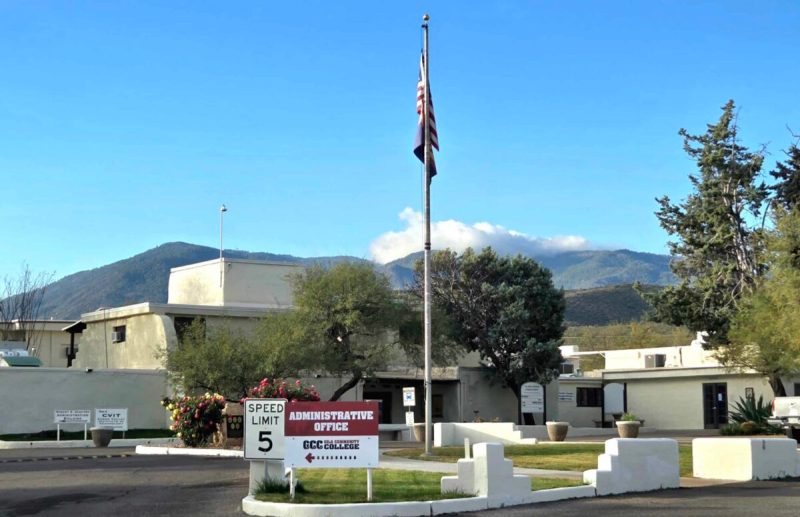
Gila Community College (GCC)
Gila Community College (GCC) serves Gila County through its Payson and Globe campuses. The Globe campus is known as Gila Pueblo, a 22-acre site containing the reconstructed ruins of a 14th-century Salado Indian Pueblo. The source of many major contributions to the study of southwestern prehistory, the camp was acquired by the National Park Service in 1952 before final ownership was ultimately granted to what was then the Gila County Provisional Community College District.
Provisional for decades, GCC contracted with Eastern Arizona College (EAC) to make classes available to the 25,000 or so residents. In July 2025, GCC celebrated a long-awaited milestone when it exchanged the provisional title for accredited, gaining independence and claiming to be the newest community college in the state.
Since then, the board has been tenacious in building the Arizona college beyond original expectations, including creating innovative classes that set the stage for the rest of the state. In the case of the Electrical Fundamentals certification course, GCC may even be setting the stage for the country.
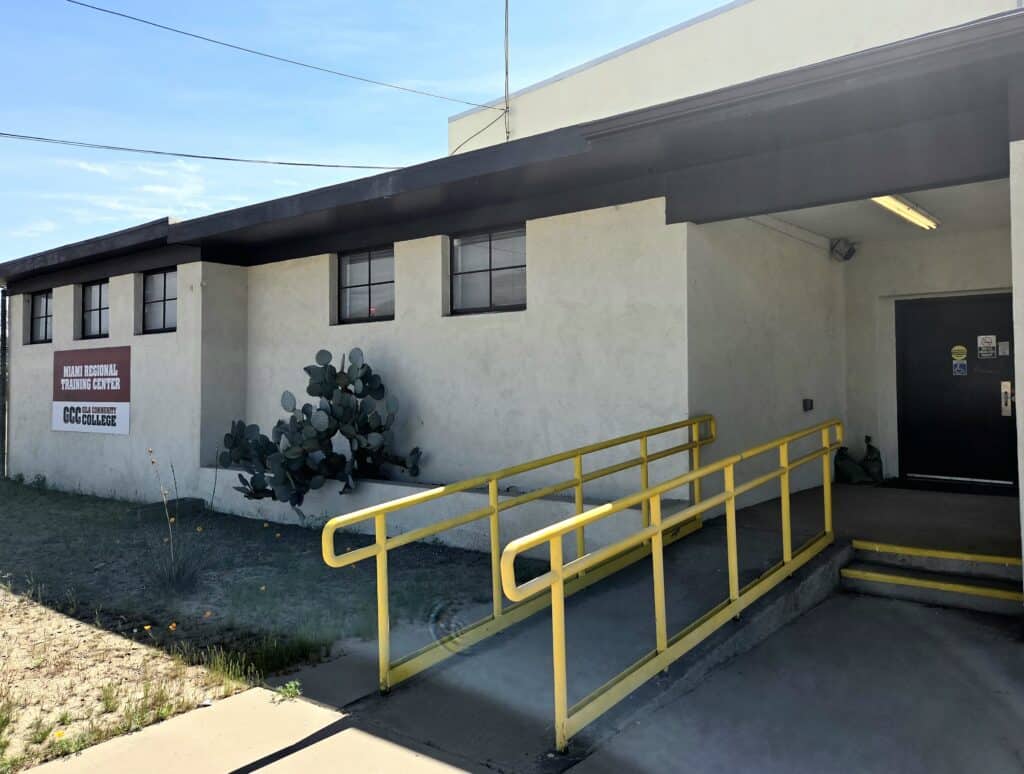
Program criteria
The pilot program for Electrical Fundamentals teaches all the necessary curriculum to help students become certified and ready to enter the workforce as entry-level electrician assistants. The premier students for the course may come as a surprise.
Globe and its surrounding region are home to copper mines, antique stores galore, cultural sites, some of the best burros in the state, and the Arizona Department of Corrections State Prison. The pilot program, earning the certification in Electrical Fundamentals, was launched in February specifically for inmates interested in setting the stage for a meaningful reintegration into society.
Prison labor is utilized throughout the surrounding community in various ways, including cleanup after events, set up of seasonal decor, maintenance and care at the animal control center, and even as the backbone of the town of Miami’s trash services. Only inmates that are nearing the end of their terms—which offsets escape risk—and demonstrate good behavior are eligible to participate in these “paid” labor tasks. (“Paid” reflects that prisoners make up to $1.50/hour as of 2026.)
Prospective inmate students must meet the same criteria, as well as have a history of non-violent crime, with some exceptions. An exception was made for one currently enrolled inmate, whose violent crime was demonstrated and proven to be circumstantial rather than a habitual character trait.
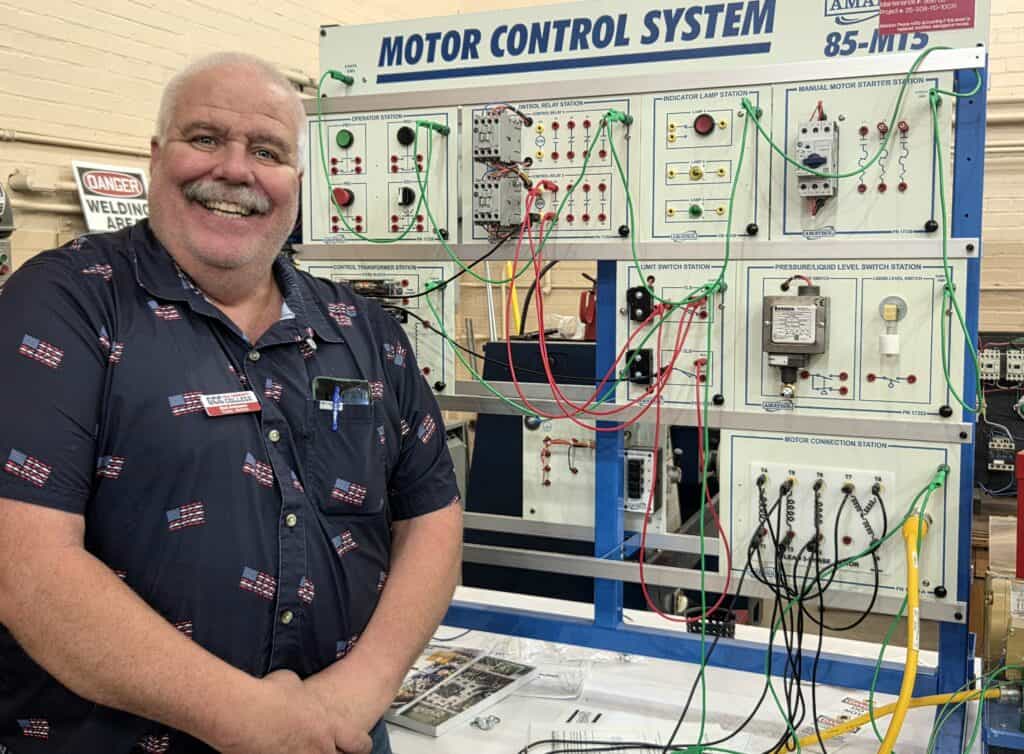
A seasoned mentor
The man leading the class is Mark Andreason—a jovial and experienced teacher with a deeply impressive history in the industry. His electrifying journey began in Utah with Local 354 of the International Brotherhood of Electrical Workers. After his time there, he traveled across the country exploring the profession in California, Idaho, Oregon, Washington, Wyoming, and finally, Arizona. Before settling in State 48, he worked on the Aegis Ballistic Missile Defense System in Poland. He also spent time with one of the world’s most sophisticated radar systems at Kwajalein Atoll in the Marshall Islands.
Leading up to his role at GCC, he taught at EAC for seven years, earning him credibility not only in the electric industry but as an accomplished educator, as well. He arrived well prepared for the class, to say the least.
Andreason was officially hired by GCC on Jan. 2, 2026, and the pilot program began on Feb. 23. 17 inmates—including five who transferred from prisons across the nation specifically to participate—eagerly entered the program. The course, which leads to the certification necessary to do entry-level electrical work across the state, is 15 weeks long and hands-on. Andreason joyfully shared, “This program is unique in that it is the only program where the prison allows inmates to venture from the prison to a classroom for the classes.”
The classroom
While other trade classes for inmates nationwide have specific schools onsite at the prison for inmates to learn skills, this one uses a regular classroom not associated with the penitentiary, where the inmates are brought with only one guard present. The men—currently only men are enrolled—are treated and taught like any other student. The caveat is that classes are taught separately from civilian students, timed specifically to avoid overlap.
The classroom is a warehouse separate from the campus that is used for various field training courses. The room is set up for electrical learning with control panels, conveyors, pumps, switches, and the like. Andreason also has repurposed wood on hand to build faux walls for students to practice running lines properly—real experience that translates into practical application.
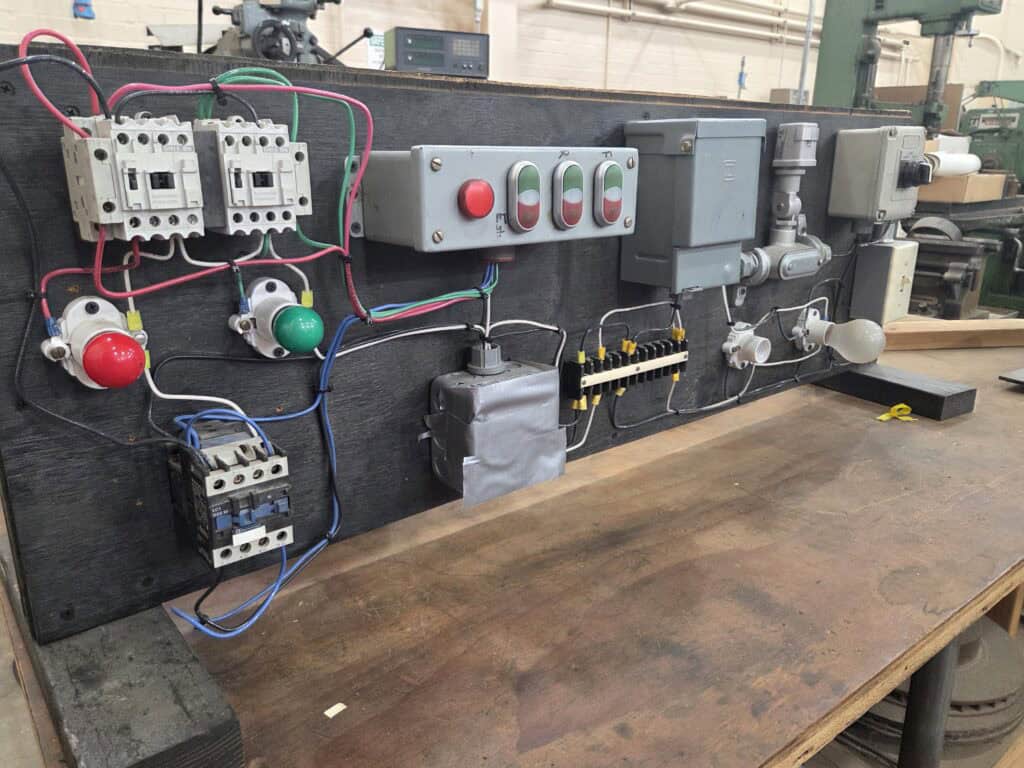
Skill building and testing
Once they learn the fundamentals, students are tested by fate. A literal roll of the dice will determine the test, creating an equal sense of surprise for each student. With five fundamentals, numbers one through five represent a certain task, whereas number six is a “choose your own” kind of test. “It’s hard to watch them fail,” Andreason said of his philosophy of both teaching and fatherhood. “Letting them get it wrong and fail gives them an experience to learn from.”
In a recent update from Andreason, he shared that although the course won’t be completed until the final day of June, “to this point everyone is doing great in the course, and I expect that every one of them is going to get the certificate.” He elaborated on their progress by sharing one of the more memorable lessons in the course so far.
“I have this one lab where the students make ‘Improvised Resistive Devices’ out of a resistive material. [They] check the properties with a meter as we run electrical current through the [resistive material] and measure the current and voltage and [then] calculate the watts of heat that the material is consuming. The resistors are actually hot dogs that we put a spike in each end and run electrical current through.”
Those specialized hot pads are actually hot dog buns, so once the experiment is complete and the hot dogs are thoroughly heated up with the resistors, the students get to eat! Andreason added, “This is an even more special treat than normal since the inmates don’t usually have great outside food where they live.”
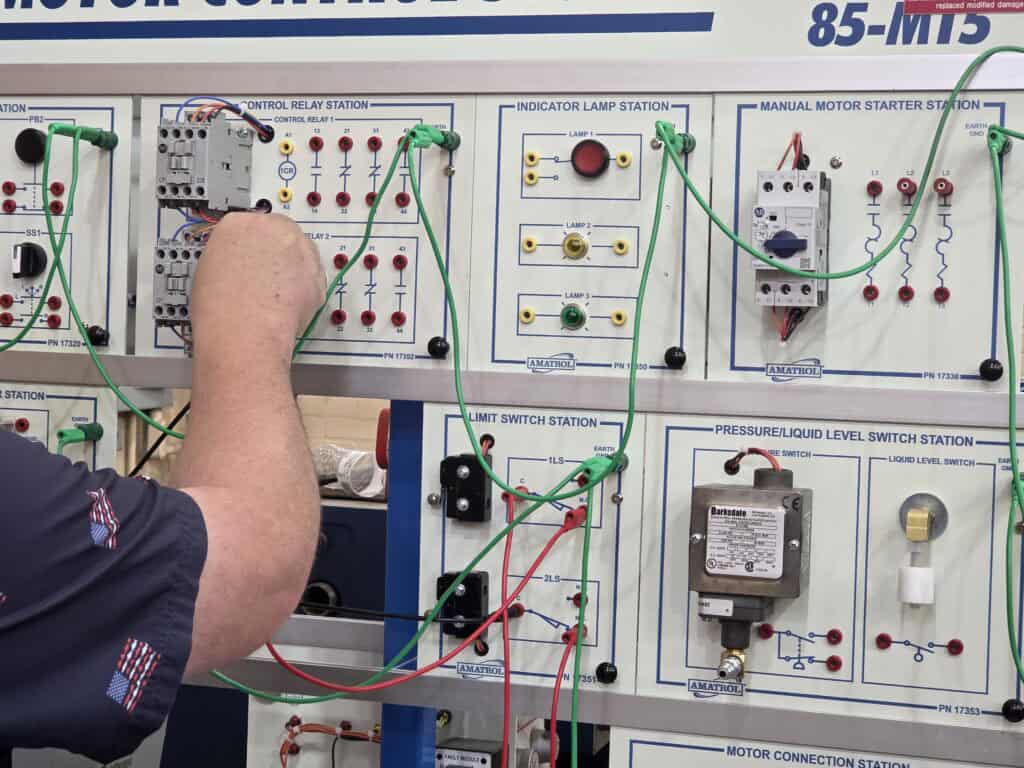
Hope for the future
The certification course is meant to give prisoners the chance to enter back into society with the prospect of a well paying job. “I want them to be able to get a career so they don’t go back to crime,” explained Mark Andreason before diving into one of the driving factors behind the innovative approach to rehabilitation.
One of his favorite books, “Les Misérables,” follows the life of an ex-con who does all that he can to get a fair chance. A cop follows him closely, waiting for him to slip up, until one day the cop dramatically realizes that the ex-con was never truly the bad guy. Andreason isn’t giving the same pass to his inmate students, who he notes “know what they did was bad.” He simply wants them to have an opportunity.
He shared this motivation playfully with his students through a simplified—yet true—statement. “I need you to get the certificate so you can get a good paying job and pay lots of taxes to pay my salary.”
Each grade is earned through proper demonstration of the lessons, and after successful completion of the course, students have all they need for entry level electrical work in Arizona.
This opens the doors for inmates to land gainful employment via HUD housing contracts, construction builds, and eventually even as private electricians. The strict standards to enter the class—contigent on type of crime—align with the standards required for licensure and insurance necessary to become an independent electrical contractor within Arizona.
Some critical voices point towards the environment being a factor for recidivism, though multiple studies point towards chronic stress as the number one reason ex-cons reoffend. Having a decently paying job to fall back on is one way to mitigate that stress, paving the way for a stronger case of rehabilitation.
Certified electricians in the state make an average of $30.40 to $48.55 hourly, a far leap from the average $19 to $21 hourly wage of a fast food worker, an industry famously known for having “felon friendly” employment practices. The higher wage may create enough support for an ex-con to utilize their second chance correctly, much like the protagonist in “Les Misérables.”
Classes for civilian students in pursuit of an Associates or certificate in electricity opened in April, but if successful, this pilot program that welcomes inmates may pave the way for how classes—and more specifically, rehabilitation—is approached nationwide. The process itself allow inmates the chance to access the outside world with a civilian teacher, real circumstances, and a classroom that leads many to the freedom of a good career. Not to mention, the occasional hot dog.
For these students, the classroom is more than a place to learn a trade—it’s a place to reconnect with possibility. Each lesson, each success, and even each failure becomes part of a larger effort to build something new—not just circuits, but a future.
Andreason reflected, “When your life is made better, it magnifies everyone around you.”