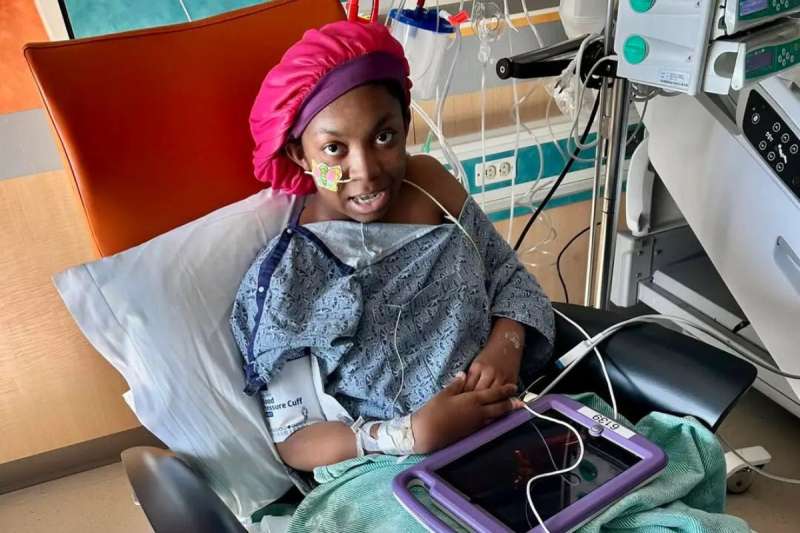
PHOENIX – The 17-year-old patient, clad in a light blue, patterned hospital gown and her pink and purple bonnet, sat in a hospital chair attached to wires and tubes, a butterfly sticker affixed to her face to connect one tube to her nose.
On Nov. 5, following two visits to the emergency room, medical professionals at Phoenix Children’s Hospital diagnosed the teenager, Aaliyah James, with hemolytic uremic syndrome resulting from the Shiga toxin, which originated from certain strains of E. coli, according to her mother, Tykeshia Thompson.
James underwent three blood transfusions and six rounds of dialysis, all because she visited the Arizona State Fair, according to Parker’s Promise, a nonprofit organization meant to support and “represent those affected by environmental pathogenic illness.”
MORE: Arizona families in limbo after sharp rise in disability spending strains state budget
On Thursday morning, James was discharged from the hospital after her condition improved. Thompson said that her daughter’s kidneys are still not functioning properly, but her creatinine levels are dropping, so doctors said it was safe to send her home.
“It’s not over,” Thompson said. “It’s going to take a minute for her body to actually get back to normal. It’s still an ongoing thing.”
Thompson credits support and prayers from family to get through the harrowing ordeal.
“She cried. She had to be sedated. She had to be held down for her IVs. She had to be held down for her feeding tube,” Thompson said of her daughter’s stay in the hospital. “It was very distressing on her. She’s getting tortured basically. I know they’re helping her, but in her mind that’s what it felt like.”
Mary McGonigle-Martin, vice president of Parker’s Promise, said the organization reached out to the family of another patient, a 16-year-old, who also fell ill not long after visiting the Arizona State Fair on Oct. 26.
McGonigle-Martin said that James is part of an outbreak that has affected nearly 200 people that Parker’s Promise has heard about so far.
“They were at the state fair,” McGonigle-Martin said, referring to the family of Aaliyah James. “So something is happening at the state fair.”
McGonigle-Martin had her own experience with hemolytic uremic syndrome when her young son was afflicted with the toxin in 2006.
“My son spent 56 days in the hospital, he was on a ventilator for nine days, he had acute pancreatitis, along with his kidneys, he had seizures,” McGonigle-Martin said. “It’s hard to believe by going and petting animals at a petting zoo, that could happen, and it does – every single year.”
The Arizona State Fair, which ran from Sept. 19 to Oct. 26 at the fairgrounds in Phoenix, sent a contact to Cronkite News on Tuesday, but failed to respond to multiple inquiries.
Who is this affecting?
Shortly after she was admitted to the ICU, one of the doctors at the Phoenix Children’s Hospital Arrowhead Campus in Glendale asked Thompson if she and her daughter had attended the Arizona State Fair. When Thompson confirmed that they had, the doctor told her she would receive a call from Maricopa County health officials.
James was not the first case they had seen, Thompson said.
“One of the ICU doctors actually told me a bunch of kiddos contracted the same exact strand as her,” Thompson said. “And they all went to the fair.”
In late October, multiple teenagers and children began appearing at emergency rooms around the state with severe symptoms that included bloody diarrhea, abdominal cramps and vomiting. Doctors determined the children had been getting sick from a toxin called Shiga.
The Shiga toxin originates from certain strains of E. coli affected by the Shigella dysenteriae bacteriophage, a virus that infects and alters the genome of bacteria to replicate.
When an affected strain, known as a Shiga toxin-producing Escherichia coli, also known as STEC, dies off, the Shiga toxin is released into the host’s body.
According to a 2023 study, Shiga toxin is responsible for 90% to 95% of hemolytic uremic syndrome cases, as seen in James.. Hemolytic uremic syndrome damages blood vessels in the kidneys, destroying red blood cells and threatening the kidneys and other organs, according to the Mayo Clinic’s website.
The “Maricopa County Department of Public Health, along with the Arizona Department of Health Services, is investigating a statewide increase in E. coli cases relative to historical trends during the month of October,” according to Courtney Kreuzwiesner, the preparedness communications supervisor at the Public Health office of Maricopa County, in a statement to Cronkite News.
On Nov. 13, the Arizona Department of Health Services alerted health care providers across the state to be wary. Kreuzwiesner said an investigation into E. coli is ongoing.
“ADHS issued a Healthcare Advisory related to a two-fold increase of E. coli,” said Juan Pablo Martin, ADHS media director, in a statement to Cronkite News. “There has also been an increase in hospitalizations involving (HUS).”
Two cases from Oct. 26
According to Parker’s Promise, the pair aren’t alone; the nonprofit has received reports of 186 cases as of Tuesday.
“There is an outbreak of STEC from the AZ State Fair and many children are hospitalized – we have heard of at least 186 cases,” according to a Facebook post by Parker’s Promise.
The Facebook post features two of 186 cases the organization said originated from the state fair. James first went to the emergency room on Halloween, and she was sent home. She returned to the ER the next day. On Nov. 2, she was transported to Phoenix Children’s Hospital. She had her third blood transfusion on Nov. 14 and a sixth round of dialysis on Nov. 15.
Another Facebook post said the 16-year-old was hospitalized for four days at Phoenix Children’s Hospital in November. She had a much shorter stint in the hospital than James.
Health officials are investigating a ‘historical trend’
The correlation between the Arizona State Fair and an E. coli outbreak is under investigation; however, as of Wednesday, the Maricopa County Environmental Services Department hasn’t received confirmation that the two instances are linked to each other or the state fair, according to MaFernanda Pacheco, a communications officer for the department.
Although E. coli is found in people’s colons, the Shiga toxin is primarily native to cows, sheep and pigs, and contact with them can lead to harm, according to Dr. Jonathan Blum, an infectious disease doctor in Santa Clara.
“The amount of bacteria that are needed to cause an infection in a human with this particular strain is exceptionally small,” Blum said Thursday. “Even a really microscopic amount of bacteria can cause an infection.”
Blum advises people who visit petting zoos to properly sanitize by washing their hands and avoid touching their faces or mouths, and be especially careful of small children or those who don’t have the capacity to “manage hand hygiene.”
“Contact with animals does not require actually touching the animal. Contact with contaminated surfaces can also spread this infection,” Blum said. “Because the infectious dose is so small, very small amounts of fecal contamination on surfaces can lead to infection. When you were a kid, your parents probably told you to wash your hands before dinner. They were right.”
The Arizona State Fair advertised the access children have when they attend the petting zoo, according to the fair’s website. “Get up close and personal with furry and fuzzy friends. Snap a selfie with a sheep.”
Phoenix Children’s Hospital media relations specialist Grace Culqui said they cannot confirm any cases of STEC at their hospital.
“In the interest of patient privacy, we’re not able to release specific patient census data,” Culqui said in an email. “I believe your questions are better suited for the county health department.”
Keily Henriquez contributed to this story. For more stories from Cronkite News, visit cronkitenews.azpbs.org.
This article first appeared on Cronkite News and is republished here under a Creative Commons Attribution-NoDerivatives 4.0 International License.