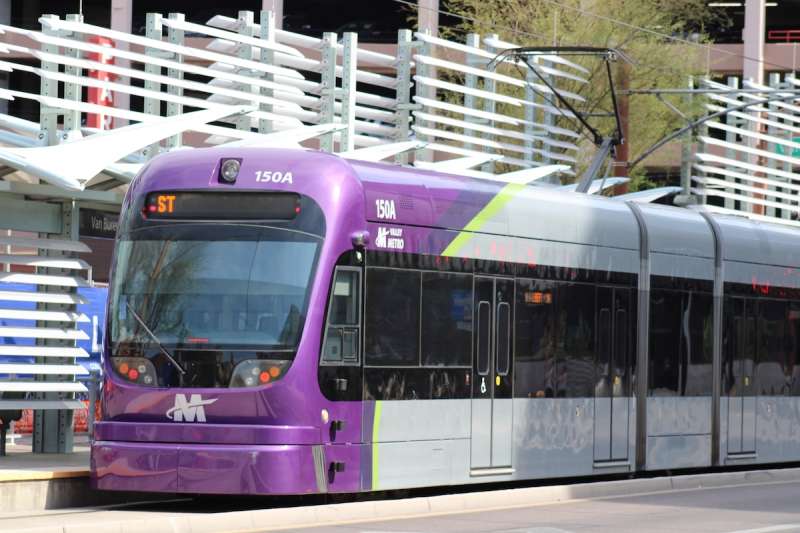
In June 2025, the Phoenix area’s Valley Metro light rail debuted its first expansion into South Phoenix, a 5.5-mile extension starting downtown and stretching as far south as Baseline Road.
While the project was a victory for advocates of reformed urban planning, it failed to form into a trend of material victories. Just seven months later, it was followed by a notable setback when a proposal to stretch the light rail to Arizona’s Capitol died in the hands of Phoenix’s municipal government.
This was the latest in a series of failures to follow through on the goals set forth by Proposition 104, or the T2050 project, a 35-year plan for public transportation Phoenicians voted to fund in 2015.
MORE: How this downtown Phoenix resident lives car-free
Prop 104 called for creating four new light rail extensions across Phoenix totalling over 40 miles, in addition to greatly expanding sidewalks and bus rapid transit.
Although taxpayers have now paid for T2050 for over a decade, only one of the approved light rail expansions and fractions of the approved bus and sidewalk expansions have been fully implemented. The Capitol extension’s cancellation marked a major blow to the proposal’s progress.
Despite this, efforts to expand the light rail and realize more of T2050 are far from dead. To alleviate frustrations caused by the Capitol extension’s cancellation, Phoenix City Council and Mayor Kate Gallego approved the creation of a third light rail line extending into the West Valley.
Running through under-resourced communities like Maryvale and Alhambra, the proposed expansion could hold massive implications for neighborhoods that disproportionately rely on public transit. The project is currently in the community outreach phase, with the city hosting frequent open houses to hear input from its constituents in the area.
However, despite edging closer to reality, the plan still faces many obstacles on its long road to being fully realized.
The West Valley
Phoenix City Councilwoman Anna Hernandez was a supporter of the Capitol extension (also called CAPEX). Now, her attention is turned to the West Valley, where she hopes a light rail expansion will help foster socioeconomic development.
“We have so many residents that rely on public transportation options in the West Valley,” Hernandez said. “In areas like Maryvale, the numbers show that this has been a need for a very long time. It’s working-class neighborhoods, working-class families that live out here on the West side who really could benefit from having more public transit options.”
Nicole Sanderson, vice president of advocacy group Urban Phoenix Project (UPP), said greater public transit access often leads to increased economic equality.
“We want the same positive effect with a transportation system that connects to the West Valley, so that folks have a reliable means of transportation to our biggest job center in downtown Phoenix,” Sanderson said. “The West Valley has been disinvested in historically, has not received as much of the city’s investment funds for things like mobility, alternatives to car travel, and street safety.”
Maryvale has an unemployment rate of 6.6%—almost 2% higher than the Phoenix metropolitan area as a whole. “Having more public transit options opens [West Valley residents] up for way more job opportunities, because it means there’s a reliable mode of transportation,” Hernandez said.
Phoenix City Council candidate Ed Hermes, a frequenter of the light rail, said he uses it so his family does not need to buy a second car. Hermes said the extension would help him in his everyday life.
“I go to Maryvale a lot for meetings, and it’s a challenge to get to Maryvale from Central Phoenix on public transit,” he said. “It’s impossible to bike there, the sidewalks just disappear, certainly the bike lanes disappear.”
For Hermes, the issue is deeply personal. “Most of my adult life I have not been able to afford a car—didn’t have the credit to buy one, couldn’t afford it even if I could,” he said. “The few instances I could have a car, it was old and it broke down a lot. What I observed is that working families are paying way more money for transportation than people who are wealthier, because of unexpected breakdowns, higher car payments, and interest rates.”
The cost of owning and maintaining a car has increased dramatically in the 2020s. The average price of a used car nationwide is now more than $27,000. Gas in Arizona is roughly $4.74 a gallon, almost fifty cents above the national average. Car-related debt is also an issue in Phoenix, with 45% of residents having auto debt and the average borrower owing roughly $14,000.
“If we could just give people an option to get around the city and to get to work without having to pay $1,000 every month for a car payment plus insurance, it could really help lift people up out of poverty,” Hermes said.
UPP President Steven Elisala said the West Valley’s dangerous roads also make varied public transit options more important. According to the Maricopa Association of Governments, nine of the 10 Phoenix intersections with the most car crashes from 2018 to 2022 are in west Phoenix.
Roadblocks
Although its advocates see benefit in a West Valley light rail line, the circumstances under which the project was approved has left them with concerns.
“In an effort to assuage the frustration of the public upon cancelling the Capitol extension project, the council maybe jumped the gun a little bit by selecting the route,” Sanderson said. “That was a mistake, and it put the city in a worse position in terms of being able to accommodate for the real worries and concerns of the affected parties.”
As the West Valley extension moves along, some local business owners have been vocal in expressing concerns about how construction near their establishments could affect traffic. In an ABC 15 article, veterinarian and pet hospital owner Suzanne Johnson said she feared the extension could put her out of business.
“Small businesses are gold for the city,” Sanderson said “Every dollar spent at a small business, a bigger percentage of it circulates locally and benefits us locally compared to a dollar spent at a national chain. That deserves care and caution around the impacts.”
Hernandez said the city of Phoenix should be willing to offer financial assistance to help small businesses through the construction period. Sanderson suggested the city implement alternative access routes to buildings and grant businesses additional land use rights so they can more freely explore methods of supplementing lost income.
“Their concerns are valid and their concerns are important,” Hernandez said of local business owners. “I want to see them voice those concerns so we can answer as many of those questions as possible before we even begin construction.”
Sanderson said Phoenix did not do enough community outreach before announcing its plans for a West Valley line. Because of how much the city still needs to do before even breaking ground on the extension, it will likely not be open for service until the 2030s.
Hernandez also expressed uncertainty about the project’s funding, which has not yet been secured and relies partly on support from the Trump administration.
“We are really reliant on funds from the Federal Transit Administration when it comes to light rail extensions,” she said. “Phoenix does have the Phoenix T2050 Plan, which is a sales tax where all our residents contribute to a public transportation fund. However, those funds will not cover a project in its entirety.”
Hernandez said she doubts the Trump administration will agree to fund the project. Given the timeline for its completion is already being pushed into the next decade, however, she said she hopes the next presidential administration will be more willing to agree to funding.
In addition, CAPEX’s cancellation was a reminder to Elisala that any light rail expansion project can be abandoned at any point. “Everything comes down to the mayor and council being a big question mark,” he said. “They may want this, but what happens two years from now? What happens five years from now, when there’s a completely different mayor and council?”
CAPEX
Even with their attention now shifted to the West Valley extension, the loss of CAPEX still stings for many urban reform advocates in Phoenix.
“[The West Valley extension] still won’t happen for another decade, whereas CAPEX would have been done by the end of the decade,” Elisala said. “Now they have to start all over again. With CAPEX they had already done years and years of community feedback and hearings.”
Hernandez shared this disappointment. “It was really frustrating because we had a plan, we had a schedule of how we were going to do it,” she said. “It’s my constituency around the Capitol extension, and seeing them so disappointed and not being able for us as a city to keep our plan to them is the most defeating part.”
Phoenix CIty Council voted to abandon CAPEX on Jan. 27, blaming threats made by the Republican state Legislature to interfere with the project. “They were making threats, but none of them were threats that they could follow up on,” Elisala said. “It was a piss-poor excuse by mayor and council.”
Hernandez also expressed confusion and frustration toward her peers on the City Council’s decision to back down. “The fear of the state Legislature was a really unfounded reason for some of my colleagues to not continue with the Capitol extension when the governor’s office was supportive and provided an opinion that we shouldn’t worry about this,” she said.
Despite setbacks and uncertainties following the cancellation of CAPEX, Sanderson said UPP will remain committed to fighting for a West Valley light rail extension to be completed as quickly as possible.
“Rail can provide fast commuting with a lot of people while being really space efficient and really safe,” she said. “It might have a high up-front investment cost, but the payoff is enormous for quality of life and cost-effectiveness for our residents to get around.”
Sanderson also said Phoenix can work to increase the light rail’s speed and efficiency by giving it traffic light priority, a change Hermes said could reduce the B Line’s trip from Baseline Road to Metro Parkway by 20 minutes or more.
Hermes reminisced on the light rail’s importance in his life when explaining what its expansion means to him. “When I started at ASU in 2002, I couldn’t afford a car,” he said. “I remember advocating for the light rail’s creation back then, and when it was first rolled onto the tracks in late 2008, I stood in line, like it was a new iPhone or something, to be first person on the light rail.”
Hermes said he’s now excited to teach his children how to use the light rail, and hopes it can soon become more accessible for more people in the West Valley.
“What people in West Phoenix deserve is a public transit system that makes driving optional,” he said.