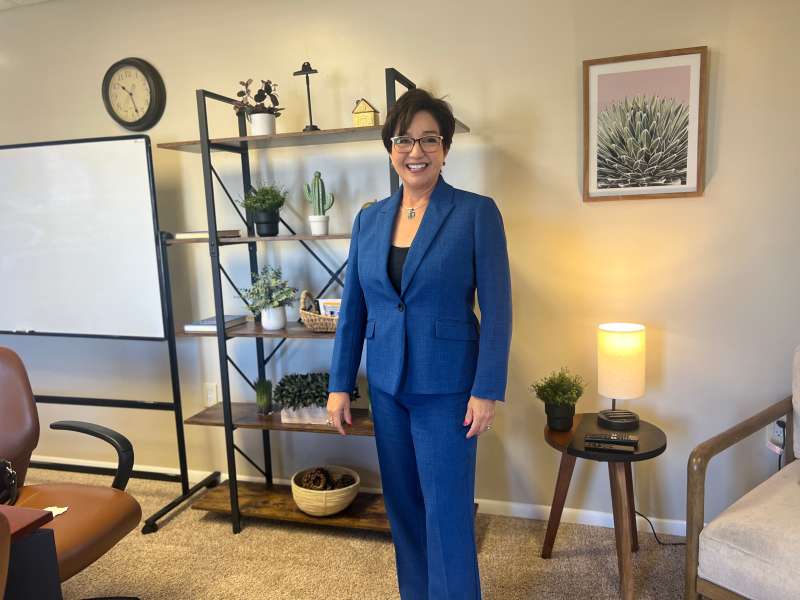
Teresa Leyba Ruiz will be the next Arizona Superintendent of Public Instruction. She defeated Arizona State Treasurer Kimberly Yee in the 2026 election.
Ruiz and Yee were running to replace current Arizona Superintendent Tom Horne, who took office in 2022.
The Associated Press called the race for Ruiz on Nov. 5. As of Nov. 12, Ruiz’s lead over Yee sat at about 6.5%.
The Copper Courier sat down with the superintendent-elect to discuss her thoughts on the universal voucher program, campaign promises, improving teacher retention, and her former opponent, who has yet to concede publicly.
The following is a transcript of our conversation with Ruiz:
Note: This interview has been edited for length and clarity
Setting up a new administration and day one changes
CC: How much turnover do you expect there to be? Are you planning on keeping a lot of people from Horne’s office?
TLR: I think the people that Superintendent Horne brought in, his high-level individuals, we’ll most likely replace. But at the same time, there’s institutional knowledge there. So we would like to open the door and invite those individuals to apply for the positions and submit their resumes as well. Because you can’t just start fresh when there’s institutional knowledge, and we want to build on that.
CC: If the entire office has turnover, there’s probably going to be a learning period where you aren’t going to be getting as much as you want done, right?
TLR: And there’s so much that needs to get done, so we really want to make sure that we have the experts in place, that we’re all moving in the same direction, and that we’re ready to hit the ground running.
CC: How do you plan on supporting dual language programs in classrooms? I know Horne’s department challenged some of them. Is that something you’re interested in reversing on day one, or what changes could be made?
TLR: So my understanding is he’s lost every lawsuit when he’s suing our schools, which is outrageous. A Superintendent of Public Instruction would sue a public school. So we’re not going to do any lawsuits.
We’re going to end those. And our experiences around Arizona as we’ve been privileged to visit dual language schools—they’re robust, important programs, and I see this role as supporting those schools.
CC: Is there any room for where a lawsuit against a school would make sense? A lot of Horne’s [lawsuits] were ideological or political. But is there any room for lawsuits against schools if they’re doing something that’s outside the scope of what they should be doing?
TLR: Well, that really feels like that’s the last step, right? There should be a lot of conversations, a lot of understanding, a lot of guidance. If there’s something outside of the law, let’s come back in line. Having a lawsuit against a school district seems so extreme and a last-resort measure.
CC: The Empower Hotline, what are your plans for that?
TLR: That’s coming down day one. That, otherwise known as the teacher snitch line. I have met educators who have left this noble profession because of that line. In a time when we need to be welcoming educators in, we do not need to have this hotline which serves zero purpose. The calls that come in, you know, very few items have been actionable.
There are other ways to get a complaint to the Department of Education. This is just one more tactic to vilify our educators.
Teacher retention and supporting educators
CC: What can the department do to keep teachers?
TLR: The focus is really going to be on, you know, nobody wants to be last in the nation in per-pupil spending. So this is really an opportunity to find the resources to elevate Arizona’s education system.
But outside of that, [we can] work with our universities. They have some really strong education models, professional development models. I think there’s opportunities to collaborate with the universities and nonprofit organizations. Let’s make sure that our teachers are receiving the training that they need so that our students can learn and be challenged.
CC: What partnerships exist right now that you’d like to strengthen? Or are there things that don’t exist that you’d like to do between the state and the universities for something like teacher retention or training?
TLR: It’s interesting you say that because just yesterday I had a conversation with Daniela Robles, who is executive director for [Northern Arizona University’s] K12 Center, and she mentioned opportunities for additional professional development.
I’m sure Arizona State University has similar programs. I don’t know if those relationships exist right now.
But my perspective will always be that the way to accomplish good work is through collaboration. So let’s find where the resources are. Let’s collaborate so that we can support our educators who can support our students.
CC: Do you know what the numbers are for teachers who are educated here but leave the state?
TLR: That’s a good question. I think what I find really interesting is teachers who come from another state to Arizona and are shocked at how low their salary is.
And on the other side, I’ve talked to teachers who have left Arizona for another state and are shocked at how much higher their salaries are outside of Arizona.
At the same time, there are teachers along our borders with California as an example, who live in Arizona but who teach in California.
They’re willing to sacrifice time away from their families because that’s an hour commute in the morning and in the afternoon. They’re willing to make that sacrifice because they’re supporting their families.
Arizona is losing talented educators because of that. It’s an issue. We must find ways to pay our teachers the salaries that they deserve and keep our talent here.
The Empowerment Scholarship Account (ESA) program
CC: You’re not in a position to pass or introduce legislation, but state lawmakers and leadership, being educators, might look to you for advice and collaboration on bills.
Would you support a full abolition of the ESA program? If not, what do you think is the best way for this program to continue?
TLR: I don’t know if the legislators will bring up a complete abolition of the ESA program.
I think in talking with them, they’re concerned about some common sense guardrails and making sure that public dollars are actually being spent on educational needs.
So I think that I will always focus on our students and their learning and our educators. Are educators well-supported? I don’t want our educators to have to spend their own hard-earned money for basic classroom supplies.
It would be wonderful to have it where our parents aren’t given a long list of supplies that they need to buy for the first day as well. Can we just fund public education? Can we focus on that?
The ESAs is a whole other issue that is multilayered and complex. I want to make sure our students are learning. I want to make sure our students are safe.
CC: It seems like people who were for regulating [ESAs] settled on Prop 212.
It was viewed as a sort-of compromise. Do you think that compromise is the way to go? Or do you think there should be a path to getting rid of [ESAs] except for its original intended purpose, which was for students with disabilities or people who couldn’t get everything they needed from a public school?
TLR: Well that’s part of the complication, right? The ESAs were created for children with special needs. I’m thankful that the children with special needs are getting the resources. [The problem was] when it was expanded to universal against the will of the voters. Remember 2018 Arizona voters voted it down 2 to 1. And in 2022, against the will of the voters, legislators pushed it through, and it was signed into law by [former] Gov. Doug Ducey.
That’s where the complications begin, and I think that’s worthy of a bigger conversation, not to take anything away from our children with special needs.
So how can my office provide some guidance and understanding by looking at the data?
I think that’s important. That’s why we want to have a transparency portal, so that Arizonans will know where our hard-earned taxpayer dollars are being used. And then let’s allow that to help guide a conversation in the legislation process.
READ MORE: ‘Turning Point killed the party’” Arizona Republicans blame Kirk’s group after massive losses
CC: I know 12News had reached out to the superintendent’s office a lot [about ESA spending], and Horne kind of stonewalled them. Is the information that they’ve been requesting something you intend to get over to them?
TLR: If it’s public records, then we need to honor that request. Remember Tom Horne also lost his lawsuit, so there’s an outstanding bill to 12News actually, to pay for lawyer fees. So we’ll have to pay that bill.
CC: Since Prop 212 didn’t get on the ballot, do you think that maybe there was some ill will against the state for not even giving them the opportunity to vote on vouchers and that carried over into your race?
TLR: I’m not sure if they connected that necessarily. But what I’ll tell you is we travel Arizona. People are really angry when you hear these investigative reports come out and [we’re] paying for vacations and luxury items. People are angry when they’re having a hard time putting gas in their cars and food on their table, but taxpayer dollars are being spent on these non-educational expenses.
They’re not happy about that, and so I believe that was the driving force. There’s been several surveys that have shown Arizonans do not appreciate and they’re not supportive of the expanded universal ESAs.
CC: It’s interesting that it has such a partisan divide in Arizona, it seems like.
TLR: I don’t think it’s partisan at all. I’ve talked to Arizonans across the board. Arizonans regardless of political affiliation, and they are not happy with the universal ESAs. And this is also supported by survey data: Education Forward Arizona did a survey, as well as the Arizona Education Association.
CC: I was looking at the election results over in Texas, and it seems like one of the reasons the Democrat got elected governor was because she was against vouchers. In Texas, they only have one or two schools in these rural towns.
TLR: Yeah, and we’re seeing that in Arizona as well. In Arizona, public schools are the hub for that community. There are no charter schools. There are no private schools. It’s the public school that is the heartbeat of the community. So yes, they’re angry as well.
CC: You invited the treasurer to join an ESA accountability team. Has she responded to you? What would that role involve, and has she called you to concede?
TLR: She has not responded to our offer of joining the team. The offer still stands. Remember, she is the architect of the ESA programs. Who better to help regulate it than somebody who helped create it?
And she has not called to concede the race? As far as I know, she might still think the race is running?
CC: How is the third-party audit of ESAs going to happen?
TLR: It needs to happen. First of all, we need to have a full third-party audit, whether that’s through the Auditor General’s office or through another organization, a trusted organization.
I think what’s really telling is that outside of some investigative reporting that got a snapshot, a piece, of the data, no one has seen the full data set. Arizonans deserve to know how our hard-earned taxpayer resources have been spent.
Technology and AI in the classroom
CC: Will your department issue guidance on AI use in classrooms?
TLR: Yes, absolutely. AI is a big topic, and the Arizona Department of Education should be serving as a hub, providing best practices and guidelines, helping districts as well.
I imagine having an open conversation where we bring in some experts. And let’s write these guidelines together and then help our districts implement them.
CC: Do you have any stance [on AI] at the moment or are you waiting for experts to come in?
TLR: Well what I know is teachers are using it in all different ways across Arizona right? [It’s] helping write lesson plans, helping do different things, and sometimes even more importantly in the classroom helping students with different learning levels.
But it would be nice to have some guidance. How do we help our students also use artificial intelligence? Not in the younger grades of course, but as the students get older.
Are we making sure our students are using it ethically and responsibly? Are we helping guide our students in this way?
Are we helping our educators understand how artificial intelligence is impacting not only their professional world right now, but our students’ world of work.
CC: I think it was New York City that they did a blanket ban [on generative AI]. Do you have any thoughts on if that would be appropriate?
TLR: Yeah absolutely. And I think what we’re seeing now even with screen time, schools are really concerned about the younger students and limiting their use of screen time.
I think it’s important for us to understand: What are other states doing? Where are the successes? What are our districts doing that is really successful, and how can we help them? How do we use this technology in a way that’s going to benefit our students?
Here’s a great example. Pendergast Elementary School District partners with Arizona State University in their Dreamscape [Learn] labs. These are programs that are written for biology and various other areas in learning. Students get to experience this AI virtual reality class. And what ASU has found is it has improved their academic learning in biology classes across the board.
CC: On screen time. I think Pennsylvania just instituted a total cellphone ban. Do you think something like that would make sense in Arizona?
TLR: That already exists.
It’s a state law. Students are no longer allowed to have access to their phones during class.
[Students] can use it during passing times, during lunch times, but not during class times.
I think this is where districts work really closely with parents so there’s a sense of comfort if there’s an emergency. Districts will implement it in different ways. But it’s the law in Arizona. No cell phones in class.
A vision for improving education in Arizona
CC: You’ve mentioned you support universal pre-K. And the governor mentioned supporting this in 2022. Have you spoken with her or anyone in the legislature about what the process would look like to implement that?
TLR: I have not spoken [to them] about this topic, no. But I think we can learn from what’s happening in New Mexico. New Mexico has universal pre-K, and the results are astounding. When children have access to universal pre-K or to pre-K learning programs, their reading skills go up and their math skills go up.
CC: On the reading and math scores, your opponent talked about those as one of her top issues. What is your plan to raise them, and how should voters who didn’t vote for you measure you on that over the next four years?
TLR: Third grade reading is really important. On average, only 36% of third graders are proficient in reading, which means we need to bring in literacy and reading coaches.
We need to really beef up the support because remember, very few of our children have access to high-quality early learning environments, so they’re already coming to us behind as kindergarten, right?
And while schools are making great progress, it’s not measuring up to the level we want by third grade. So we need to bring in the resources. And similarly with math. Right now in Arizona, only on average 27% of eighth graders are proficient in math.
So this is literacy coaches. Math coaches. This is ensuring that our students are well-supported, and we’ll find the resources by partnering either with the legislature or with other organizations to bring in the resources needed for our schools.
CC: If you run again in four years, what is one thing you think you could do now that would cause voters to give you more time in office?
TLR: Improving math and reading scores, stabilizing our teacher workforce, being a good steward of public resources through the [ESA] program, making sure that public dollars really have public accountability. That education dollars are being spent on education, and being able to show the difference.
CC: And if you don’t get elected, what would be one big thing people would be able to point at and say, “This is an unfulfilled campaign promise. We’re going to move in a different direction.”
TLR: I think if I couldn’t deliver on any of those, right?
We ran on those. I believe deeply in academic performance and helping our students, which means helping our educators and stabilizing our teacher workforce.
We know what happens when a classroom does not have a permanent teacher. When there’s a revolving door of substitutes. That automatically affects academic performance because there’s no consistency, there’s no planning, there’s no understanding the students’ needs.
Thankfully there’s an adult in the classroom, but when you don’t have a permanent teacher, that affects the whole year. So we need to stabilize our teacher workforce.
CC: Is there anything that you think would be important for our readers to know that we haven’t talked about?
TLR: As we come off this election, I am filled with gratitude for the support that we received around Arizona. And what this really says is that Arizonans care about public education. They want it to be strong. They want to elect an educator, not a career politician.
This is a new chapter for Arizona. This is a victory for all of Arizona: our schools, our students, and to have a legislature that is being led by educators in both the house and the senate, this is our time.
We have pro-public education executive leaders, and now’s the time to really make a difference in public education.