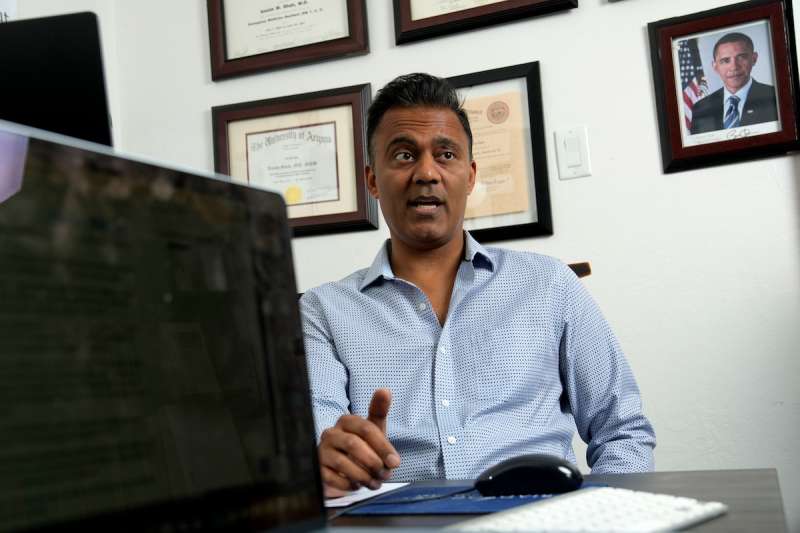
Amish Shah, a Democrat, is running to make life better for Arizona residents. Part of that, he says, is ensuring Arizonans in the 1st Congressional District can afford to live there.
A top campaign priority for Shah, a former state lawmaker and ER doctor, is to make the state more affordable for Arizona voters and better the economy.
But how?
For Shah, who wants to represent voters in Scottsdale, Cave Creek, Paradise Valley, Carefree, and Fountain Hills, the answer is simple: undo Trump’s policies that have led to higher costs for Arizonans and invest in the state. Specifically, Shah called for an end to the Iran war, which has led to higher gas and grocery prices. A report by the Congressional Budget Office found that the war was responsible for more than 40% of inflation this year and that it will likely push inflation higher into next year.
Trump launched the war in February, and Iran retaliated by closing the Strait of Hormuz, a critical shipping route, disrupting global oil supplies. Arizona voters have paid the price at the pump: the average cost of a gallon of gas in Maricopa County is $4.81, compared to $3.57 a year ago, according to the American Automobile Association.
“First and foremost, let’s stop the hemorrhage. These guys got us into the war in Iran, which is reckless and is now a quagmire, but has caused the gas prices to rise,” Shah said. “Get us out of that quagmire so we can start to bring the gas prices down.”
Roughly two-thirds of Americans say the US is not winning the conflict, and more say Trump isn’t doing enough to end it, according to a CNN poll. Shah’s Republican opponent, former NFL kicker and CBS analyst Jay Feely, on the other hand, has indicated support for the war.
“(Trump) took action that was in the best interest to protect our country, even though it wasn’t in his own best interest short term,” Feely said in a PBS debate.
To ease the burden on Arizonans, Shah also wants to undo Trump’s tariffs. He said the tariffs, implemented in April 2025, have led to increased costs and hurt Arizona businesses. While Trump argues foreign countries pay the price, economists say the costs shift onto consumers instead, leading to higher prices for Arizonans.
The Supreme Court struck down most of those tariffs in February, but Trump later introduced a 10% global import tax. The Court of International Trade ruled that tax illegal in May, and the administration appealed. The back-and-forth has led to unpredictable markets and economic uncertainty.
“You’re talking about unpredictability, and businesses need predictability in order to make investments to do more business,” Shah said.
Studies show that tariffs negatively impact workers: as costs rise and businesses handle the fall-out, some companies turn to lay-offs to counteract increased production costs and slowed down sales. Axing tariffs could help lower the unemployment rate, too.
On the other hand, in a Republican debate with PBS in May, Feely rejected the idea that tariffs are contributing to higher prices.
“Well, we haven’t seen that,” Feely said.
In a June interview with the Arizona Republic, Feely defended tariffs and other Trump policies contributing to higher costs.
“I love his policies and what he’s trying to implement,” Feely said.
What about healthcare?
For Shah, an ER doctor, Trump’s One Big Beautiful Bill Act, backed by all Arizona Republicans in Congress, was particularly shocking. If elected, Shah wants to repeal the law, which cut Medicaid and SNAP food assistance by more than $1 trillion over a decade.
Arizona has been hit particularly hard by the cuts after state agencies moved quickly to implement the new rules. As a result, more than 400,000 Arizonans, including 180,000 children, have lost access to food assistance since July 2025, according to the Arizona Department of Economic Security. More than 300,000 Arizonans are at risk of losing health care once the Medicaid cuts go into effect in 2027.
Shah’s position on the law puts him at odds with Feely, who has indicated support for the megabill.
“This bill fulfills President Trump’s campaign promises and gives the American people permanent tax relief,” Feely wrote in a Facebook post. “It is what the American people voted for.”
Repealing the law is no small feat: it would need to pass both chambers and, if Trump vetoed it, which he likely would, Congress would need a two-thirds majority to override the veto.
Aside from repealing the law, Shah pointed to higher premiums that came after congressional Republicans failed to renew enhanced Affordable Care Act subsidies. Roughly 300,000 Arizonans who rely on the ACA faced an average premium increase of nearly 140% to keep their coverage, according to the Center for American Progress, a left-leaning think tank.
“Health insurance costs have gone up tremendously for people, and it’s causing real pain for the voters,” Shah said.
Repealing the megabill and renewing ACA subsidies could offer Arizonans relief, Shah believes. Beyond undoing Trump’s moves, what matters is how members of Congress move forward.
“After that, we have to start to move things forward for them, and that’s what I’m running to fix,” Shah said.
The Democrat said he would prioritize a Medicare buy-in option to lower prices. Democrats have floated a buy-in for years, and if enacted, it would allow people under age 65 to buy into Medicare. Advocates say a buy-in could lower administrative costs compared to private insurance.
Shah argues allowing people the option will “cause some downward price pressure in the market.”
What about housing?
On housing, Shah pointed to young adults who are ready to move out of their parents homes and start their adult lives, but can’t due to high housing costs. Across the country, a third of young adults are still living at home due to high housing costs and a difficult job market, according to a study by Realtor.com.
In a Democratic primary debate in June, Shah said Congress should allocate more money to increase supply to meet housing needs. There are a number of ways Congress can fund housing, including increasing the budget for the Department of Housing and Urban Development, expanding block grant programs like HOME or CDBG to send money directly to states to build or repair homes, and expand federal programs like the Low-Income Housing Tax Credit, which provides funding for the development of new and affordable housing.
Shah’s already supported similar legislation. In the state house, Shah co-sponsored House Bill 2805 in 2022, which would have expanded the state’s Low-Income Housing Tax Credit, but the bill never advanced.
Arizona was short about 56,000 homes in 2025, according to the Common Sense Institute. Permitting has slowed to its lowest pace since 2019, a phenomenon experts attribute to high mortgage rates, rising land and labor costs, gas prices, and tariffs.
He added that he would support more clean energy projects to lower electricity and utility costs for residents. As more data centers pop up across Arizona, utility companies, including Arizona Public Service, are submitting rate hike requests of nearly 14%, which would add about $240 annually for Arizona homeowners. The Arizona Corporation Commission is expected to make a decision by the end of the year. Shah said an investment in clean energy could help lower costs for Arizona residents.
“We’ve got to start working on actual solutions to lower prices for all these voters,” Shah said.
What is Feely’s plan?
Feely’s campaign website lists a “strong economy” as a top issue, writing he would expand Trump’s tax cuts, cut regulations, and bring down inflation.
“We need an economy that rewards working Americans,” Feely wrote on a campaign site. “That’s how we bring good-paying, stable jobs to the Valley and reduce our national debt while we’re at it.”
However, Feely has indicated support for a number of Trump positions that have raised prices and contributed to inflation, including the Iran war and tariffs.
A Noble Predictive Insights poll found that 58% of Arizona voters disapprove of Trump’s job performance. That could hurt Feely, who has remained in lockstep with Trump and indicated support for Trump policies that have contributed to rising costs. In Arizona’s 1st District, deemed a “toss-up” by the Cook Political Report, it’s unclear if district voters will send someone to Congress with strong ties to Trump. While the district leans slightly Republican, it’s home to more than 170,000 independent voters who could flip it blue.
Shah and Feely will face off in the Nov. 3 election. Early voting begins on Oct. 7.