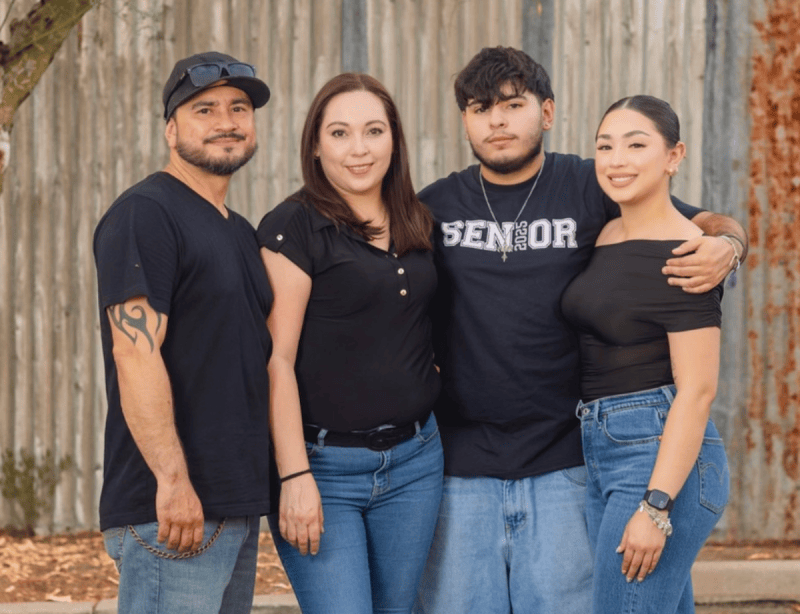
When Stephany Leal heard her mother crying “in agony” at 7 a.m., she had a gut feeling that her worst fears had come true. Her father had been detained by Immigration and Customs Enforcement (ICE) on his morning commute to work fixing houses.
Stephany, who has no relation to a well-known digital creator with the same name, had different plans for that day, Oct. 20, to do some simple errands and attend class at Pima Community College. Instead, she spent the day with her family, trying to locate her father, Nelson Leal —the family’s breadwinner, now in ICE custody—and to find an immigration lawyer to handle the case.
A life in Tucson
Leal has lived in the US for more than 21 years. Originally from Hermosillo, five hours south of Tucson, he and his wife came to Arizona in 2003 to visit her parents, who lived here. Upon arrival, they decided to stay in pursuit of a better life, Stephany said. The family has since laid down roots in Tucson with their three children.
In that time, the tight-knit family built a life for themselves: the children attended public schools in Tucson, Leal has been working in construction for decades, and Stephany’s been working towards obtaining a degree in Medical Interpretation.
Stephany said her father considered pathways to citizenship, but there were limited options. Asylum seekers must apply within a year entering the US, and there are limited paths for an undocumented immigrant to become a citizen.
The family always knew their status meant an increased risk of being detained by ICE, especially in recent years.
“Our plan was to just continue to keep our records clean and not draw any attention to ourselves, just keep to ourselves,” Stephany said. “Do what you need to do, but do it safely, where you’re not risking yourself or risking others.”
President Donald Trump campaigned on a campaign pledge of mass deportations, going after the “worst of the worst.” But data from the Transactional Records Access Clearinghouse at Syracuse University shows that of the more than 65,000 people currently detained, 70% have no criminal conviction, just like Leal.
“My family are immigrants who have been here, paying taxes, waking up every day just to come home and provide for their family,” Stephany said. “My dad is going to work to provide for his family, and so are so many other people. It’s so sad that this big narrative is being placed over all immigrants.”
The family made plans for what to do in the event of an arrest—plans that would later come into fruition, including remaining silent in the event of arrest and avoiding signing anything.
After some people in their neighborhood were detained by ICE, Stephany said her father started driving a Camaro, ditching his red work truck after seeing people in similar vehicles pulled over and detained by ICE more frequently.
It didn’t matter: ICE detained him anyway.
What happened that morning?
The 47-year-old father left for work slightly earlier than usual on Oct. 20, around 5:50 a.m., and took his usual route. When he pulled onto a street near his job site in Tucson, three ICE vehicles were already waiting, and three more were behind him, Stephany said.
After Leal invoked his Fifth Amendment right to remain silent, agents took his work bag, cellphone, and wallet. They took Leal to the ICE field office in Tucson. Agents questioned him, but he declined to answer their questions, Stephany said.
After a long day of detention at the Tucson Field Office, Leal was transferred to the Florence Processing Center, where he was held for four days. The Florence Processing Center is designed for short-term stays, but as ICE ramps up arrests, an increasing number of people have remained in custody there longer than the legal 72-hour limit. US Rep. Adelita Grijalva (D-Tucson) told Arizona PBS that while these facilities are meant for short-term stays, she’s seen the opposite during her oversight visits.
“It’s the unannounced visits that are really the only way I feel like I can get an accurate read as to what’s really happening,” Grijalva said. “The facilities that I’ve seen are really horrible.”
Stephany quickly began contacting immigration lawyers, but she said the ones she called informed her they were no longer accepting cases.
There is a shortage of immigration lawyers in Arizona, and as ICE ramps up arrests, they have struggled to keep up with the pace. The scarcity of lawyers leaves families like Stephany’s struggling to fight back against the federal government’s case. While the government is required to provide a public defender in criminal cases, it does not do so for immigration courts. Immigrants must hire their own counsel, and legal fees can range between $2,500 and $15,000.
Stephany said her father was transferred into Florence detention on Oct. 24, and as of Nov. 2, Leal is still there, according to the ICE Detainee Locator, and the family has had limited contact with him.
Medical concerns
Two years ago, Leal had a pacemaker placed onto his heart. At the time, he expressed frustration because he worried he would have to work less, and in turn, bring home less money. Stephany said he was frustrated at the thought of not being able to take care of his family, but she assured him it was her turn to take care of him. Now Stephany is worried what his medical care will look like in an ICE facility.
In initial phone calls, he assuaged their concerns and told them all was well and not to worry. More recently, his tone started to shift. Stephany said she could feel the frustration in his voice once he was transferred to the correctional facility: Leal, who also has high-blood pressure, told them the facility wasn’t providing him with his medicine. A surgical appointment to replace his pacemaker is a little over a month away, she said.
The family brought his medications to the Tucson field office, but Stephany said he received them only at the processing center and hasn’t received them while housed in Florence. Untreated high blood pressure can lead to disability or even a deadly heart attack or stroke. The family is worried about his long-term health while detained.
People with high-blood pressure also must carefully manage their diet, something Stephany says her father can no longer do, as his food choices are limited to what is served in the facility that day. Other detainees have told the Copper Courier that the food in Arizona’s detention centers are “bland” and lack proper nutrition.
“You can just hear that frustration, that he’s very upset,” Stephany said. “If we’re out on the outside, frustrated and overwhelmed, I can’t even imagine what he’s feeling. To hear him so distraught is just upsetting.”
Leal told Stephany that inside Florence, a lot of people are sick, it’s crowded, and that detainees have slept on the floor.
The Florence facility has a history of medical neglect: In March, Emmanuel Damas, a Haitian asylum seeker held there, died after complaining for weeks about a toothache. In August, the family of Guillermo Gallardo Barrera, who has spent the past year detained at the facility, sounded the alarm about his declining health, fearing the family patriarch could die without proper care. Since Trump’s second term, at least 59 people have died in ICE custody.
In a statement, an ICE spokesperson disputed the claims, stating Leal has been seen by medical providers at least three times while in detention.
“Claims of inhumane conditions are false. ICE provides safe, secure, and humane conditions for all individuals in custody, consistent with the Performance-Based National Detention Standards,” said Yasmeen Pitts O’Keefe, Regional Director-Southwest for the Department of Homeland Security. “Detainees receive medical and mental health screenings within 12 hours of arrival, full assessments within 14 days, and access to 24/7 emergency care.”
The spokesperson added that “detention is a choice,” and encouraged self-deportations.
The conditions are so bad, that even though Leal has been detained for a little over a week, he has considered signing self-deportation papers to escape the facilities, Stephany said. Critics argue the bad conditions within ICE facilities are intentional, to push detainees to voluntarily leave the country rather than fight the case.
“The conditions that they are in are just inhumane,” Stephany said.
The aftermath
That first day was all a blur of calls, high emotions, adrenaline, and a checklist of things Stephany had to do to help her father.
“I just wanted to give up in those moments,” Stephany said. “I don’t even know what to do. Like, how do you navigate this?”
But the 25-year-old stayed focused and determined for the sake of her parents, who she knew needed her the most in those moments. Her twin-sister lives in a different state and her brother went into emotional paralysis, Stephany said. As the oldest, and fluent in both English and Spanish, she knew she had to stay strong and keep pushing forward to try and help her family who depended on her.
“It’s been so difficult. It’s been so difficult. It’s just always in the back of my mind,” Stephany said. “Nobody deserves to have their family broken apart, and then hear that they are suffering and being ignored and there with no care.”
After some difficulty, she was able to find an immigration lawyer to represent her father. They’re raising money for bonds in case the government offers it. With the family’s breadwinner detained, they’ve also had to find other ways to replace his lost income and cover the hefty costs of fighting the US government.
The emotional toll has been the hardest part. Stephany’s mother has been married to Leal for 28 years.
“Her world is falling apart,” Stephany said. “Her and my dad have always relied on each other for everything. They’re each other’s shoulder to lean on.”
The family has set up a GoFundMe to assist with costs.