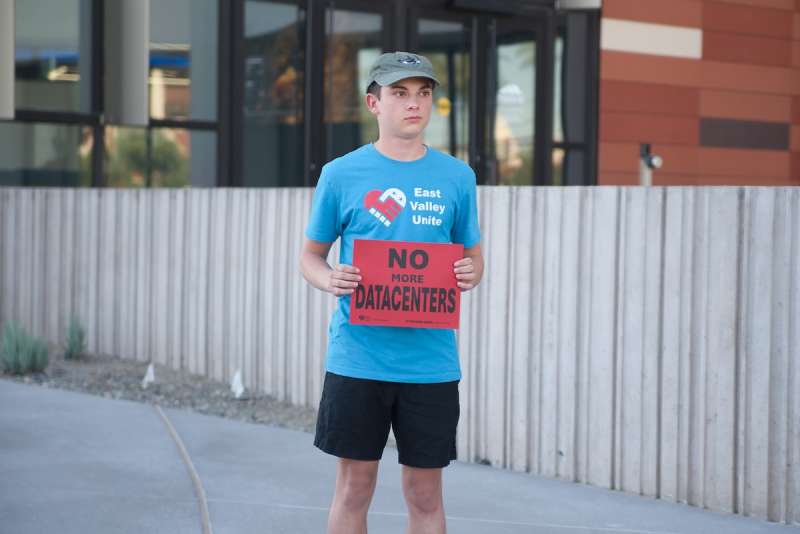
Domonique Carter’s family has lived in Mesa since 1992, before Loop 202 reached it and before the lightrail, too.
That’s why Carter showed up outside the Mesa City Council meeting on June 8, urging city leaders to reject a rezoning request for a new data center and prioritize the longtime residents, like his grandmother, instead.
In May, Mesa’s Planning Commission voted unanimously to recommend a rezoning request, a council use permit, and a plan modification for the project. Tokyo-based NTT Data Group Corp purchased 173 acres at 10126 E. Pecos Road for $300 million in 2025, and is proposing a seven-building, 2.2-million-square-foot campus with a private power substation along with a new Salt River Project substation.
The project is grandfathered under Mesa’s tighter data center rules because NTT submitted its application Aug. 4, 2025—four days before the city’s new data center ordinance took effect, according to city documents.
In a statement, a city spokesperson said the project is consistent with Mesa’s Pecos employment corridor, which is designated for technology and industrial development, and confirmed it was grandfathered under Arizona law. “The facility must still meet all city requirements and continue coordination with utility providers to ensure long-term power needs are addressed,” the spokesperson said.
Carter said his elderly grandmother lives less than two miles from the prospective data center. If approved, he worries it risks worsening her water and energy supply. He pointed to other communities in Virginia and Georgia that have experienced environmental harm after data centers moved in.
“Water is the most precious resource in the desert. We should use it to help our communities, not enrich billionaires,” Carter said. “Even if the AI data centers claim that they will pay for their own electricity, the load placed on the electrical grid will inevitably cause rates to go up for everybody.”
In cities with data centers, residents have also been met with higher utility bills and drained water resources.
Environmental consequences
Nathan Taylortaft, a Mesa High School student and the co-director of East Valley Unite, a progressive advocacy group, also spoke out against the project Monday.
“It is unconscionable to approve this data center that would take our most valuable resource away from the communities that need it and the environment,” Taylortaft said. “Water is not a commodity, it is an essential resource, and if we continue to allow data centers to be built in a place already strained by drought, we will feel the consequences.”
Arizona has grappled with persistent drought conditions since 1994 and the Colorado River — a critical water source for the state — is drying up as Arizona faces increasingly hot summers with temperatures reaching 100 degrees in March. Activists say that makes industrial water users like large-scale data centers an especially poor fit for the desert.
Asif Kazimm, a spokesperson representing NTT, said each building would have its own internal closed loop and a chiller system on the roof.
“The proposed data hall/shell buildings have been thoughtfully designed to limit southern sun exposure to optimize necessary interior cooling systems,” the company said. “Each of the data hall buildings will be completed with a closed-loop water cooling system that is filled up only once. The closed-loop system is entirely self-contained and does not employ any evaporative cooling methods that would result in evaporative or condensation loss.”
To account for large amounts of water usage, NTT is proposing the use of building design and industry-standard conservation practices.
A closed-loop system uses less water than other cooling methods by recirculating the same fluid rather than evaporating thousands of gallons. But the systems use chemical additives that prevent rust, starve microbes, and move heat off chips.
Carter worries those additives could contaminate the local water his grandmother depends on if the system ever needs repair.
“Even if we take into account the claims that closed loop systems are more efficient, the water used in those systems are chemically treated,” Carter said. “And if that system ever needs to be repaired, where will the data center release all that contaminated water?”
Public backlash
Last year, the Mesa City Council voted unanimously to tighten its zoning rules after an influx of data center development projects along with community concerns. According to Data Center Map, a research tool, Arizona is 7th in the nation for the most amount of data centers within the state.
Just last year, community members and local advocacy groups in Arizona successfully pushed back against a massive data center project in Chandler. The City Council unanimously rejected the rezoning request after residents raised concerns about water, energy, and other environmental impacts.
The Party for Socialism and Liberation, which participated in Monday’s protest, is hosting a community town hall on June 27 at 4:00 p.m. to organize against the project.
The rezoning request was set to be introduced at the June 8 meeting, but a city spokesman said it is expected to be scheduled for introduction later this summer.