“Residents that don’t even speak will start speaking and smiling. They get very excited to see animals, and they seem to connect.”
PHOENIX – When you share space with an animal, “you can just feel the whole energy change,” said Dawn Milburn, who directs a memory care facility in Gilbert.
And not just for those with cognitive problems – animals can make therapy easier and more fun for people with a variety of conditions, from Alzheimer’s to PTSD to learning disorders.
Animal-assisted therapy is a growing form of therapy that can help people of all ages both mentally and physically by relying on the unique bond between animals and humans.
“Animals – even without words – seem to be better at providing support to suffering humans than other humans do,” said Joanne Cacciatore, an associate professor in Arizona State University’s School of Social Work and founder of Selah Carefarm near Sedona, where grieving people and rescued animals heal together.
This animal-human bond includes micro-mini cows bringing joy to seniors with memory loss, horses helping children gain strength, mini horses building confidence in children struggling to read and dogs supporting military veterans with trauma.
Micro-Miniature Cow

When Karin Boyle’s father was diagnosed with Alzheimer’s in March 2021, his doctor recommended he do the activities he did when he was healthy.
“That’s when the brainstorming happened,” Boyle said. “I was like, ‘You know what, I’m going to figure out how to bring a cow to my dad.’”
Growing up on a family dairy in Arizona, Boyle spent a lot of time around cows.
“Dogs and cats are great,” she said, “but dairy farmers especially connect to their livestock.”
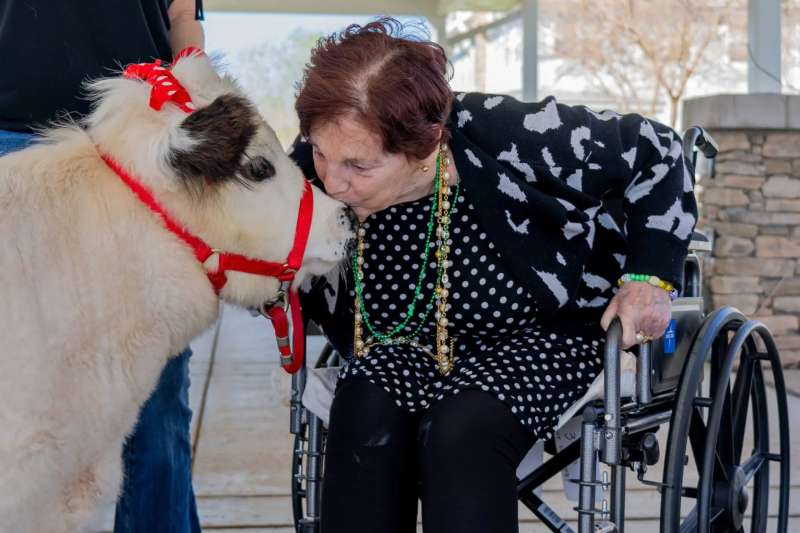
On Aug. 28, 2021, Boyle brought home a newborn mini White Park heifer and named her Dolly Star. Dolly Star’s breed is smaller than miniature cows and grows to be a little bigger than a standard newborn calf. Boyle calls Dolly a micro-mini and says her size is perfect for traveling to and from care centers.
Shortly after Boyle got Dolly Star, doctors determined her father’s condition stemmed from a brain infection that presented like Alzheimer’s, and once the infection was cured, his memory returned.
But Boyle, wanting to help others with her micro-mini cow therapy, founded the Dolly Star Foundation, a nonprofit in Gilbert. Since then, Dolly Star has been helping memory impaired people around town.
Milburn, who’s the executive director of the Watermark at Morrison Ranch, a living and memory care facility in Gilbert, said many residents are from the Midwest and grew up around farms and ranches.
Boyle said seeing Dolly Star “helps remind them of their younger years.”
Milburn said that for some patients, animals “pull out some memories that maybe they haven’t been able to retrieve in a long time.”
When Dolly Star entered the Watermark at Morrison Ranch on a morning in March, residents’ faces lit up.
“We’ve seen lots of cows in our days,” one resident said. “My neighbor had a cow!” another added.
“Residents that don’t even speak will start speaking and smiling,” Milburn said. “They get very excited to see animals, and they seem to connect.”
Horses

At Silver Spur Therapeutic Riding Center in Cave Creek, time in the saddle helps children with a range of disabilities and health issues gain confidence and motor coordination, and improve balance and posture.
Phoenix Wilson, 8, who was diagnosed with a neuroblastoma at age 3, fell in love with the horses at Silver Spur and has gained core strength in the few months she’s been riding.
“She’s been off treatment for a few years now, but she’s just thriving and it really is 100% because of programs like this,” said Andrea Wilson, Phoenix’s mother. “Honestly, I can’t imagine a more perfect place for kids who need some extra help because it’s a great environment to be in.”
Silver Spur offers activities and small classes – usually three or four riders – depending on the individual child’s need. Director and founder Debra Kermott said the priority is to give quality time to every rider.
“The basic thing that happens for every rider with autism is they usually have low muscle tone,” she said. “When a horse starts to walk forward, the rider leans back and has to correct their posture and sit back up. So every time we stop and start, that’s doing core work.”
Except those in advanced classes, children work with at least four volunteers to ensure they’re safe and following the activities.
Silver Spur volunteer and creative director Elaine Leisenring is in charge of coming up with games to keep the kids mentally engaged and confident on the horse.
“We focus on the individuality of each rider and what they’re capable of,” Leisenring said. “Everything that we do starts with building their core and their inner strength, then working outward to find motor skills, to verbalize words associated with horses and to just reach inside each child to find what we can do with equine therapy to help them grow.”
Miniature Horses

Full-size horses help a variety of ailments, and miniature horses are known for offering emotional support.
Tender Little Hearts is a nonprofit organization in north Scottsdale that uses miniature horses and donkeys to build reading confidence in young children and bring joy to hospital patients.
“The bigger horses are amazing, but usually the person has to go to them,” said Terry Holmes-Stecyk, founder and president of Tender Little Hearts. “Whereas with the miniature horses, we’re mobile and we can go to people who maybe wouldn’t be able to come to us.”
For about two years, Holmes-Stecyk has brought her miniature horses to the Fountain Hills Library for Tender Little Hearts’ Mini Tales program, where children build their skills by reading to the miniature horses.
“You have kids who are readers and will always read, but then you have those who struggle, and you need to find a way to help them find some sort of reward,” said Christy Valentine, children’s librarian at Fountain Hills. “That’s what these horses do.”
The horses’ diminutive size also provides benefits.
Children “are actually looking into the horse’s eyes,” Holmes-Stecyk said. “They’re not having to look up at something or even feeling intimidated by the size of a large horse.”
Joanna Shakro, 5, got to read “Go, Go, Cars!” to Mas, who’s named for the Italian carmaker Maserati.
“It was funny because it was like the horse was the child and I was the parent,” Joanna said.
“The horse was really listening, he seemed to think I was a good reader!”
“They’re a nonjudgmental listener,” Holmes-Stecyk said, “and that is probably the most important thing for a child who is learning or perhaps even struggling with reading.”
Dogs

Soldier’s Best Friend in Peoria saves dogs from local shelters and pairs them with veterans living with PTSD.
Marine Corps veteran Jonathon Bailey trained his first service dog, but after it died, he found himself looking for organizations in the Valley that could help with his PTSD symptoms. That led him to Soldier’s Best Friend, which matched him with Anubis, a white German shepherd mix.
Anubis is trained to do deep body pressure therapy, putting his whole weight on Bailey to calm him during post-traumatic stress disorder events. When Bailey gets anxious or starts to sweat, he tells Anubis to “Push,” which helps ground him. And when they’re in a crowded space, Anubis nudges people away and helps create a safe and calming space for Bailey.
“It’s hard unless you’ve been through the situations and combat to understand what we deal with, what we see, what we feel,” Bailey said. “He just does his job … and is always there.”
Bailey now works as a veteran service specialist for Soldier’s Best Friend.
“I think it’s hard for veterans to be able to come out and talk about stuff from PTSD because there’s always that stigma out there, but just understand it’s OK and just seek the help if you need it,” he said.
Soldier’s Best Friend rescues dogs to be service dogs and emotional support animals. The tasks that each dog learns are personalized to each veteran.
Air Force veteran Lendrick Robinson has been working with a certified trainer with his dog, Bella, at Soldier’s Best Friend for over a year.
“When I’m having an episode, I can call her and pet her, and it helps me,” Robinson said.