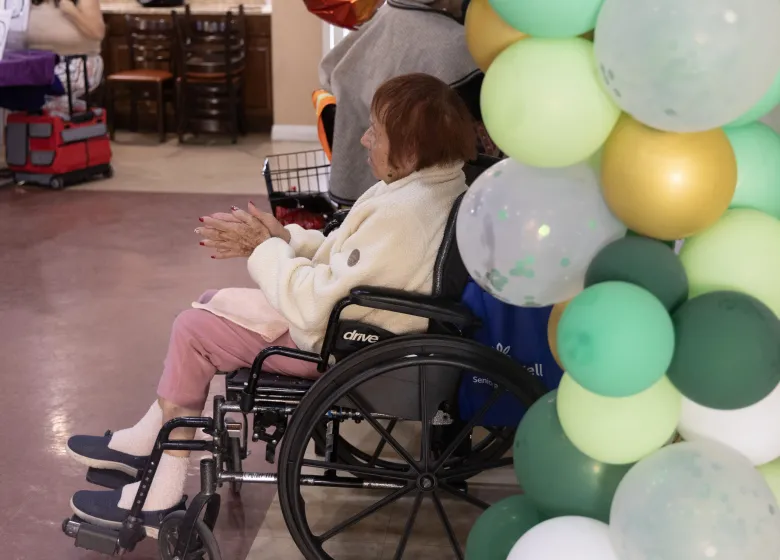
An attendee at the Chicanos por la Causa Healthy Aging Spring Fair on March 20, 2025, in Phoenix. (Photo by Olivia Williams/Cronkite News)
PHOENIX – Arizona’s population is aging, and more seniors are facing a life alone. “Solo agers” have no family, spouses or lifelong friends who are alive or live nearby.
In 2024, nearly one out of five of Arizonans was 65 or older — and the number has been steadily increasing over the past decade, according to data from the Arizona Department of Health Services.
With this growing but fragmented population comes a diversity of life experiences, and some of those include profound levels of social isolation.
This lifestyle exists on a broad spectrum — for some, it’s desolate. For others, it’s freeing.
‘Aging successfully’
Navigating solo aging requires intention, which means building and maintaining a life of fulfillment.
It’s hard work. Michael Iffland knows.
“It’s pretty lonely,” he said, sitting in the office of the Salvation Army in downtown Phoenix. Iffland, 72, has lived in Arizona for about 15 years now. He’s originally from Chicago, where he became homeless and was essentially abandoned by his tightknit group of friends, he said.
MORE: What are Arizona’s safest hospitals? These 9 got a D in latest report
He received help from the Central Arizona Shelter Services and got a job working in maintenance until he decided to retire and start collecting Social Security benefits. However, after his apartment suddenly raised his rent by $250 a month, he had to look for housing elsewhere.
There was no one nearby to help him, and his only source of income came from food stamps.
“My sister lives in Hawaii, so as big a help as she was financially and supportive, there was just nobody here,” Iffland said.
That’s when the Salvation Army found him, providing him with housing and other resources. It’s one of the few things that was there for him when he had a severe heart attack, requiring four stents placed in his heart.
Iffland’s story is one of many across the spectrum of solo aging experiences. It’s often a clashing of systems that leave older people behind, making them financially vulnerable as they navigate changes in health.
Iffland does enjoy his alone time, and he’s especially fond of music and his guitar.
“I’m the biggest Beatles fan you’ll ever find. I have a giant collection of Beatles records and memorabilia,” he said.
For some, it’s a meaningful opportunity to create a life of complete freedom, experiencing it as it happens firsthand, with self at the center.
That’s the experience of Arizona State University researcher David Coon, who has studied aging extensively and is both a solo ager himself along with the caregiver of his neighbor, who is also aging alone.
Coon emphasized the importance of prioritizing what he calls “aging successfully.” This does come with a weight of personal responsibility, he said, yet it is traversable and manageable with the right mindset.
One thing Coon focuses on is creating a network.
“It’s really important to consider a ‘buddy system’ for solo agers. Is there someone that is your closest person, where you would check in either once a day or once every couple of days to make sure everything’s OK?” he said.
Tami Bohannon started caregiving at 17 when her father received a terminal diagnosis.
“Everything that I’ve done has led up to me being here in this space that’s so important right now. The silver tsunami is a real thing,” she said.
Today, Bohannon is the president and CEO of senior resource organization AllThrive 365. She shared a story of the time she met the self-proclaimed “Golden Girls of Pineview Manor,” a housing community for people 62 and older located in Pinetop, Arizona.
They created the “Blind Brigade.”
“When you woke up, you opened your blinds, and if your blinds weren’t open by 10 a.m., they had permission to knock on your door or call,” she said.
Creating community
A cornerstone of aging alone is finding friendship and a circle of trusted people.
Karen Cisek is one of Iffland’s neighbors, and her solo aging experience has been a mostly fulfilling and positive journey. She’s lived in Arizona for 57 out of her 67 years.
“I’ve made a lot of new friends here. I feel like I have a family here,” she said.
In her alone time, she tends to her plants, reads and she’s just “stuck on TV.”
Cisek worked in the restaurant industry as a server and a bartender, so she said she feels comfortable talking with anyone and everyone. She said she has 60 friends at the Salvation Army.
“I have an intentional community,” she added.
Cisek’s circle is something Coon refers to as an “informal network” — a system of people that provide consistent emotional support and social enrichment. It’s created with purpose.
Alternatively, there is the concept of a “formal network” — the people trusted with handling finances, important legal paperwork and future plans, including those after a person has died.
Coon encourages people to think of this as a “social safety net,” taking into account the constantly changing terrain that so often accompanies growing old — people die, move away or grow apart.
Bohannon’s organization runs adult day centers, which she found can combat isolation and be a way for older people to build a social network without completely upending their lives or relinquishing independence.
These centers offer a place outside the home for older people to be around others and to receive care as necessary, providing in-home caregivers with a reprieve. Those can be people who are taking care of their spouse or parent or hired help.
Without insurance, eight hours at an AllThrive 365 center costs $128. The organization does not directly accept Medicare, but some seniors use Medicaid’s Arizona Long Term Care System plan. Commonly known as ALTCS, the program covers long-term care in nursing homes and adult day centers.
“It is absolutely more affordable to live in your own home and come to adult day than move into assisted living facilities,” Bohannon said.
They’re great models, she said, but they’re expensive to manage, and it can be difficult to find staff who are well-equipped to take on the job.
In Maricopa County, the number of adult day centers across organizations was halved after the COVID-19 pandemic forced drastic funding cuts.
It can be hard for the organization to keep up financially, she said, as they have to raise around $2 million in private philanthropy to keep these centers going.
“There’s a systemic change that needs to happen around aging,” she added.
This article first appeared on Cronkite News and is republished here under a Creative Commons Attribution-NoDerivatives 4.0 International License.
Author

Arizona sues RFK Jr. over vaccine, advisory committee changes
Arizona has joined its 36th lawsuit against the Trump administration with a case that challenges a new childhood vaccine schedule and remade vaccine...

It’s 2026 and you’re uninsured. Now what?
By Renuka Rayasam Health policy changes in Washington will ripple through the country, resulting in millions of Americans losing their Medicaid or...

Arizona Medicaid now covers traditional healing, helping Native communities preserve tradition
PHOENIX – Natasha Bowman is a Navajo doula and student midwife. Her work centers around revitalizing traditional birthing through practices that...

What are Arizona’s safest hospitals? These 9 got a D in latest report
A nonprofit focused on improving hospital safety and quality in the U.S. gave nine Arizona hospitals an "A" grade in its biennial hospital safety...