PHOENIX – Arizona’s blood supply is in crisis. For minority patients, the shortage is even more severe.
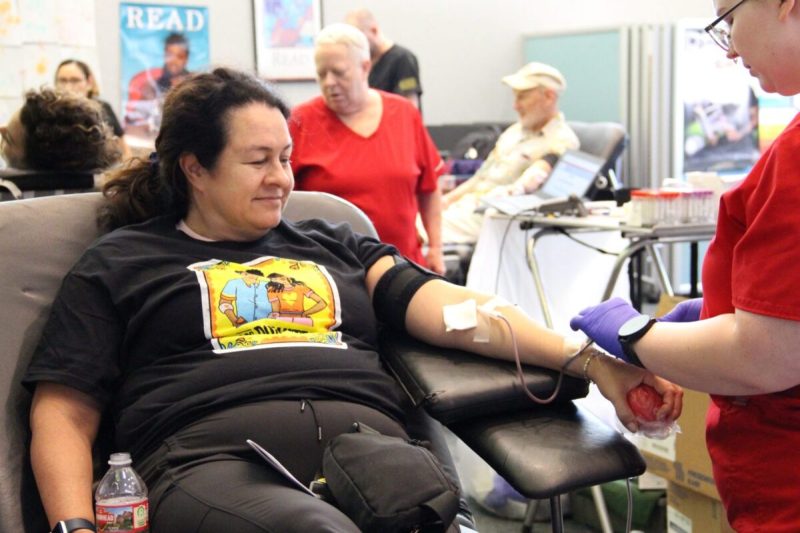
Corina Chick sat in a reclined chair at a community blood drive at Cesar Chavez Library, her arm stretched out as a needle drew a pint of blood. A Red Cross nurse taped the clear plastic tubing in place while Chick, a registered nurse herself, explained why she had taken time from her day.
“It’s important that we practice what we preach. As Latinas and Latinos, we do not typically donate,” Chick said. She tugged down the hem of her shirt, revealing a festive illustration of a Hispanic couple printed across the fabric.
Want Arizona news in your inbox each morning? Sign up for our free newsletter.
For many regular blood recipients, survival can depend on finding a blood donor from a similar racial or ethnic background.
Most people are familiar with the main blood types: A, B, AB and O. But for many patients who need consistency in transfusions, a successful match is far more complex. The answer lies in antigens, which are molecules on the surface of red blood cells that distinguish one blood type from another.
“Different blood types are named based on the antigen that is on the cell,” said Rollin Medcalf, assistant teaching professor at ASU’s College of Health Solutions. “So it’s like a little name tag: A blood has an antigen that is sticking out that says ‘I’m an A blood’.”
When a patient receives a blood transfusion, their immune system can react to antigens that are different from their own, “and if they are not compatible, they have an antibody that will attack that,” Medcalf said.
MORE: ‘Stop playing games with our lives’: Arizonans urge lawmakers to protect ACA subsidies
The state’s largest nonprofit blood provider, Vitalant, reports overall donation levels hovering between a two- and three-day supply.
“We supply all 62 hospitals in Maricopa County, and 90% across the state,” said Linsey Cherveny, communications manager at Vitalant. “To meet the needs from our hospitals and our patients, we need 600 donors, and that’s just for our daily usage.”
However, the crisis is not just about the number of donations; it’s about the type of donations.
“When you have somebody who’s receiving blood multiple times on a monthly basis … their needs for blood is more finely tuned,” Cherveny said. “They may need to have something that is more related to their genetic makeup in order to make it safe for them.”
This is why the most compatible blood match often needs to come from a donor of a similar ethnic or racial background, whose blood is more likely to share the same unique antigen profile.
Yet the gap between blood supply and demand is wider in minority communities due to higher demand for specialized blood types and lower donation rates.
Genetic conditions such as sickle cell disease and thalassemia are more common in minority populations, highlighting the vital need for diversified blood banks.
A single patient may require thousands of transfusions over their lifetime.
“I encourage everyone to donate, specifically the African American community to meet the transfusion needs for patients with sickle cell disease,” said Yvette Miller, chief medical officer for the American Red Cross, at a Sickle Cell Roundtable.
More than 600 known antigens exist, and some of these are unique to specific racial and ethnic groups. For example, the Ro haplotype is over 10 times more likely to be found in people of African descent than in white individuals, making one in three Black donors a match for a patient with sickle cell disease.
For Hispanic patients, the story is different but just as urgent. “Our blood types are typically type O, which is the most commonly used blood type here in the United States,” said Maria Noris, community outreach chair for the Phoenix chapter of the National Association of Hispanic Nurses.
“When we have traffic accidents or emergency surgeries, the type of blood that we use to infuse is type O, and right now we are at a critical low in Arizona in type O blood.”
Despite the urgent need, minority donors are significantly underrepresented nationally. In the U.S., African Americans donate at a rate that is 25-50% that of white individuals. Nationally, only 12.2% of whole blood donations come from minority donors, and there was a staggering 35.4% decrease in these donors between 2019 and 2021. This gap is caused by a combination of factors.
Mistrust in health care, rooted in a complex history of racial discrimination, remains a major factor preventing Black Americans from donating blood. According to the National Institutes of Health, additional barriers include higher rates of medical conditions that can lead to donor ineligibility, previous negative experiences with medical staff, safety concerns and inconvenience.
Despite these barriers, studies have shown that motivations to donate blood are similar across races and ethnicities: altruism, sense of social obligation, personal pressure and increased self-esteem.
However, personal connections have been shown to play a significant role in increasing donation rates within communities of color. People are far more likely to donate for a friend, family or community member.
Yet kinship-driven motivators alone cannot solve the ongoing shortage for minority blood recipients, as the need extends far beyond one’s immediate circle.
Chick and Noris attributed barriers such as mistrust of the medical system, misconceptions about eligibility and fears that the process is time-consuming or painful.
“Even in the medical community, we don’t want to donate because we feel like it’s going to take a very long time, it’s going to take most of the day to do it, it’s going to hurt, we’re going to feel sick,” Noris said. “But I think that’s where we are responsible to educate our people. It takes a minimal amount of time, it isn’t painful.”
Cherveny added that many people don’t realize how simple the requirements are. “You need to be 16 years or older, 110 pounds or heavier, and in general good health,” she said. “The entire process is about an hour, maybe 45 minutes. The actual donation time period is really just 10 to 15 minutes.”
Donating blood can also provide valuable health insights. For individuals who lack access to regular health care or routine blood screenings, donating blood may be the first time they learn they’re at risk for conditions like diabetes or high cholesterol.
Vitalant has expanded mobile blood drives and outreach efforts, while the National Association of Hispanic Nurses encourages members to lead by example and educate their communities through social media and direct community outreach. Donors now receive texts or emails when their blood is used, a step Cherveny said makes people feel directly connected to the lives they’ve saved.
“There’s not many things in this world that you can do that are going to directly and positively impact more than one person every time you do it.”
This article first appeared on Cronkite News and is republished here under a Creative Commons Attribution-NoDerivatives 4.0 International License.