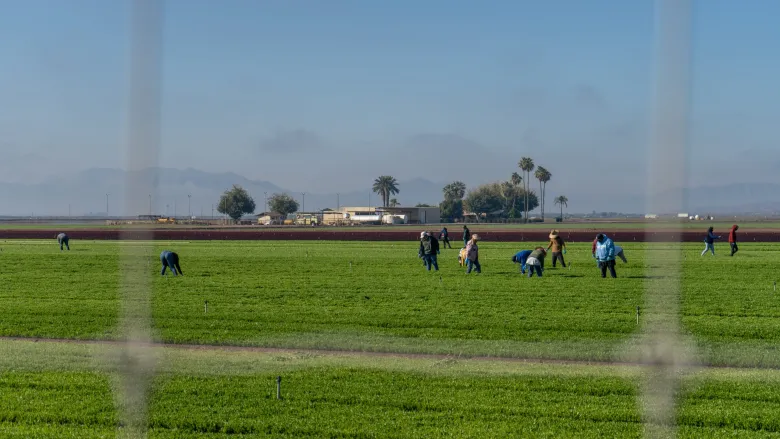
A group of farmworkers working in a field in Yuma, Arizona, on Nov. 24, 2025. (Photo by Oliver Boye/Cronkite News)
This is the second installment in a series examining pesticide use in one of the nation’s largest agricultural hubs – the Yuma area. Cronkite News expanded its original reporting by speaking with farmers, growers and farmworkers.
YUMA– As the sun rises, patches of acreage come to life in the small yet bustling outskirts of Yuma. Tractors and crop vehicles are running, filling the air with noise. Thousands of workers set out to spray, test, thin and harvest thousands of pounds of crops.
Yuma County produces 90% of the nation’s lettuce during the winter months, a pace that growers say would be difficult to maintain without pesticides, even as organizations like Beyond Pesticides warn of their public health risks.
MORE: The human cost of Yuma’s vegetable empire
John Boelts co-owns and operates the family-run Desert Premium Farms, questions the scientific basis of those arguments.
“I feel very comfortable with the level of robust science and monitoring that goes into it,” said Boelts, who also leads the Arizona Farm Bureau. “I don’t put much faith in some of the pseudoscience out there that says this is bad or that’s bad.”
Pesticides – including herbicides and insecticides – protect crops and maximize yields during harvest.
Yuma County’s agricultural economy is a blend of large operations and smaller farms, like Desert Premium. Both use pesticides to stay on track for their harvest date, especially in seasons of inconsistent weather.
Over the past four months, Yuma has seen record rainfall, well above the 30-year average.
The constant rain has brought mildew into play, and Boelts said he relies on pesticides to mitigate its impact.
“It’s very challenging to understand that literally overnight, the crop that you’re growing, that you’re gonna depend on for food, could be eaten up by insects. It could be devastated by fungus that develops or is devastated by a disease,” Boelts said.

The Environmental Protection Agency and the Food and Drug Administration oversee pesticide monitoring. Boelts said his farm strictly adheres to the guidelines.
“People’s health and welfare are number one. When you have that mindset, the rest falls into place. … We’re training folks long before they ever see a pesticide. … We’re also never gonna use any pesticides that aren’t registered by EPA and have not gone through the proper course of inspection and approval for use,” Boelts said.
Each pesticide has a designated wait time before farm workers are allowed back on the sprayed field.
“We have to use suits, masks, gloves, carbon filters on the tractors so that the smell doesn’t pass through, and yes, we can have training when something happens, like washing our hands, our face, our body,” said Francisco Javier Morales Alvarado, a Desert Premium farmworker.
Each time Desert Premium plans pesticide application, workers consult a pest control advisor.
“It’s heavily regulated pesticides, and we’re only able to get them through the PCA (pest control advisor),” said Andres Elizarraras, the spray foreman at Desert Premium Farms. “If we’re gonna have them (spray), we make sure they’re not gonna be harvesting within those days.”

On Boelts’ farm, tucked away behind a large bulletin board, a thick yellow book called the Pesticide Application Records documents every instance of pesticide use.
“We fill out what’s called a 1080 form. Once we complete it, we turn it into the state and have a record of what time, in case someone does get sick, we can go back and see the times that we sprayed them,” Elizarraras said.
For Boelts, keeping people safe comes down to following regulations designed to minimize the impact of necessary pesticide use.
“What we’re trying to accomplish out here is produce people’s food and fiber and do it in the most ecologically, environmentally and responsible way possible,” Boelts said.
This article first appeared on Cronkite News and is republished here under a Creative Commons Attribution-NoDerivatives 4.0 International License.
Author


Ready to see ‘tech heaven’? Micro Center to open new store in Phoenix
Get in line, tech heads — Micro Center will soon open its doors in Arizona. The popular technology superstore is widely known for carrying a vast...

Inside a woman’s fight to save her family’s tortilla business in a historic Tucson barrio
Gracie Soto’s first memories were in her grandparents’ market. She would fall asleep under the cash register to the cacophony of laughter and...

Skoden Coffee & Tea combines traditional Native American cuisine with activism
PHOENIX – For Indigenous small business owner Natasha John, the road to owning a coffee shop has been long. About 300 miles, in fact. John first...

Dozens of student pilots sue United Airlines and its Arizona flight school over fraud allegations
Dozens of former student pilots who say they racked up tens of thousands of dollars in debt for tuition are suing United Airlines and its flight...