
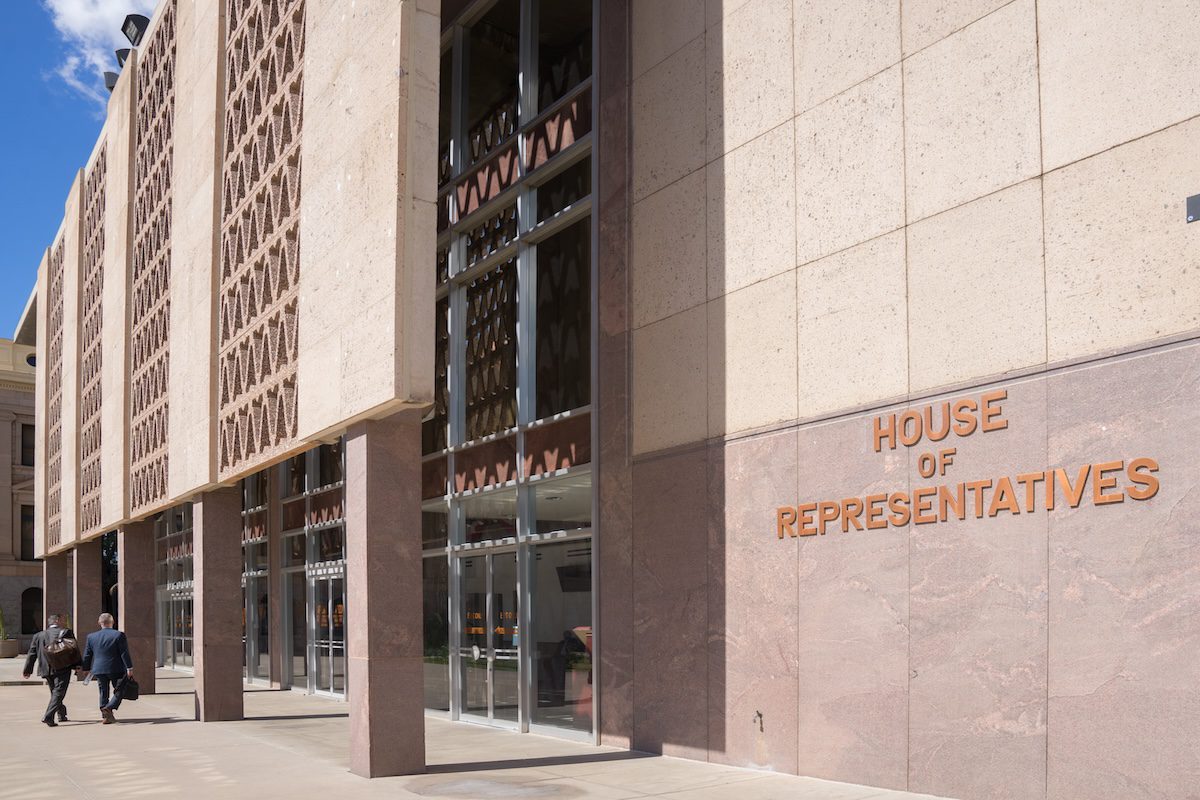
The Arizona House of Representatives on Feb. 28, 2018 in Phoenix, Arizona. (BCFC/Shutterstock)
*This article was updated from a previous version originally published in Jan. 2025*
Arizona’s 2026 legislative session begins on Jan. 12, and residents may be wondering how they can make their voices heard.
There are multiple ways Arizonans can step in and express their opinions about bills as the House and Senate debate and vote on them.
Want Arizona news in your inbox each morning? Sign up for our free newsletter.
Civic Engagement Beyond Voting (CEBV), a nonprofit that helps the public participate in local politics, has a variety of resources designed to help people dip their toes in these waters.
“I don’t think that most Arizonans understand how profoundly local politics affects our lives, most decisions that affect Arizonans are made at the local level,” said Melinda Iyer, CEBV’s co-founder and policy director.
CEBV focuses on teaching people how to reclaim their voice and their power as citizens in local politics—in systems that are designed for lobbyists, rather than regular people.
Using the Request to Speak (RTS) system
The RTS system is a website that allows the public to register opinions and voice comments on bills as they pass through the Arizona House and Senate.
To create an RTS account, you have to go to the State Capitol or at a kiosk in Tucson, located at 400 W. Congress Street, Suite 201 and use a kiosk in either the House or Senate the first time you use the RTS system to activate your account.
Once you’ve registered for an RTS account and activated it in-person, you can leave comments on a bill from any computer with an internet connection.
Yes, this is a hurdle that people must jump over in order to make their voice heard—making the RTS system inaccessible to many people who don’t have access to transportation to get to the state Capitol.
READ MORE: Want to speak at a city council meeting? Here’s how to do it in Arizona
CEBV is attempting to remove that barrier for some by offering to create an RTS account and activate it on behalf of people who fill out this form.
Once you have registered an opinion on a bill, other members of the public, including journalists and legislators, are able to get an idea of how much support or opposition there is for a bill.
If you use RTS, you do not actually have to speak in support or opposition of a bill in a hearing—the RTS system allows you to choose whether or not you would like to speak before legislators during a committee meeting at the Capitol before a vote takes place, or simply have your name on the record with your stance on the bill.
How to speak during public comment in a committee
Legislators are assigned to committees presided over by committee chairs. Committees are separated by various subject areas, like education, finance, or public safety.
Bills are assigned to related committees; this is where legislators debate the merits of the bill, propose amendments to bills, and decide whether to send them to the larger body for a vote. If a bill does not pass through the committees it is assigned to, it is considered “dead.”
This is also where legislators hear from people who have requested to speak through RTS and choose to speak in person in front of a committee.
Committee assignments for the House and Senate are available to view here.
After someone has registered an RTS account, here’s how they can sign up to speak on a bill in front of a committee:
- Visit apps.azleg.gov and click “Sign On” in the upper right corner.
- Enter your email and password you used to create your RTS account.
- Choose the “Request to Speak” tile, then “New Request” on the left column.
- Search the bill number you want to speak on, click “add request” on the right side.
- Select whether you are “for,” “neutral,” or “against” the bill.
- Choose “Yes” if you would like to speak during public comment in a committee hearing.
- Optional, write a comment on the bill — this may be read aloud during committee hearings.
- Plan to attend the committee in person on the date and time listed on the screen once you select the bill you want to comment on. Legislators have until 24 hours before the bill is scheduled to be heard in committee to change the agenda, so make sure to check the agenda before making a trip to the capitol to make sure the bill is still scheduled to be heard.
Other resources
CEBV also offers a Letter to the Editor Toolkit, which outlines how to craft compelling messages to submit to traditional media like newspapers and television. CEBV even lists the best way to submit a letter to over 50 local news outlets.
On an even more local level, the organization offers a civics toolkit on how to engage with local government bodies, from school boards to the Corporation Commission.
Author

Support Our Cause
Thank you for taking the time to read our work. Before you go, we hope you'll consider supporting our values-driven journalism, which has always strived to make clear what's really at stake for Arizonans and our future.
Since day one, our goal here at The Copper Courier has always been to empower people across the state with fact-based news and information. We believe that when people are armed with knowledge about what's happening in their local, state, and federal governments—including who is working on their behalf and who is actively trying to block efforts aimed at improving the daily lives of Arizona families—they will be inspired to become civically engaged.


Gov. Katie Hobbs vetoes GOP tax cut policy. What it means for you
Arizona Gov. Katie Hobbs swiftly killed a Republican-backed tax plan, guaranteeing the battle at the state Capitol over how much money Arizonans pay...

10 Arizona Republicans support bill that would further restrict SNAP
In late Dec. 2025, Arizona House Republicans introduced House Bill 2107: legislation that would restrict Supplemental Nutrition Assistance Program...
Former GOP lawmaker in Arizona pleads guilty to charges for forging petition signatures
A former Republican lawmaker in Arizona pleaded guilty Monday to criminal charges for forging signatures on nominating petitions during his 2024...

Longtime lawmaker shapes the debate as Arizona grapples with dwindling water supplies
PHOENIX (AP) — Throughout two decades marked by drought, climate change and growing demand for water, Arizona’s leaders have fiercely debated an...


