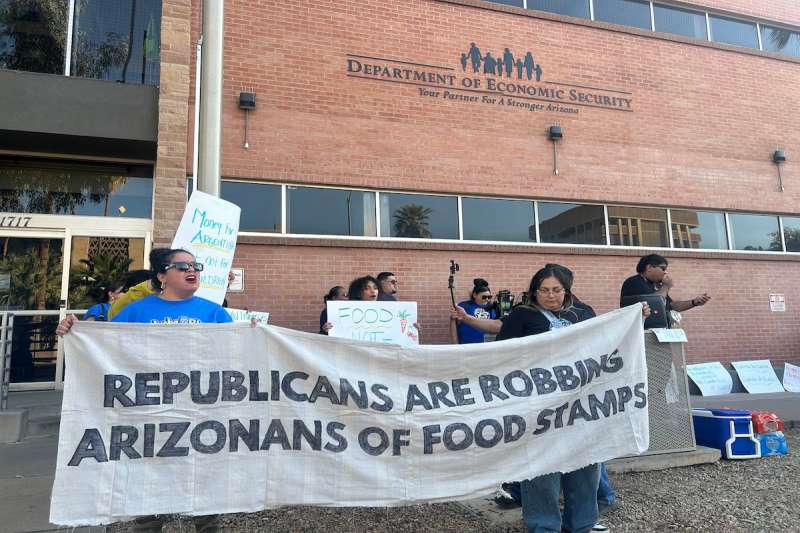
In late Dec. 2025, Arizona House Republicans introduced House Bill 2107: legislation that would restrict Supplemental Nutrition Assistance Program (SNAP) benefits and ban recipients from using it to buy fast food.
Arizona lawmakers are expected to consider the proposal when the legislative session resumes on Jan. 12.
HB 2107 was introduced or cosponsored by the following Republican members of the Arizona House of Representatives:
- Rep. Teresa Martinez (LD-16)
- Rep. Chris Lopez (LD-16)
- Rep. Leo Biasiucci (LD-30)
- Rep. Michael Carbone (LD-25)
- Rep. Neal Carter (LD-15)
- Rep. Matt Gress (LD-4)
- Rep. Ralph Heap (LD-10)
- Rep. Laurin Hendrix (LD-14)
- Rep. Rachel Keshel (LD-17)
HB 2107 would guide the director of the Arizona Department of Economic Security to request a waiver from the United States Department of Agriculture that would exclude fast food from SNAP. It would also add coverage for vitamins.
There are already restrictions in place that prohibit SNAP usage at most restaurants in the state, but the Restaurant Meals Program is a state option that allows people who may not be able to prepare meals for themselves or who don’t have permanent housing to buy prepared meals with SNAP benefits.
Presently, around 25,200 Arizona households qualify to use SNAP at restaurants. HB 2107 would also disallow those purchases.
The bill isn’t creating a new restriction, it’s expanding those restrictions to the most vulnerable people.
READ MORE: These Arizonans are feeling the squeeze as ACA subsidies disappear
“Fast food” is vaguely outlined in the bill—and this leaves plenty of room for interpretation or debate. HB2017 defines fast food as “a type of mass-produced food that is designed for commercial resale with a strong priority placed on speed of service.”
“Vitamins” are also not defined in the text of the bill, and it isn’t clear whether SNAP would only cover basic options like calcium and vitamin B—supplements are another concern.
Disabled, elderly, and homeless people—folks who don’t always have resources to cook for themselves—face the harshest consequences if the law passes. Nevada families enrolled in SNAP, many of whom juggle multiple jobs and school with limited vehicle access or food resources, would also be at risk.
The impacts of food insecurity and hunger reach beyond the fast food line.
Cuts to SNAP could result in fewer meals for children, and underfed children score worse on testing than children who eat breakfast in the morning. The specific food eaten by children didn’t have significant correlation with academic test scores, so children eating something (fast food or not) proves more beneficial than not eating at all.
“The percentage of [calories] from carbohydrates was positively correlated with spelling standard score,” the study said. “But no other aspects of the macronutrient distribution of the diet were significantly associated with scores.”
Further restricting SNAP, a move that the federal government and Republicans have already tried to kickstart, doesn’t just affect people who already struggle to afford to put food on the table. It touches every part of families’ lives, from education to parenting.