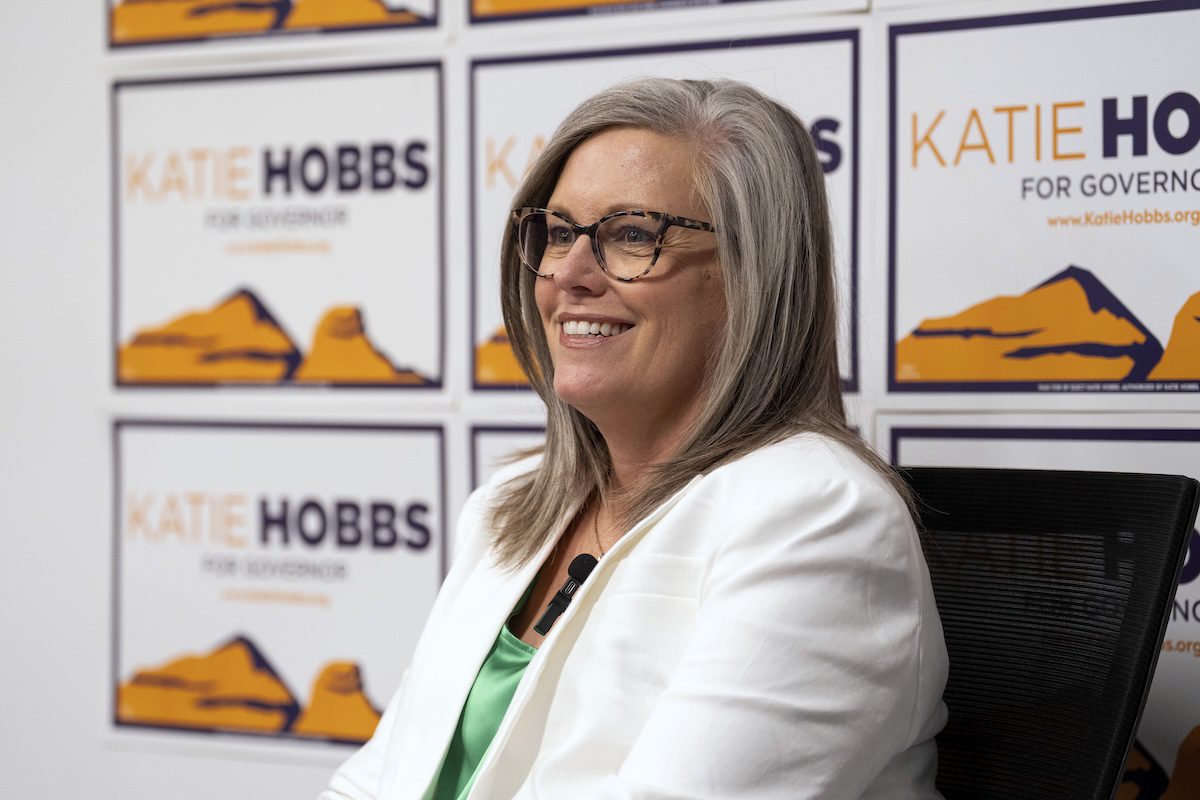
Democratic Arizona Gov. Katie Hobbs speaks during an interview with The Associated Press, Tuesday, Oct. 7, 2025, in Phoenix. (AP Photo/Samantha Chow)
Arizona Gov. Katie Hobbs swiftly killed a Republican-backed tax plan, guaranteeing the battle at the state Capitol over how much money Arizonans pay in their tax bills will continue brewing.
Hobbs said Jan. 16 she had vetoed the bills that landed on her desk one day earlier, calling them a “wish list of every tax proposal they’ve ever introduced” that “blows a huge hole in our budget.” Tax preparers and consumer advocates have encouraged an early resolution to the disagreement over tax policy — for taxpayers’ sake — but that remains weeks or months out.
The disagreement prompted one leading state senator to warn Arizonans “must not file” their state taxes. But Hobbs’ aides say the majority of taxpayers won’t need to refile even if it takes time to reach a compromise.
RELATED: How can I make my voice heard at the Arizona Legislature?
The legislature’s Republican majority passed identical bills on Jan. 15 to align state tax policy with new federal tax cuts and lawmakers warned that taxpayers wouldn’t know what to pay without a new law in place.
Any of the matching state tax cuts that become law this year are retroactive for the 2025 tax season, which begins in late January.
In cautioning taxpayers, State Sen. J.D. Mesnard, a Chandler Republican who chairs the Senate Finance Committee, was one of several GOP leaders who blamed the Democratic governor for creating “chaos” with her own tax-matching plan.
“Right now, there is uncertainty for the taxpayer,” Mesnard said. “Many Arizonans don’t want to wait for their refund. They want to file now. They’ve got bills to pay.”
The Republican plan to pass on the federal tax cuts in the One Big Beautiful Bill, known formally as H.R. 1., in state tax filings was passed in record time after no apparent negotiation with Hobbs.
The governor released her Middle Class Tax Cuts Package in November that matches only part of H.R. 1 and was in large part copied into the GOP plan. On Jan. 16, she again placed her support behind that plan, which is being introduced by Democratic leaders Rep. Oscar De Los Santos and Sen. Priya Sundareshan.
But Hobbs didn’t stop the state tax agency, which she oversees, from putting out tax return forms that essentially mimic the cuts in H.R. 1. Those forms, which represent a tax-break plan that costs roughly the same as that forwarded by state Republican lawmakers, would need to be amended if they’re filed after either the GOP or Hobbs’ tax plan becomes law.
Republican legislative leaders ripped Hobbs in the news conference for what they called a leadership “failure.”
“What have we gotten from the ninth floor? We’ve gotten inaction, indecisiveness,” said House Speaker Steve Montenegro, while also praising GOP lawmakers for passing their bills so quickly. “We’ve got an executive press release that conflicts with her own department’s planning for tax forms. The chaos that is to come is a Hobbs creation.”
Officials from the state Department of Revenue testified Jan. 14 that “any retroactive changes” to the policy in H.R. 1 would bring the agency’s operations to a halt. They said it would require a $20 million infusion and 200 more staffers to deal with all the amended returns. Lawmakers disputed those figures.
But at the least, taxpayer refunds would be delayed if state tax policy isn’t set before the April 15 deadline because of political arguments.
Democrats oppose tax cuts for wealthy people, businesses
Hobbs’ package included a higher standard income deduction, an increased deduction for people 65 and older, a deduction for interest on loans for new vehicles assembled in the United States and eliminates taxes for overtime pay and tips.
The GOP plan included the same standard deduction and no tax on overtime and tips. It replaced Hobbs’ plan for seniors with deductions for pensions and retirement investment account transfers and skips the vehicle loan provision for childcare deductions and an increase in per-child tax credits. The most expensive difference is the write-offs for expenses and deductions for businesses, which average about $112 million over three years. But Republicans said the savings to businesses stay essentially the same as before H.R. 1, except they allow businesses to claim their deductions in the same year they took on their expenses instead of spreading out the savings over several years.
Both plans avoided matching the federal State and Local Taxes deduction, which allows taxpayers to deduct more of their property taxes and sales tax they paid for vehicles and other purchases.
Democrats voiced deep concerns with the bill while showing support priorities intended to provide relief to middle-income Arizonans. In explanations for their “no” votes on the GOP plan, Democrats claimed the GOP plan did little for average residents who were struggling to afford basic needs. They noted the state had minimal excess revenue for crucial programs and services for the upcoming 2027 budget plan lawmakers must finish, and Hobbs must approve, no later than June 30.
The Republican conformity bill “will only benefit billionaires and large corporations on the backs of working families,” said Rep. Cesar Aguilar of Phoenix.
Rep. Mariana Sandoval of Goodyear said the GOP plan would cost “hundreds of millions of dollars that the state does not have,” denying funds that would otherwise go to schools, healthcare and roads. “How do we meet these existing obligations?”
Sen. Mitzi Epstein of Tempe harshly criticized the move to largely conform with federal policy, comparing the Legislature to a “lap dog.”
“It’s foolhardy, irresponsible and childish,” Epstein said.
The difference between the GOP and Hobbs’ roughly $700 million in tax cuts Hobbs and GOP plans averages to about $150 million per year over three years, according to reports by the Joint Legislative Budget Committee. Lawmakers and Hobbs must approve a state budget later this year that will spend more than $17 billion.
Small business owners await clarity on tax refunds
Republicans introduced two small business owners at their Jan. 15 news conference to highlight how their tax breaks don’t just benefit multimillion-dollar corporations.
Jonathan Stuart, owner of Stuart Custom Cabinetry, said his business needs to know what tax returns will look like before they can plan ahead.
“I want to employ more people,” Stuart said. His company currently employs nine people.
Jeff Fleetham, a one-man operation working in construction consulting, said delaying a tax conformity decision will put pressure on small businesses that don’t have the staffing to navigate the changing tax code.
“We’ve added this additional burden on these companies that don’t have the resources to hire tax experts,” Fleetham said.
Reporting by Ray Stern, Helen Rummel and Stacey Barchenger, Arizona Republic
Author

Progressive org launches ‘Arizona We Deserve’ affordability campaign
“Arizona isn’t broke. It’s being robbed.” That’s the tagline of a new economic justice campaign from the Arizona Center for Empowerment (ACE), a...

Readers weigh in on Arizona GOP’s SNAP fast food bill
This story was first published in The Copper Courier’s daily newsletter. Sign up here. Arizona Republicans introduced a bill, HB 2107, that would...

How can I make my voice heard at the Arizona Legislature?
*This article was updated from a previous version originally published in Jan. 2025* Arizona’s 2026 legislative session begins on Jan. 12, and...

Arizona’s 2026 legislative session begins next week. Here’s what you need to know
*This article was updated from a previous version originally published in Jan. 2025* A special session this, concurrent resolution that. Every...