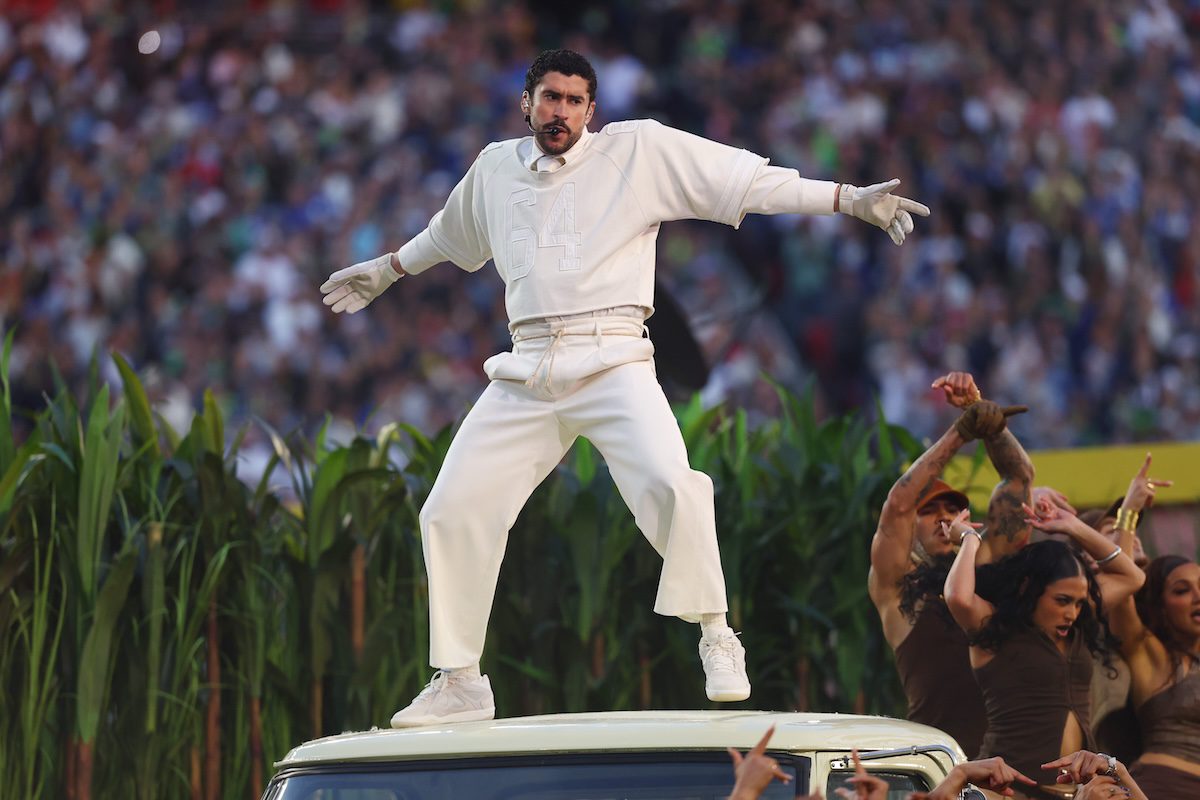
Bad Bunny performs during the Super Bowl halftime show at Levi's Stadium on Feb. 8, 2026. (Mark J. Rebilas-Imagn Images via Reuters Connect)
The three Tucson natives smiled and swayed slightly as they played their violins to Bad Bunny’s song “Monaco” against a backdrop of people dressed as tall fields of grass.
Desiree Velasco-Zavala, Julissa Dominguez, and Leah Lopez took the opportunity to play alongside viral musician sensation and vocal immigrant advocate Bad Bunny.
At a time when the Latino community feels their community and immigrant communities are under attack, Velasco-Zavala said the performance was a moment to show the labor, love, strength, resilience and community-oriented mindset of the Latino community.
MORE: The world’s best hoop dancers are competing in Phoenix. How to watch
“And that’s like something that people can connect to no matter who they are, no matter how old they are. No matter where they’re from,” Velasco-Zavala told The Arizona Republic.
The trio members originally are from Tucson and moved to Los Angeles to advance their careers as musicians and mariachi performers.
They normally play with the Los Angeles-based group Mariachi Divas de Cindy Shea, but they were independently contracted for the Feb. 8 Super Bowl LX halftime show at Levi’s Stadium in Santa Clara, California.
The dream performance they never dreamed of
In their multi-decade careers as musicians, Velasco-Zavala and Dominguez have played at many different events and alongside many different musicians.
The director of the mariachi group, Cindy Shea, told the women there was an opportunity for her to submit the musicians’ applications for the opportunity to perform at the halftime show with Bad Bunny, Dominguez said.
However, neither of them dreamed they would play alongside Bad Bunny.
“I’ve always played Mexican regional music, and it’s not a stage that you even connect to the Super Bowl. Like Latin music, you don’t even connect it to the Super Bowl at all,” Velasco-Zavala said. “And so this was a really groundbreaking thing and it wasn’t even a dream that I had formed.”
Dominguez was blown away by the opportunity to perform at the Super Bowl halftime show and never thought “in a million years” that she would get to play at the Super Bowl with Bad Bunny.
“It’s crazy,” Dominguez said.
Velasco-Zavala called the opportunity a dream “so big that it just hasn’t even occurred to you.”
What was Rep. Adelita Grijalva’s connection to the musicians?
Rep. Adelita Grijalva, a self-proclaimed “mariachi-mom,” was excited when she saw the three Tucson musicians performing during the Super Bowl halftime show.
Grijalva, D-Arizona, used Instagram to highlight their performance as a proud moment for their community. The post was reposted more than 2,900 times and received more than 420 comments.
Grijalva said she used to drive Leah Lopez and her daughter to Tucson Davis Elementary School mariachi camp when they were about five years old.
“I’ve seen her literally grow up. So it was amazing to see her reach this whole other pinnacle,” Grijalva told The Republic.
Leah Lopez was not available for an interview.
‘Play until I die’
Velasco-Zavala came from a long line of musicians, going as far back as her grandmother’s brother, Lalo Robles.
Robles’ band toured with Lalo Guerrero, a musician dubbed the father of Chicano music, Velasco-Zavala said.
Velasco-Zavala’s father also had a band that placed second in a battle of the bands competition. Tucson native Linda Ronstadt took first in that competition, Velasco-Zavala said.
“I used to listen to him when I was a kid, and I would think, ‘I just want to play as good as my dad. I want to sound like that,'” Velasco-Zavala said.
Velasco-Zavala said her father is battling pancreatic cancer and has neuropathy in his fingers. Neuropathy is a condition in which the nerves outside the brain and spinal cord are damaged, leading to the hands and feet feeling weak, numb and painful, according to the Mayo Clinic.
“He still sits at the piano to play,” Velasco-Zavala said.
Velasco-Zavala said Robles also played music to the very end.
One day, when Velasco-Zavalawas was at Robles’ home, she said he came home late from a gig where he played the saxophone all night.
Robles had stomach cancer at the time, Velasco-Zavala said.
“And the next day we were at his house and he was like, ‘oh my God, my stomach is killing me. And if I play all night like that, again, I know I’m gonna die.’ And I told him, ‘oh Tio (Spanish word for uncle), what are you gonna do?’ And he goes, ‘tonight I’m going on guitar,’ Velasco-Zavala said.
Velasco-Zavala thought Robles was going to stop playing, but he said, “no, I’m gonna go tonight on guitar.”
Robles died two months later, Velasco-Zavala said.
“I just thought I’m going to be like that. I want to be like that. I want to be like him. I want to play until I die,” Velasco-Zavala said.
From early career ‘frosty receptions’ to Super Bowl Performances
Velasco-Zavala entered the mariachi scene at a time when “the reception was very frosty.”
“I remember very clearly this man telling me, ‘you know, these days you women think that you’re going to come and play mariachi, but you’ll never be a charro. You’ll never be a true mariachi because women aren’t mariachis. They’re not charros. What you are is an ornament,'” Velasco-Zavala said.
Before Velasco-Zavala played in mariachi, she was trained in classical piano.
When Velasco-Zavala first started playing the violin, she said she was terrible.
“I had never played violin, and it was really a struggle. And so many days I would like sit outside the practices and cry because I didn’t know how to learn by ear,” Velasco-Zavala said.
Many times, Velasco-Zavala would sit with her frustrations, but she said she would think about her two choices: quit or keep practicing and dedicating herself to this music.
Velasco-Zavala chose the latter.
Velasco-Zavala’s mariachi skills improved with her career taking her to Los Angeles. To this day, Velasco-Zavala still consistently practices her craft, whether it is for a party with a small audience or a large stadium-sized crowd.
Velasco-Zavala will often practice in the backseat of her Nissan Pathfinder during her kids’ volleyball or soccer practice.
Velasco-Zavala and Dominguez were feet away from Bad Bunny when he said his viral line: “Hoy estoy aquí en la Super Bowl LX porque yo nunca, nunca dejaré de creer en mí. Tú también deberías de creer en ti. Vale más de lo que piensas. Creerme”
This translated to “I am at Super Bowl LX because I never, never stopped believing in myself. You also need to believe in yourself. You are worth more than you think. Believe me.”
Dominguez and Velasco-Zavala described it as a pinnacle moment.
“I feel that same way in that moment is that sticking to something, hard work, dedication, it pays off. And to represent Tucson, to represent the mariachi community, the Latino community as a whole, Mexican music, women in mariachi music, I don’t take it lightly,” Dominguez said.
The most important thing is that people keep that faith in themselves alive, Velasco-Zavala said.
“I just always knew there’s like two options. You’re either going to keep doing this and work harder, or you’re just going to walk away now and say, ‘that’s it.’ And I’ve always said, ‘You know what? I’m going to keep at it,'” Velasco-Zavala said.
Reporting by David Ulloa Jr, Arizona Republic
Author

Support Our Cause
Thank you for taking the time to read our work. Before you go, we hope you'll consider supporting our values-driven journalism, which has always strived to make clear what's really at stake for Arizonans and our future.
Since day one, our goal here at The Copper Courier has always been to empower people across the state with fact-based news and information. We believe that when people are armed with knowledge about what's happening in their local, state, and federal governments—including who is working on their behalf and who is actively trying to block efforts aimed at improving the daily lives of Arizona families—they will be inspired to become civically engaged.


This Phoenix family just won the ‘Great Christmas Light Fight’
If Christmas spirit had a ZIP code, it would probably forward its mail straight to north Phoenix because The Biggest Little Christmas in...
Ordinary Arizonans who performed extraordinary acts of kindness in 2025
Small acts of kindness can quickly turn extraordinary, as evidenced by these 13 stories. As 2025 comes to a close, reflecting on both the good and...
Hazel Chandler, who fought for cleaner air and climate action in Arizona, dies at 80
Next time the Phoenix environmental activism community gathers to demand action on air quality or climate change, it will be without one of its most...
Arizona political giant Alfredo Gutierrez remembered at celebration of life
People gathered on the afternoon of Oct. 26 at the Salvation Army Kroc Center in Phoenix for a celebration of the life of Alfredo Gutiérrez, a...