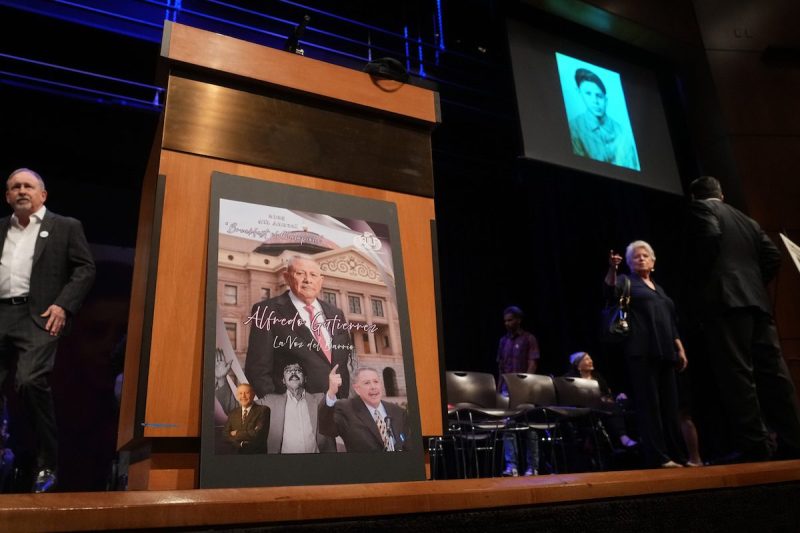
People gathered on the afternoon of Oct. 26 at the Salvation Army Kroc Center in Phoenix for a celebration of the life of Alfredo Gutiérrez, a progressive political leader whose influence in Arizona spanned decades.
Gutiérrez died July 29 from cancer. He was 79.
Gutiérrez’s life was filled with many roles — Army private, civil rights activist, state lawmaker, Arizona Senate majority and minority leader, gubernatorial candidate, political consultant and radio host, among others — linked by his desire to improve the lives of immigrants and increase access to education.
He helped found Chicanos Por La Causa and Valle del Sol, two organizations that provide social services to working-class Latino families. Gutiérrez was also instrumental in opening South Mountain Community College to serve students in predominantly Latino and Black neighborhoods in south Phoenix.
Want Arizona news in your inbox each morning? Sign up for our free newsletter.
Memorial attendees began trickling into the auditorium where Gutiérrez’s service was scheduled for about 2 p.m.
Some mourners quietly took their seats in anticipation of the service, while others gathered in groups to talk.
“I knew Alfredo when I was a legislative intern, so I was able to see him work his magic,” said Eddie Cissins from Phoenix. “I loved his willingness to work with people and the fact he knew where he wanted to go.”
A slideshow was projected on the stage, showcasing photos of Gutiérrez and his family and highlighting his legacy of service to immigrants and Arizonans.
She concluded by promising to keep pushing forward and to remain courageous for those in the community who need support.
READ MORE: Nearly 100 volunteers stuff stockings in Phoenix for Chicanos Por La Causa’s holiday events
The event began a little after 3 p.m., a fitting tribute to Gutierrez’s legacy of being a little late, said his wife, Sharon Gutiérrez, who spoke about her husband’s deep connection to the Kroc Center, describing it as her husband’s second home and saying there was no more fitting place to hold his memorial.
“It is extremely appropriate that we are here at the Kroc Center in District 23, where he served,” she said.
She also shared a more personal note, mentioning the couple’s pet cat, who, she said, was grieving like the rest of the family.
Gutiérrez’s obituary was then read aloud in Spanish.
Gov. Katie Hobbs followed, reflecting on Alfredo Gutiérrez’s influence on her career and describing him as both a friend and an inspiration.
“Alfredo taught us to always lead from the front line,” Hobbs said. “So in his absence and in honor of his life’s work and commitment to freedom and justice for all, we must come together as one community and look out for each other.”
Hobbs grew emotional as she recalled a moment when Gutiérrez once called her courageous. “For a man like Alfredo, whose entire life was courageous, to use that word to describe my actions, truly meant the world to me,” she said.
Next, Earl and Mary Rose Wilcox took the stage. The couple, introduced more than five decades ago by Alfredo Gutiérrez, reflected on the influence he had on their lives and community.
Earl Wilcox spoke first, describing how Gutiérrez had long been a political inspiration, particularly as an advocate for education for Latinos acrossArizona.
“It was about motivating,” he said. “It was inspiring a community into action, about having the community involved in the political arena.”
He also reflected on Gutiérrez’s humility, adding, “He never talked about his achievements. Others will talk about his achievements.”
Mary Rose Wilcox followed, emphasizing that Gutierrez should be remembered most for his commitment to expanding health care access.
“Our communities need to be treated with dignity, they need to be treated in fairness, and they need, more importantly, access to good, good healthcare,” Mary Rose Wilcox said. “So that is the thing that I think, if anything, if you want to remember him by, remember him by access.”
Gutiérrez served in Vietnam, then led protests at ASU
Gutiérrez grew up in a working-class family in Miami, an Arizona mining town east of Phoenix. At 17, Gutiérrez enlisted and spent three years in the Army infantry, including a year fighting in Vietnam as a sharpshooter and carrying out operations as part of a special unit.
While in the military, he realized that the soldiers he met who had college degrees were no smarter than him.
“They had no common sense, I thought, on how to deal with the realities that are imposed upon you in the Army in the ’60s,” Gutiérrez said in 2024. “So the idea of going to college became agreeable to me. It was no longer the impossible barrier to me.”
When he came home from Vietnam, Gutiérrez enrolled at ASU on the GI Bill. He was the first person in his family to attend college.
It was a time of large student protests on college campuses. The civil rights movement, the Chicano movement and the anti-Vietnam War movement were all taking place.
Inspired by Cesar Chavez, the farm worker advocate and civil rights leader, Gutiérrez helped form the Mexican American Student Organization at ASU, which later became Movimiento Estudiantil Chicano de Aztlán, also known as M.E.Ch.A.
One of the Mexican American Student Organization’s main causes became fighting for Mexican women, many undocumented, toiling in deplorable conditions for low pay at a laundry that washed bedding for sororities and fraternities on campus under contract with ASU.
Gutiérrez led protests demanding that ASU pressure the laundry to improve working conditions and wages. When the university refused, Gutiérrez helped lead a group of students who took over the president’s office for several days.
In response, state troopers surrounded the building, the Arizona Board of Regents demanded the students be expelled, and the Legislature asked the governor to call up the National Guard, Gutiérrez said.
“It was kind of crazy,” Gutiérrez said.
Gutiérrez said the university was determined to kick him out. He said he was accused of violating a student code of conduct that the university rejiggered specifically to force him out. He was given a choice, he said: be expelled with no chance of returning or leave voluntarily with the opportunity to reapply for admission in the future.
“I chose to leave so I could come back,” Gutiérrez said.
But Gutiérrez never went back.
He got married, had a baby and needed money to support his family.
“Life happened,” Gutiérrez said.
‘Alfredo’s store’: Gutiérrez was dealmaker in Arizona Legislature
Gutiérrez went to California to work with Cesar Chavez, organizing farm workers. He also worked for Robert F. Kennedy’s 1968 presidential campaign. He was at the Ambassador Hotel in Los Angeles the night Kennedy was shot on June 5, 1968.
After Kennedy’s death, Gutiérrez was among the first to receive a Kennedy Memorial Fellowship to spend 18 months training to pursue a career in politics, public service and social justice. The stipend allowed him to support his family, and the experience was life-changing. It put Gutierrez in contact with some of the day’s most prominent and important social justice and civil rights leaders.
“I attended a number of seminars with some extraordinary people, went to Harvard for special programs and in D.C. met with some unbelievable folks,” Gutiérrez said. The people he met included U.S. Sens. Ted Kennedy and J. William Fulbright and political activist Ralph Nader.
In 1972, when Gutiérrez was 27, he ran for the state Senate in District 23 and won. Two years later, he was selected to serve as Senate majority leader. He spent 14 years in the Legislature, most of that time in leadership roles.
To Democratic Gov. Bruce Babbitt, Gutiérrez was an eye-opener when Babbitt suddenly ascended to the office in 1978.
“I quickly learned that my success was in his hands,” Babbitt said in a phone interview from Washington, D.C., shortly after Gutiérrez’s death.
“He really ran the Legislature in many ways,” Babbitt said. “We all referred to the Legislature as ‘Alfredo’s store’: Any Republican who needed something came to Alfredo first.”
Pete Rios, a former state Senate president, said Gutiérrez earned the nickname “Captain Chaos” for his ability to divide the Republican caucus.
Gutiérrez used the leverage he had over Democratic votes to extract concessions from Republicans when they were in power. His “store” was the epicenter of classic deal-making, resulting in more funding for the underserved populations that Gutiérrez advocated for.
Babbitt said Gutiérrez was regarded as a “wild-eyed” lawmaker, a reputation the south Phoenix legislator enjoyed.
“But in fact he was the consummate politician, a dealmaker,” Babbitt said, calling Gutiérrez perhaps “the most important legislator in my life.”
While in the Legislature, Gutiérrez pushed for Arizona to finally join the Medicaid program. Since then, the Arizona Health Care Cost Containment System, or AHCCCS, has provided health care to millions of low-income families and individuals.
Stories abounded about Gutiérrez’s sway at the 90-member state Legislature.
“They used to say it was 89 people surrounded by Alfredo,” recalled Terry Goddard, who watched Gutiérrez’s maneuvers long before he himself got into politics. “He was the whirlwind that sort of went around everybody else.”
Like many others, he marveled at Gutiérrez’s strategic thinking on issues, from the launch of the state’s Medicaid program to the creation of the 1980 groundwater code.
“I never knew anyone who was so farsighted,” said Goddard, who went on to become Phoenix mayor and, later, state attorney general.
Nor, he said, had he ever in his entire public life met anyone who would quote Samuel Beckett’s “Waiting for Godot” when discussing policy.
Gutiérrez’s life after the Legislature saw more activism and a degree
Upon arriving at the Capitol, Gutiérrez was quickly labeled a radical by The Arizona Republic. But despite his populist ideologies — he pushed for expanded social services, education and better protection of civil rights — he was able to find some common ground with some conservatives.
When he left the Legislature in early 1987, lawmakers and lobbyists pooled together the money to buy and present him with a new Pontiac Grand Am. Gutiérrez did not own a car at the time.
After leaving office, the political consulting firm he co-founded, Jamieson and Gutiérrez, helped pave the way for the construction of sports arenas in a downtrodden area of central Phoenix. Although the idea of using public money to build sports arenas was politically unpopular at the time, Gutiérrez said he saw building the facilities as a way of revitalizing the city’s economically depressed core.
In the 2000s, Gutiérrez helped lead grassroots campaigns against the 2010 immigration enforcement law known as Senate Bill 1070 and former Maricopa County Sheriff Joe Arpaio’s immigration sweeps. He also slammed the federal immigration policies of then-President Barack Obama, and became a lecturer for the grassroots migrants-rights organization Puente.
He hosted a Spanish-language radio program for seven years, too.
Given his broad following, he would often receive personal items found in the desert near the Arizona-Mexico border. He would describe the items during the radio show, hoping that someone would recognize them or confirm that they had made it across the border safely.
“My father was deported during Operation Repatriation in the mid-’30s. He was recruited to return to the U.S. during World War II because of the shortage of underground miners,” Gutiérrez told MSNBC. “From the time I can remember, it was drilled into us never to discuss the deportation or the legal status of the family outside the house. … Advocating justice for immigrants has seemed like my calling.”
In 2014, Gutiérrez was appointed to the governing board of the Maricopa Community Colleges. He stepped down as board president in 2018 after a fall caused a brain injury that temporarily affected his ability to walk and talk.
“I have seven or eight good years (left), and I don’t want to spend them arguing with right-wingers, which is what I do on that board,” Gutiérrez told theArizona Capitol Times in his typically brusque style. “I need to get on with doing something great again.”
In 2023, Gutiérrez decided to return to ASU and complete his degree, graduating in 2024. It was one of his crowning achievements and made personal his lifelong push for better educational opportunities for minority communities.
Over the years, Gutiérrez spent a lot of time speaking to young people, especially Latinos, about the importance of staying in school and encouraging them to go to college. But the fact that he had never graduated himself gnawed at him.
“It seemed to me at 78 somewhat hypocritical that I had done that most of my life, and I didn’t have the discipline, or didn’t make the time, whichever the case may be, to go back and finish myself,” Gutiérrez said. “I just felt I had to do it.”
Reporting by Daniel Gonzalez and Wren Smetana, Arizona Republic. Former Republic reporters Mary Jo Pitzl and Maria Polletta contributed.
(This article has been updated to add new information.)