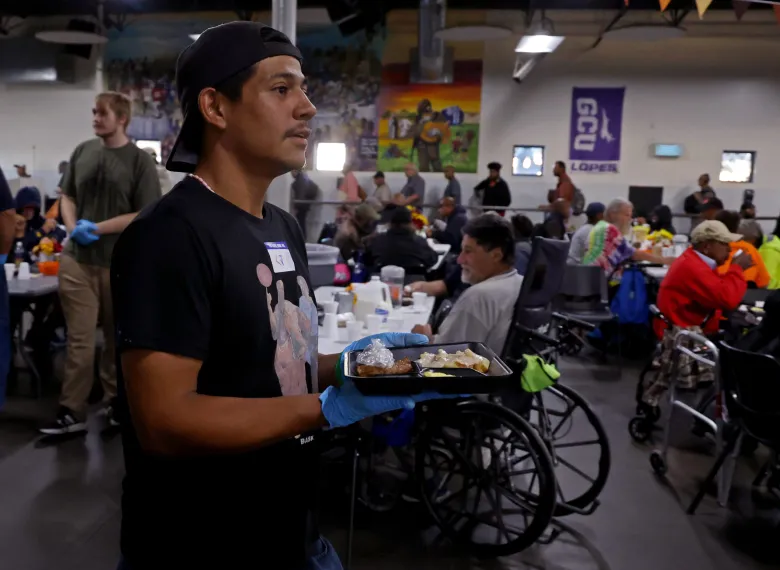
CJ Chavez, a volunteer who is also facing homelessness, carries a breakfast tray at the St. Vincent de Paul Phoenix Dining Room on the Key Campus in downtown Phoenix on Nov. 5, 2025. (Photo by Sydney Lovan/Cronkite News)
PHOENIX — As the sun began to peak over the horizon, the roosters tested out their newly developed crows, signaling the new day to come to everyone on the Key Campus.
But inside the St. Vincent de Paul Phoenix Dining Room, volunteers were already hard at work scooping peanut butter into small containers, filling coffee pitchers and placing fake flower arrangements on each table, prepping the room for the soon-to-arrive visitors. Among them, CJ Chavez too helped ready the room. He sported cuffed jeans, an ear-to-ear smile, and yellow socks to match his bubbly, enthusiastic attitude.
As dining room visitors filed in, Chavez bounced around the room, throwing away empty trays and grabbing ones for those unable to do so themselves. Beneath Chavez’s Indigenous Voters hat and chipper disposition, he worked to serve the people in the same situation he was in — those experiencing homelessness.
RELATED: Amid rise in homelessness in Phoenix, resources drop as COVID-19 era funding ends
Chavez had been homeless since March, he said, but now he is living at the Respiro Shelter on the Key Campus and volunteering in the dining room. Volunteers choose their shifts and how often they volunteer.
Chavez is just one of the many people in Arizona experiencing homelessness. There were almost 10,000 unhoused people in Maricopa County alone as of January 2025. Just under half of those individuals are in some kind of transition housing or emergency shelter, just like Chavez is.
Homelessness, according to the Point in Time Count Report, rose 3% from 2024 to 2025. And as numbers rise, funding for services diminishes. Vital homeless services throughout Phoenix and the state rely on federal and state funding, especially money allocated from the American Rescue Plan Act. The act provides a variety of funding for organizations like Keys to Change, the Phoenix Office of Homeless Solutions and the Arizona Health Care Cost Containment System.
Additionally, the Trump administration has proposed sweeping budget cuts — $2 billion — to permanent housing assistance programs that help provide permanent housing options to people experiencing homelessness. That has meant that the institutions on the frontlines have had to come up with novel solutions to serve the homeless community, depending more and more on volunteers to fill the gaps.
Proposed cuts and looming funding expirations haven’t deterred determined volunteers and homeless services employees, though. Volunteers and full-time workers alike find the passion to show up for their shifts, but their strikingly different circumstances challenge them in distinct profound ways.
Chavez volunteered at the St. Vincent de Paul Dining Room when he felt up to it. It offered respite from his temptation to get high each morning, he said.
“So it was hard to not get high this morning, because I know where to find it. But I didn’t get high, and I just came straight here, and there was the Lord following me the whole way,” he said.

Volunteering in the dining room offered a distraction, and it helped him connect with his faith. While fellow volunteers had different backgrounds than Chavez, they did share some common ground — leaning on their faith to serve others.
For full-time employees at Keys to Change and St. Vincent de Paul, destressing on and off the job is essential to keep them going when the emotional burden of working with a vulnerable population weighs them down.
Volunteering for God, leaning on his comfort
Volunteering isn’t new for Chavez. He was volunteering before he became homeless in March, but he said he had to “be selfish” for a bit before returning\. He said he was going through a lot, and working so closely with people in the same boat as him was too much at first. He’s been volunteering on and off since then.
Not only is Chavez giving back to the community, but he said he’s connecting with his religion and “starting the day off serving the Lord.” He believes in good karma, too, hoping his spiritual hard work will sow physical reward.
Back in the dining room, the faux sunflowers and carnations, the friendly eyes of volunteers, and — of course — the free food brought warmth to the concrete floors, fluorescent lights and the white rectangular folding tables. The dining room provides breakfast Monday through Friday, lunch daily, and dinner on Fridays from 4 to 5 p.m. Each meal relies on volunteers to help prepare the dining hall, hand out food, clean up and interact with visitors.
When Chavez volunteered on Nov. 5, he was joined by a cohort of Grand Canyon University students who regularly spend their Wednesday mornings in the dining room volunteering. That morning, the GCU students joked with each other, their laughter bouncing off the walls despite the early morning wakeup call.

After finishing the dining room setup, the students gathered in prayer before the visitors arrived. They held hands, squeezed each other’s shoulders and bowed their heads, praying for a good shift and to carry the Lord with them throughout it. And they did just that. Students carried Bible verses with them, passing them out to visitors and the dining room staff. Some students even prayed with visitors, grabbing their shoulders, bowing their heads again and praying for them.
Having faith and thinking of the Lord reminds GCU student volunteer Eden McKay that “there’s hope.” Sometimes the emotional weight of a shift can be a lot, or simply the early morning wake-up, but leaning on her fellow students in the same boat helps her push through.
Prayer is a common theme for the GCU students volunteering as part of the Homeless Ministry, a community outreach program at the university. Before arriving at the dining hall, the students meet for a devotional with their leaders and colleagues. At the conclusion of the shift, they share their wins, impactful conversations they had and overall how they’re feeling. This time is key for students feeling down, McKay said, adding that sharing with others and talking to their leaders is crucial when the emotions become hard.
GCU students and Chavez volunteer for their faith, but Chavez also uses his volunteering as a distraction — a common refrain for many in a similar situation, according to Jessica Dickerson, assistant manager of the St. Vincent de Paul Phoenix Dining Room.
“Having a sense of something to do and a purpose, of like, ‘Oh, I’m not just kind of wandering today, I’m going to help, and I’m going to, you know, have a job to do, a task to perform,’” she said.“That helps as well.”
Working for heart and purpose, pushing through hard days
Dickerson works full time in the dining room. She got her start in the kitchen after going to culinary school, and then she moved to one of the St. Vincent de Paul thrift stores. But when she had the chance to return to the kitchen, she took it.
“This is just more my heart, like the food and to serve,” Dickerson said.

She isn’t immune to the stressors of work, especially when working with a vulnerable demographic. So she colors and she hangs out with the chickens at the dining room when she needs relief.
“There’s some really good stories that we get of people that do, you know, want help. They get the help, and they come and let us know,” she said. “That’s always like ‘ahh,’ it makes you feel good, like ‘ahh,’ about, we are doing good.”
But it’s not always good things, and that can sometimes bring Dickerson down.
“And then there’s just, you know, we have clients that this is what they prefer, their lifestyle. You do your best to support that,” she said. “It’s kind of sad, but just try to help keep their days positive.”
When the sad stories hit harder, she makes a trip to see her feathered friends, the very ones that greet volunteers with their cries as they arrive early in the morning. For Jennifer Frazier, her stress relief leans more on the spontaneous side, though she, too, is an animal lover, she said.
Frazier is the supervisor of the Keys to Change Safe Outdoor Space, which is a collaborative project with Phoenix. The campus provides 200 campsites that serve 300 people experiencing homelessness, as well as meals, showers, restrooms and case management.
Before Frazier became the supervisor, she worked for Community Bridges Inc., which helps with addiction treatment and behavioral health concerns, exactly what Frazier took classes in while she was in prison. Before her CBI job, she served two and a half years in prison, though she was facing 25 to 111 years. And before her prison sentence, Frazier was addicted to heroin and experiencing homelessness.
Then she turned things around. After taking a plea deal that drastically brought her prison time down, she said she knew something needed to change.
“So I decided right then and there that I needed to do something with that second chance,” she said. “So I had my mind made up right there, that I was going to do better for myself and my family, for my kids.”
Frazier said she found her purpose after she was released from prison. She never felt like her life had meaning until she began working with vulnerable communities and helping people using her own life experiences, she said.
“Working with the homeless population is very close to my heart, because I was homeless, too,” she said. “ I discovered that I never felt like I had a purpose my entire life, like I just kind of felt like I just had no purpose or meaning. And as soon as I started working down on campus with CBI, I realized that I do have a purpose.”
Her move to the Safe Outdoor Space and the position she holds now just solidified that sentiment for her. Frazier had some “dark days” in her past, but that drives her passion for her job now.
“I never thought, like in a billion years, that I would ever be anything more than a homeless heroin addict,” she said. But she tells her story to everyone at work, including the participants seeking care and housing.
“Eight years ago, I was in your exact same position. I’m like, you could be in my exact same position, too,” she tells the people she interacts with.
She loves her work, but she also has to fight through the tough times just like Dickerson, the GCU volunteers and Chavez.
“Anytime I feel like I need to go to check out, like, I’ll just tell my husband and be like, ‘Hey, pack a bag. We’re going to Flagstaff,’” she said. “Like it’s just, I really just do things on a whim.”
Spontaneous trips and concerts give Frazier an occasional outlet from work. On a more consistent basis, she makes sure to spend time with her family because she said she wasn’t present for them earlier in her life. She doesn’t bring her work home, and once she gets in her car, she knows it’s time for her family, pets and husband, she said.
A quick escape to Flagstaff or the Grand Canyon gives Frazier relief after a long day or a long week, but sometimes she needs relief on the job. Luckily, Frazier said she has a great team behind her and she can always excuse herself for a walk when emotions strike.
Even though her work can be triggering at times when she sees people in the same situation she was in, she wouldn’t want to be anywhere else.
“Working in the field has given me, my life, meaning,” she said.
This article first appeared on Cronkite News and is republished here under a Creative Commons Attribution-NoDerivatives 4.0 International License.
Author


New Buckeye neighborhood has homes priced in mid-$300Ks. Check it out
A new Buckeye community with home prices starting in the mid-$300,000s is open for sales. Dream Finders Homes has launched Apache Farms with 85 home...
Arizona AG settles with 1 of 9 landlords accused of price fixing
The Arizona Attorney General's Office has settled with one of nine landlords it sued in February 2024 for engaging in a price fixing operation that...

Metro Phoenix’s housing market started 2026 slow. Here’s what to know
Metro Phoenix’s median home price held steady in 2025, but slid in January with a drop in home sales. Pricier home sales propped up the Valley’s...

What $1,500 in rent gets you in different parts of metro Phoenix
For most renters, the biggest factor guiding their decision on where to live is how much the rental costs. The average cost of an apartment rental...