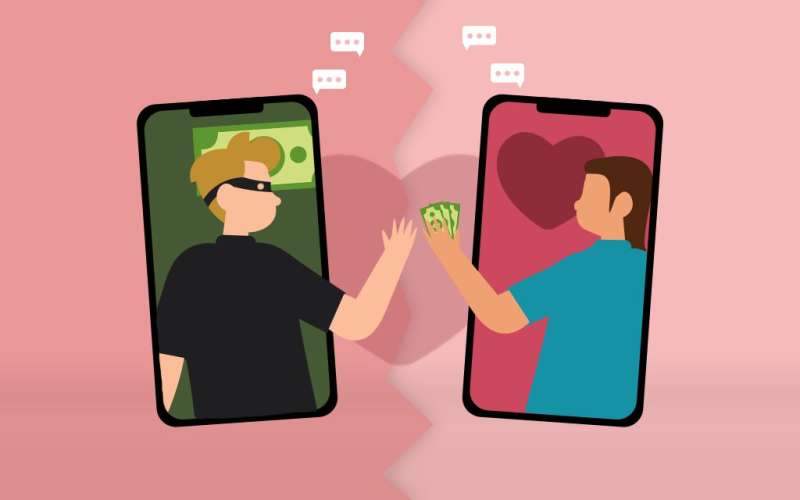
Dawn Alexander, an analyst with AARP Arizona, said the biggest red flag when starting a romantic relationship online is communicating with someone who professes “instant love.”
PHOENIX – Looking for love online? Be on guard: That suitor tugging at your heartstrings over text messages and emails may be interested only in your purse strings.
In Arizona, losses from online romance scams totaled more than $47 million in 2022 and 2023, according to data from the FBI Internet Crime Complaint Center. The Investor Loss Center ranked Arizona fifth for losses based on the FBI figures, behind only California, Florida, Texas and New York.
The issue has been on Arizona Attorney General Kris Mayes’ radar for a while.
“This is an all-hands-on-deck moment,” Mayes said earlier in February after a town hall on the subject. “These scammers are everywhere. These crimes are on the rise, and the amounts of money that they are stealing from especially our elderly are astronomical.”
In April 2024, the AG’s Office brought a case against Donald Franklin Huegel, a California resident who worked with Nigerian scammers to defraud two older Arizona residents out of $457,000. Huegel was convicted of fraudulent schemes, illegally conducting an enterprise, money laundering and theft. He was sentenced to four years in prison by a Pima County Superior Court judge.
RELATED: Rent’s due: What to do if you are being illegally charged rental tax in Arizona
In a press release after Huegel’s sentencing, Mayes cautioned scammers that they would be discovered and prosecuted by the state Attorney General’s Office. While people over 60 are among the frequent targets of online fraud, the FBI report showed people as young as 30 also are vulnerable.
Dawn Alexander, an analyst with AARP Arizona, said the biggest red flag when starting a romantic relationship online is communicating with someone who professes “instant love.”
“Somebody is going to engage somebody, and they’re going to move very fast,” Alexander said. “They’re going to want to get off the original platform that you got on, and they’re going to move to either text messages or email. They’re going to be instantly in love with you. They are never really going to be available, but they will connect you when it’s convenient for them.”
Another tipoff is that the scammer won’t post photos of themself. And some immediately ask for money. Some victims can be strung along for a long time, even driving them to bankruptcy, she added.
Unfortunately, with such a sensitive topic, Alexander said, she believes that the amount of money lost to romance scams is underreported.
“People are embarrassed,” she said. “People don’t want to express the fact that they’ve been taken advantage of. So the numbers we have are high, but unfortunately, they’re not true numbers because people are not reporting it.”
Sgt. Lance Hunzeker of the Maricopa County Sheriff’s Department said romance scams have been skyrocketing in recent years. Part of the reason they’re so high in Arizona is the number of retirees.
When asked why older adults are affected disproportionately, Hunzeker said “it’s not because these victims are dumb or old, but because they’re at a stage in their life where they have money.”
Con artists are increasingly using artificial intelligence and new technology to snare victims.
“We’re coming up on Valentine’s Day. This is a time when people are looking for love. We all love love. But unfortunately, sometimes that leaves us vulnerable to attempts to take advantage of us,” Mayes said. “These scammers know that, and they are increasingly using AI and technology to try to scam us out of money, using our desire for romance as a hook, as a bait for that.”
Jaron Mink, assistant professor at Arizona State University’s School of Computing and Augmented Intelligence, studies emerging technologies and how they impact security and privacy.
“The biggest concern is the ability to duplicate people’s identities in ways that weren’t possible before,” they said. “You can now create fake images of a very consistent persona in different places, areas, and make something very convincing. You can impersonate specific people and you can do this in all different types of medium in terms of text, image, video, audio.”
As the capabilities and frequency of these scams increase, AARP Arizona has taken an active role in educating all age groups to be vigilant about suspicious activity and correspondence. If you believe that you or someone you know has been a victim of fraud, call AARP’s Fraud Watch Network helpline at 1-877-908-3360. It is free and available to anyone, regardless of age or AARP membership.
The Arizona Attorney General Office also has a Task Force Against Senior Abuse where fraud can be reported via telephone or email. Call the toll free helpline at 1-844-894-4735 or email seniorabuse@azag.gov.
For more stories from Cronkite News, visit cronkitenews.azpbs.org.