In Maricopa County, feral cats cannot be picked up and taken to shelters—and that’s where volunteers step in.
PHOENIX – In the sprawling urban landscape of Phoenix, where the desert sun sets over bustling streets, there are volunteers quietly tending to a population often overlooked: feral cats.
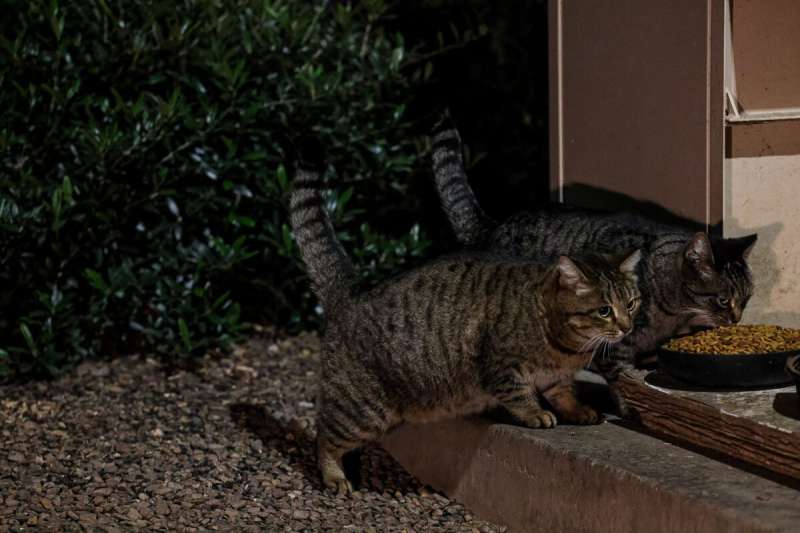
Jennifer Nitrio’s nightly routine involves filling food dishes for these feline friends. It’s a ritual she’s faithfully performed for a quarter-century.
“I’ve always had this thing that attracted cats to me, and I definitely started doing this younger than most people,” she said. “A lot of people are already retired at a different place in their life, so I’m definitely an atypical demographic to have started doing this in college and then kept up with it for all of these years.”
In Maricopa County alone, the need is staggering. In 2014, the Arizona Humane Society estimated that 250,000 cats roamed the streets. Nitrio thinks that number has more than doubled in the past decade, but she doesn’t see the feral cats as a problem.
RELATED: Here’s how Arizona Animal Welfare League houses over 400 animals and maintains a ‘no-kill’ status
“We view this as something that has happened because of the behavior of humans,” Nitrio said, noting that feral cats aren’t subject to the same rules as other animals and fall somewhere between household pets and wildlife.
Nitrio volunteers with Kind to Nature, a nonprofit dedicated to protecting animals. Beyond merely providing food and water, the organization, along with others, practices “Trap, Neuter, Return” (TNR), a humane approach aimed at stabilizing and improving the health of feral cat populations. TNR is when volunteers trap the cats and take them to a vet to get spayed or neutered, and after the cat is healed, it is released back to its colony.
According to Nitrio, with TNR there is less of a chance for disease to spread, male cats do not fight as much, and the production cycle of kittens is stopped.
“Our goal is always to get a single colony completely. You never want to leave one or two out there because if you’ve left a breeding pair or even two males, they’re going to go out and find females elsewhere. So it’s hugely important to us to always focus on getting one colony out completely,” Nitrio said.
When Nitrio isn’t out with Kind to Nature, she acts as an independent trapper, scrolling sites such as Nextdoor for people who are looking for help with feral cats. She often will go out and help set up traps or educate them about how they can do TNR properly themselves.
In Maricopa County, cats are not subjected to the same rules as dogs. Stray cats cannot be picked up and taken to shelters, and that’s where volunteers step in.
Anna Zhundrikova is a volunteer with Saving One Life, another nonprofit that advocates for TNR.
“I don’t want to see a bunch of animals suffering outside, and I think Trap, Neuter, Return combined with proper colony management is the most humane solution,” she said.
Even municipalities are joining the effort. In a bid to address concerns regarding cat behavior on residential properties, Tempe’s Office of Animal Welfare is working with residents to find effective solutions to manage cats in their community. A big part of the effort is TNR.
Nitrio doesn’t get paid, but she finds fulfillment in the gratitude of the animals, who can’t advocate for themselves. She said her currency is the well-being of the cats she cares for.
“It bankrupts me to see their little faces. You know you’re doing good for animals that can’t advocate for themselves,” she said.
One night in February, dozens of cats flooded to an open alley in Tempe as Nitrio drove up and pulled out food dishes. It’s almost as if the cats knew the sound of her car. Some approached her for affection, with one even jumping in her car, but most kept their distance. Still Nitrio knows she’s welcome there.
“I’d like to think that they have some level of gratitude, that they know they’re loved and cared for,” she said.