Amid public concerns about the controversial Flock license plate readers installed in various locations across the Navajo Nation, the Navajo Division of Transportation said the project was not its initiative, but was led by the Navajo Nation Criminal Investigations Department and the Navajo Nation Police Department.
Flock cameras capture images of passing vehicles and upload information—including the license plate number, make, model and color—to a searchable database that law enforcement officials can use to investigate crimes and locate suspects. The company that supplies the cameras described them as an important way to cover enforcement gaps.
MORE: Are Chandler’s surveillance cameras helping ICE track immigrants?
The appearance of these cameras on the Navajo Nation seemingly caught Navajo citizens off guard. At a Gallup City Council meeting, one resident called the prospect of the cameras “terrifying” and an invasion of privacy. But the initiative has the support of Navajo leaders, who said it would help solve crimes faster.
The Arizona Republic contacted the Navajo Division of Public Safety seeking information from the division and the Navajo Police Department about the Flock cameras. The public information officer referred to the director of the Navajo Nation Criminal Investigations Department, saying the office would be the best source for the requested information.
A day later, the Navajo Police Department posted a news release from Flock on its Facebook page discussing the project.
It confirmed that Flock has partnered with the Navajo Nation to deploy its license plate reader cameras in support of the Navajo Department of Criminal Investigation and the Navajo Nation Police Department.
“When we launched Flock, our goal was to help make communities safer everywhere, especially in places that have been underserved for far too long,” said Garrett Langley, founder and CEO of Flock. “The Navajo Nation faces some of the most difficult public safety challenges in the country, and we’re proud to stand with the NDCI and NNPD to help close that gap.”
The release noted that the Navajo Nation has roughly one police officer for every 1,000 residents, forcing many officers to respond to calls from more than 100 miles away and resulting in response times that can exceed an hour. It said those challenges contribute to a broader public safety crisis that disproportionately affects Indigenous communities.
The release cited statistics that Indigenous women are murdered at rates up to 10 times the national average, and more than 10,000 Native Americans were reported missing in 2024, with just over half of those cases involving women.
License plate-reading cameras give criminal investigators and patrol officers investigative leads even when they can’t be physically on the scene, capturing vehicle and license plate data that can help identify suspects, locate missing persons, and close cases across the Navajo Nation’s vast landscape.
Flock’s technology has assisted in more than 1 million criminal investigations and incidents nationwide in 2025, the company said, contributing to an estimated 20% of crimes solved in jurisdictions where the system is deployed. The technology has also helped reunite more than 10,000 missing people with their families each year.
“It’ll benefit our department by helping us identify suspect vehicles in our open active investigations, whether that may be drug smuggling, child abductions, missing persons, homicides, and more,” stated an unnamed Navajo Criminal Investigator in the release. “Flock will assist us by being our eyes in the community and help get dangerous subjects in custody as we navigate the shortage of manpower on the reservation. It is simply an added tool for us.”
Navajo Nation leaders support initiative
The partnership between Flock Safety and the Navajo Nation began taking shape as far back as December 2024, when the Kayenta Criminal Investigations Department submitted a memo to the Law and Order Committee requesting support for Flock cameras and gunshot detection technology “for communities across the Navajo Nation.”
A month later, representatives from Flock Safety appeared on the Navajo Nation Council’s Law and Order Committee agenda to discuss the proposed technology. By August 2025, the committee revisited the initiative, with the Law and Order chairperson stating during the meeting that the Budget and Finance Committee had supported the proposal and that funding would be considered for inclusion in the Fiscal Year 2026 budget.
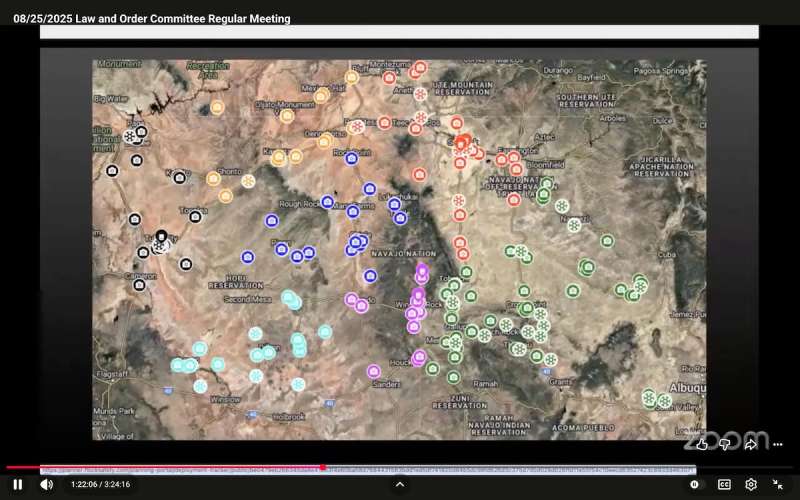
In August 2025, Cameron Lewis, Flock Safety’s territory sales manager for West Texas and New Mexico, presented information to the Law and Order committee regarding the license plate reader technology to enhance the operations of the Navajo Police Department and Criminal Investigation.
Lewis explained that the camera network was intentionally designed in collaboration with leadership from each police district across the Navajo Nation. He said officials identified major highways, key intersections and crime hotspots to determine where cameras should be installed, rather than placing them arbitrarily.
“This was a made-for-Navajo Nation PD deployment,” Lewis said. As of August 2025, Flock has also partnered with the Gila River Indian Community Police Department and Tonto Apache Police Department.
Flock’s license plate readers use machine learning to identify a vehicle’s “fingerprint,” Lewis said, including its make, model, color and body style, allowing investigators to search for vehicles even without a license plate number. The system can also provide alerts related to stolen vehicles, warrants, Amber Alerts, Silver Alerts and missing persons cases.
Cameras will ‘change how the Navajo Nation addresses crime’
Lewis said the technology is well suited for rural areas and would help the Navajo Police Department investigate crimes, including drug trafficking, reckless driving and missing person cases, and noted it is already used in Arizona, New Mexico, Utah and by other tribal nations.
“This license plate reader technology will change how the Navajo Nation addresses crime and will improve public safety by recording and storing evidence for violent crimes,” said Charles-Newton. “It’s important our people feel safe and that we’re not burning out our first responders.”
Lewis assured the Law and Order Committee that Flock is ready to make any necessary adjustments for implementation. He emphasized the system’s potential in missing person cases by sharing vehicle fingerprint data with nearby agencies.
“I am very excited this is being added to the budget,” said Lewis, as he mentioned letters of support from Navajo Department Criminal Investigators for the partnership with the Nation.
Michael Henderson, the former director of Division of Public Safety, said this program would start with 417 devices across the Navajo Nation. During the January 2025 meeting, start-up costs for the Navajo Nation to purchase Flock devices were estimated at $1.8 million, with a recurring cost of about $1.5 million
“For the longest time, we have been looking to the public that witness these crimes…we’ve been reaching out to have them contact us and use them as a witness to prosecute,” said Henderson. “We’ve always had a problem with our people, they don’t always come forward. They don’t want to get involved.
Charles-Newton addressed privacy concerns, stating that license plate readers do not violate privacy rights because license plates are publicly displayed and drivers do not have an expectation of privacy regarding the exterior of their vehicles on public roads. Law enforcement already has the ability to run license plate information during traffic enforcement.
Lewis said the system is not designed to identify people, “it’s not facial recognition technology, we we don’t go down a a path where we’re violating individuals rights and privacy.”
“They are motion-detect cameras, so they are taking pictures of of everything. A bird can fly by one of the cameras and it will snap a picture of it,” said Lewis. ”You don’t actually have the ability to search within the Flock platform for people. That’s not a search function. The data, there’s the ability to search for images that do not include vehicles. And so that’s where you would be able to get data, and see images of individuals that may have walked by the camera. For privacy reasons, there is not the ability to search for people specifically.”
Tampering with or damaging tangible property of the Navajo Nation is a criminal offense under Title 17 of the Navajo Nation Code.
“Once people find out what this device is as it sits on the road side, I am concerned that there will be a lot of damage by these people on purpose,” said committee member Nathan Notah during the August 2025 meeting. “How do you work with that?”
Lewis said the program’s cost includes funding to replace cameras that may be damaged or vandalized. He said Flock Safety anticipated those incidents and built provisions into the contract to address them, while hoping community trust and awareness of the technology’s purpose would reduce vandalism over time.
Navajo Nation Criminal Investigations Department did not respond to The Republic’s questions as of Thursday morning.
Border towns oppose Flock
In Gallup, New Mexico—the closest border town to the Navajo Nation capital—residents voiced opposition during an April city meeting to the city’s proposed use of Flock cameras.
“I am here tonight in strong opposition to the City of Gallup implementing a system of mass surveillance…I’m sure you understand what Flock safety does with its so called license plate readers is make a thumb print for every vehicle that comes in sight of its cameras,” community member Rose Eason told the Gallup City Council. “It gathers license plate numbers, vehicle makes and models and distinguishing features like body damage and bumper stickers, that allow it to track vehicles across all of its hundreds of camera locations.”
Eason said using taxpayer dollars to fund a private company that records people’s movements as they commute, take their children to school or attend church was “frankly terrifying.” She argued that because license plate information and many police records are subject to New Mexico’s public records laws, the system could expose sensitive location data, potentially allowing domestic violence perpetrators and others to track victims.
Another resident framed their opposition as a constitutional issue, arguing that automated license plate readers amount to warrantless surveillance that undermines Fourth Amendment protections against unreasonable searches.
Reporting by Arlyssa D. Becenti, Arizona Republic