Reporting by Elena Santa Cruz, Arizona Republic
A draft environmental assessment has found that a planned federal detention center project in the northwest Valley will have no significant environmental impact.
The U.S. Department of Homeland Security said it completed a draft environmental assessment and draft “finding of no significant impact” for its planned ICE center in Surprise that will hold up to 1,500 immigrant detainees, 676 ICE officers, administrative personnel and contractor support staff 24 hours a day, seven days a week.
But the planned facility would increase the demand for potable water, wastewater services, electricity, transportation and emergency-response resources, according to documents released Nov. 9. To address concerns, the federal government proposed several commitments related to the project’s impacts.
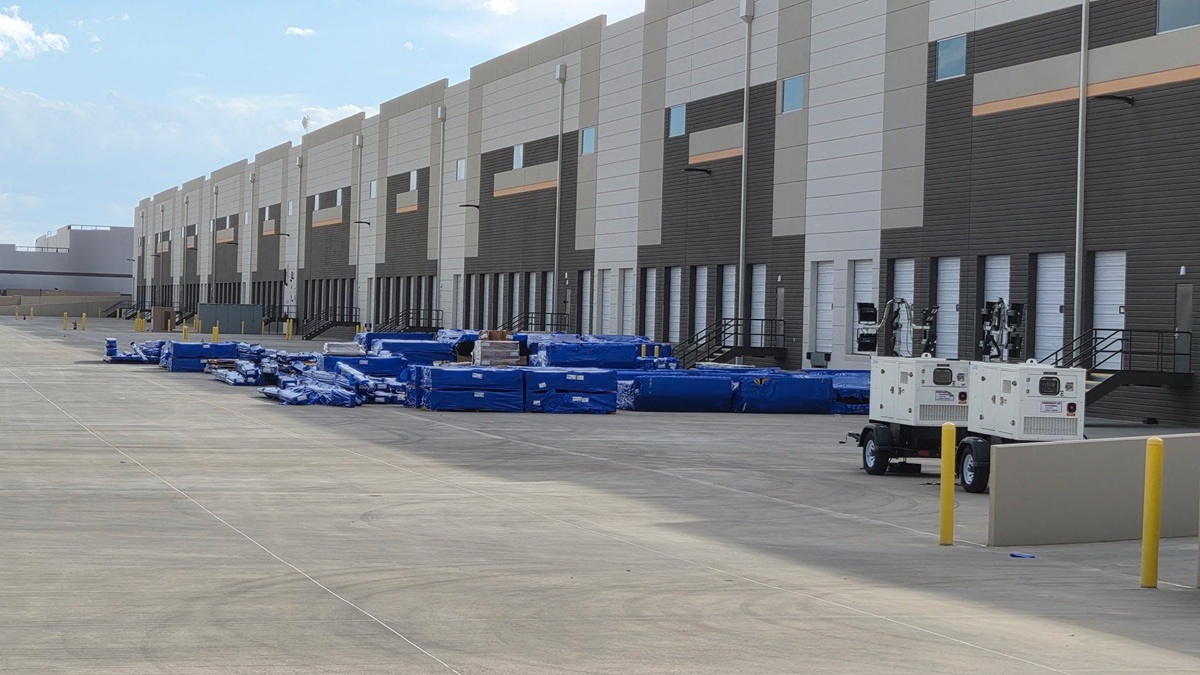
In January, U.S. Immigration and Customs Enforcement quietly bought a 418,400-square-foot warehouse near Dysart Road and Sweetwater Avenue to expand detention space.
The planned project has become controversial in Surprise, and Arizona Attorney General Kris Mayes sued to block it. Part of her argument was that the federal government had done no environmental analysis required by federal law.
Surprise was one of several U.S. communities blindsided by DHS’s plan to buy up warehouses to increase detention space. A USA Today report found that DHS repeatedly advanced such plans before resolving fundamental infrastructure and regulatory questions, prompting legal action and public resistance that helped stall or abort several facilities.
DHS put many of its warehouses back on the market ― but not the one in Surprise. However, in the summer, DHS agreed to hold off on converting the warehouse until it completed an environmental review.
Ultimately, DHS’s draft assessment said that its planned project “would not significantly affect the quality of the human environment.”
Richie Taylor, spokesperson for Mayes’ office, said the state was still reviewing the documents.
The draft assessment and findings will be available for public review and comment for 30 days starting Nov. 9. The documents can be found at dhs.gov/publication/surprise-immigration-processing-center.
Public input will be taken into consideration for the final environmental assessment, according to DHS. Anyone who wishes to comment on the draft assessment and findings can email ICESustainability@ice.dhs.gov with the subject line “Surprise, AZ Comments.”
DHS is also looking to purchase a slice of city-owned property at the southeast corner of the warehouse, according to Surprise’s website. DHS’s assessment noted it is trying to acquire the property for additional perimeter security.
Tamim Chowdhury, ICE’s senior real estate contracting officer, told Surprise City Manager Andrea Davis that obtaining the property was “mission critical” and that the federal government would “seek to use the authorities granted to us to obtain possession.”
Surprise requested a formal appraisal on Oct. 27, as part of due diligence so the city could have accurate information about the site.
“It should not be interpreted as a willingness to sell the parcel, enter into negotiations, or accept the valuation or other terms contained in the letter of intent,” the city’s website said.
DHS commits to mitigating water, traffic, public safety concerns at ICE center in Surprise
ICE’s warehouse was built in 2024, and the federal government is its first tenant.
When the building was first constructed, it was expected to have an average water demand between 63,000 and 126,000 gallons per day, according to Surprise and DHS’s assessment.
ICE’s proposed project is expected to use nearly three times that.
To address this, the federal government said it would financially contribute to a new groundwater well and water treatment. It would also be subject to Surprise’s high-water user ordinance, which will require DHS to provide 15 years of qualifying water resources, which the city said would be a condition of receiving water service.
ICE’s facility will also have an 800,000-gallon water storage tank for domestic water and fire protection.
Residents and students have raised concerns about the building’s proximity to Dysart High and Middle Schools. Dysart High School students walk by the building to get to and from school, according to former student body vice president Cali Overs, who has repeatedly criticized the project.
DHS’s assessment acknowledged its proximity to the schools and the increased traffic during construction, renovation and operation. Employee shifts would overlap with school related-traffic in the morning and afternoon, and DHS anticipates about 25 detainee-transport vehicles entering and exiting the facility per day, according to the assessment.
To help mitigate this, DHS committed to managing shift changes and other routinely scheduled activities to avoid high traffic times and consider the school’s arrival and dismissal times.
Another building near ICE’s has also raised concerns for activists and Mayes: Rinchem, a chemical and gas storage facility directly across the street.
Brent Peak, co-chair of Northwest Valley Indivisible, previously said Rinchem’s risk management plan had several chemical release scenarios involving clouds of hydrochloric acid. The chemical can cause burns, make it difficult to breathe and cause blindness depending on the amount of exposure, according to the Virginia Department of Health.
DHS’s assessment mentioned Rinchem as a facility with substances that pose the greatest risk of harm from accidental releases. However, the assessment said Rinchem had no reported violations or chemical releases.
Still, DHS committed to developing an emergency response plan to address possible off-site chemical releases, which the government anticipated would be a shelter-in-place since the building has a closed-loop HVAC system. The assessment said any secure evacuation would be coordinated between local emergency personnel and ICE.
As for overall public safety, the assessment acknowledged the facility would increase demand for police, fire and emergency services. But because of its location in an urbanized area of the city, the assessment concluded that the facility’s anticipated needs were not expected to exceed the capacity of police, fire or medical providers.
DHS committed to coordinating with public safety personnel about emergency response procedures and points of contact before the facility is operational.
However, ICE’s facility has already affected Surprise’s police force, according to a July email from Jodi Tas, the city’s government relations director, obtained through a public records request. The email was to staff for U.S. Sens. Ruben Gallego and Mark Kelly.
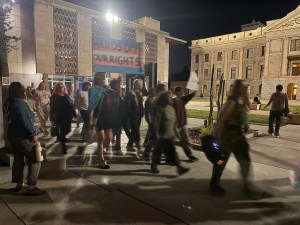
Before ICE bought the warehouse, only a few police officers worked a council meeting. That changed following the federal government’s purchase. At the first city meeting following news of ICE’s plan, dozens of people told Surprise leaders they opposed the planned facility while more than 1,000 protested outside City Hall.
The Police Department began staffing 15 to 20 officers per meeting, Tas said, leading to a more than 700% increase in staffing hours at the meetings. The move burdened the department’s budget and led to a public safety budget amendment in April, Tas said, adding that the city expected the demand to continue.
“Police officers and firefighters are handling prolonged protest duties and emergency planning tasks beyond their already strained staffing levels in a growing city with many competing demands,” Tas said.
Elena Santa Cruz covers the West Valley cities of Glendale, Surprise and Peoria. Reach her at elena.santacruz@arizonarepublic.com or follow her on X @ecsantacruz3.
This article originally appeared on Arizona Republic.
Related: Why communities are pushing back against data centers in Arizona