Michael Oei teaches English at Hamilton High School where he says he noticed a fluctuation in attendance in January and February, around the same time as the heightened Immigration and Customs Enforcement (ICE) activity nationwide.
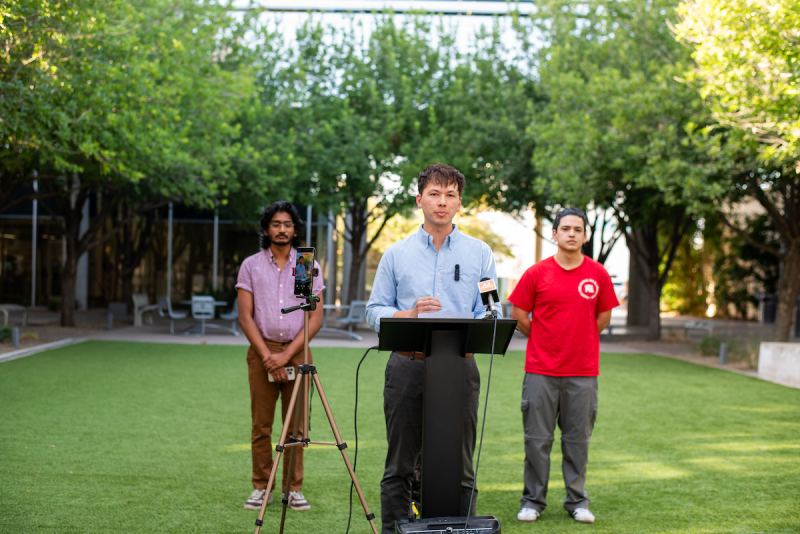
Oei is worried for his students in the face of President Donald Trump’s mass deportation agenda that’s led to the detention of more than 60,000 people nationwide. That’s why on May 18, he showed up outside the Chandler City Hall during its study session to speak out against the city’s contract with Flock Safety, urging the city not to renew it at its next Council meeting on May 21.
“ The surveillance makes me worry for my students. I have students who are immigrants, and these cameras have been linked to ICE enforcement actions,” Oei said. “Having these cameras makes me worry about my students, their safety, and school attendance.”
Chandler has a $153,400 contract with Flock Safety. In 2024, Chandler Police installed 14 automated license plate readers (ALPR) and last year the council approved 26 more. The city says the cameras assist in recovering stolen vehicles and license plates and aid police investigations.
The city would be joining a nationwide trend if the city ditches the cameras. Across the country, at least 30 localities have moved to end contracts with Flock Safety, including Flagstaff, Sedona, and South Tucson.
Oei worries that the cameras give ICE an opportunity to target immigrants in the city and create a culture of fear for immigrant communities.
“ We’ve seen in lots of places all over the country that when ICE is more active, when people have that fear, they don’t go to school,” Oei said. “When children aren’t going to school, they’re not learning, and they’re falling behind, which is a huge issue for the community.”
What Flock says — and what the data shows
While Flock says its cameras do not assist ICE agents, an investigation by 404 Media found ICE indirectly accessed Flock’s system more than 4,000 times between June 2024 and May 2025 through requests routed via local and state law enforcement.
During Monday’s study session, Katie Dauphinais, Flock Safety’s public affairs manager, told council members that the city owns “100%” of the data obtained from the cameras.
Councilmember OD Harris called the cameras “a public trust issue” before asking a Chandler Police Department representative, who didn’t identify herself, what Flock would do to protect residents from ICE.
“Although the data and all those other things are important, I think we’re really talking about ‘how are we making sure we’re protecting our residents from ICE?’ Harris said. “Even for residents, they’re nervous about ICE, and they’re residents and citizens of the United States.”
Chandler Police Chief Bryan Chapman stepped in, saying it is very unlikely that ICE could gain access and that ICE has never asked for the information, and if they did, it’d be a “one off,” instance, he said.
Flock Safety did not respond to a request for comment at the time of publication.
Cameras used to track protestors, women seeking abortions
In cities like Tempe, Anaheim, Tulsa, and others, law enforcement agencies have used Flock data to track protesters at different events, including at No Kings Protests and Hands Off protests. The Electronic Frontier Foundation, a nonprofit digital rights group, documented a case in Texas where a law enforcement officer searched Flock’s network to track down a woman suspected of self-administering an abortion, a claim Flock later denied.
Those instances are why Amelia Nguyen, an organizer with the Party for Socialism and Liberation (PSL), urged the city to cut the contracts.
“ These cameras cannot truly keep us safe when they’re used to do things like harass protesters, assist ICE, and stalk women attempting to get abortions,” Nguyen said. “I would argue that these things make us unsafe. Because of Flock cameras, families can no longer go to a simple No Kings Day protest without feeling afraid, nor can a woman seek health care.”
Organizers with PSL said they will host a town hall at the Chandler Downtown Public Library on May 20 at 6 p.m. to prepare residents for May 21’s vote.
“ Real safety doesn’t come from more cameras. It comes from making sure that all citizens have access to the resources that they need to live a good life,” Nguyen said.