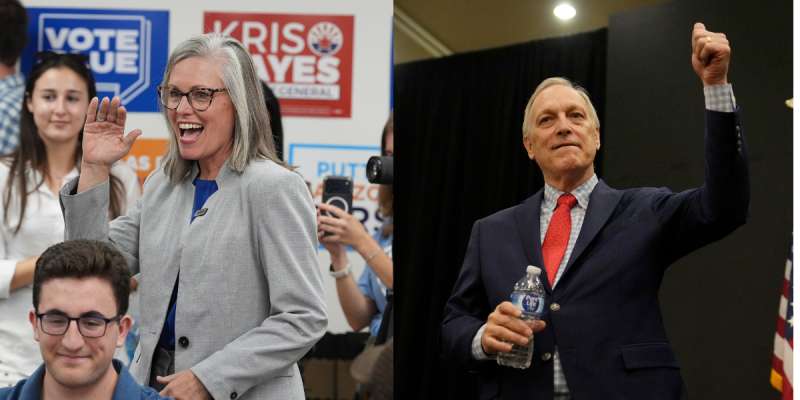
Arizona is in the midst of a competitive governor’s race, with Democratic incumbent Katie Hobbs facing US Rep. Andy Biggs (R-Gilbert) in the general election. The two candidates are hoping to appeal to Arizona voters on their vision to win the governorship this November.
So, where do the candidates stand on the issues?
Katie Hobbs
Hobbs is vying for her second term after winning against former broadcast journalist Kari Lake in the 2022 election.
The 56-year-old incumbent grew up in Tempe, Arizona in a “working-class family,” according to her website, and said her family relied on food stamps and community assistance to make ends meet. A former social worker, Hobbs ran for statewide office in 2010 and was elected to the Arizona House and later to the state Senate. In 2018, Hobbs was elected Arizona secretary of state and in 2022, she was elected governor of Arizona.
During her time as governor, Hobbs has positioned herself as bipartisan, often refusing to sign legislation if it doesn’t have both Democratic and Republican support. She has vetoed 541 bills since 2023, including anti-LGBTQ and anti-abortion legislation.
Healthcare
In 2025, Hobbs and a nonprofit that eliminates outstanding debt announced the state erased $429 million in medical debt held by more than 352,000 Arizona residents. As of August 2026, Hobbs has eliminated more than $1 billion of medical debt for nearly 671,000 Arizonans.
After the US Supreme Court’s 2022 Dobbs decision—which overturned the longstanding Roe v. Wade and Planned Parenthood v. Casey and sent abortion back to the states—Arizona’s Supreme Court ruled the state could enforce an 1864 near-total abortion ban in April 2024 that garnered international attention. After nearly a month of political back and forth in the state Legislature, Hobbs signed the repeal in May that year.
In 2025, funding to provide critical services to nearly 60,000 Arizonans with disabilities was set to expire if lawmakers couldn’t pass a funding bill. Hobbs announced a moratorium on signing legislation until a bipartisan supplemental funding bill was passed to fund the Division of Developmental Disabilities (DDD). Lawmakers cut a deal in April and Hobbs later signed it into law.
Affordability
Hobbs has spent the last year focusing on affordability measures, including eliminating tax exemptions for data centers and rerouting that money to social services. In June, Hobbs signed a bipartisan budget deal that included a three-year pause on data center tax exemptions. Hobbs’ office said the money–which comes to about $57 million—will go instead to Arizonans childcare and healthcare services.
Water
In the midst of a 20-year drought, Hobbs has focused on sustainable groundwater management, including canceling contracts with a Saudi company accused of pumping copious amounts of Arizona’s groundwater. The Democratic incumbent also pushed back against a federal plan that would leave Arizona with water cutbacks, working to ensure Arizonans get their fair share of water supply.
School vouchers
A longtime critic of the state’s voucher program, Hobbs has attempted to rein in the program for years, but has received pushback from the GOP-controlled chambers. Hobbs has stated the program is in need of guardrails to prevent fraud and high costs, arguing that too much state money is being rerouted from public schools and wasted due to the lack of accountability measures. She is at odds with Republicans, however, who are staunch advocates of the program.
Immigration
Hobbs has vetoed a number of anti-immigrant bills sent to her desk by the Republican Legislature, including legislation that would force the state to work with US Immigration and Customs Enforcement (ICE) directly. In February, Hobbs’ office launched a “know your rights” website ahead of reports that ICE had planned a crackdown in Phoenix. Her office vowed to stand up to the administration should the federal government target Arizona next.
On border security, Hobbs said she has focused on halting the flow of drugs and potentially dangerous people, citing Task Force SAFE, which is part of her Stopping Arizona’s Fentanyl Epidemic (SAFE) Initiative, composed of members of the Arizona National Guard. SAFE was created to assist immigration officials in stopping the flow of drugs from entering through Arizona.
Criticism
On the other hand, Hobbs has faced criticism for siding with a Taser-making company, Axon, after Scottsdale voters and the city’s mayor pushed back against a bill Hobbs signed that let the company skip a public vote on its new headquarters in Scottsdale.
Hobbs also has a history of refusing to debate opponents, including former opponent Lake and now Biggs. In 2022, Hobbs attempted to convince the Clean Elections Commission to host separate town halls for the candidates, arguing that Lake “only wants a spectacle,” but the request was later denied. Hobbs’ campaign told the commission the governor would not be engaging in a debate with a conspiracist who would engage in “constant interruptions, pointless distractions, and childish name-calling.”
This year, Hobbs’ campaign manager Nicole DeMont said in a statement that the Democratic governor was declining a debate with Biggs “because face-to-face engagement with Arizonans is more effective than a stage designed for short soundbites and political theater.”
Andy Biggs
US Rep. Andy Biggs (R-Gilbert) has been in Congress for more than nine years, representing Mesa and Gilbert in the US House. A lifelong Arizonan, Biggs served in the Arizona House of Representatives for eight years and in the Arizona Senate for six years prior to serving in Congress. In 2012, Biggs was elected state Senate president, where he killed a bill designed to hold a religious cult accused of abusing girls accountable.
A member of the far-right House Freedom Caucus and backed by both Turning Point Action, headquartered in Arizona, and President Donald Trump, Biggs has made it clear he is running on a far-right agenda that might not land well with purple voters in Arizona.
Since Trump’s second term, Biggs has voted with Trump approximately 98% of the time, according to Center for American Progress, a left-leaning think tank.
Healthcare
In 2025, Biggs voted for Trump’s “One Big Beautiful Bill Act,” or OBBBA, which cut Medicaid by more than $1 trillion and cut SNAP by $186 billion over a decade. Since then, more than 400,000 Arizona families, including 180,000 children, have lost what could be their only access to food. Grocery store workers later called out Biggs for the cuts, stating stores were hurting from fewer sales.
“I will always stand shoulder-to-shoulder with President Trump as he continues to fight the bloated bureaucracy left behind by years of anti-American oligarchy. The fight to restore fiscal sanity has only just begun,” Biggs said in a 2025 statement.
After Arizona voters voted overwhelmingly to enshrine abortion rights into the state constitution, Biggs co-sponsored legislation that would ban abortion—with no exceptions—by extending constitutional “personhood” to a fertilized egg.
Affordability
Biggs has cited affordability as a top campaign issue, including bringing down costs for families and helping businesses. However, Biggs has consistently supported Trump’s tariff policies which have hurt local business owners. In March, the congressman doubled down in his support for tariffs, stating that Trump had “tamed” inflation and that tariffs are “not inflationary.”
Biggs also opposed an extension of Affordable Care Act tax credits, voting against an initiative earlier this year that would have made health care more affordable for hundreds of thousands of Arizonans.
Water
Biggs emphasized working with the federal government to advocate for Arizona’s water. Biggs has framed the issue as one of management rather than a shortage.
On data centers, Biggs told KTAR News he aligns with Hobbs’ policy of opposing additional tax breaks and subsidies for data centers. He said they should generate their own energy and avoid straining Arizona’s power grid and water supply.
“This is probably a policy that I agree with Gov. Hobbs on is a moratorium on the incentives to come here,” Biggs said. “There’s enough incentives to come to Arizona anyway. The state’s just got to make sure we take care of the water and the power situation so we don’t crowd out and squeeze out and drive up costs for our current residents and current users.”
School vouchers
Biggs has ardently supported Arizona’s controversial school voucher program which has been rife with fraud. In June, Biggs stepped in to kill a bipartisan deal in the state Legislature that would have put guardrails to prevent waste and fraud from the program that’s costing the state more than $1 billion annually.
Immigration
As US Immigration and Customs Enforcement (ICE) agents carry out Trump’s mass deportation orders, targeting longtime Arizona residents and business owners, Biggs has backed Trump’s deportation push across the country.
“Americans demand mass deportations,” Biggs wrote in a 2025 post on X. “NO AMNESTY.”
After OBBBA allocated $75 billion in supplemental funding specifically for ICE, Biggs voted in favor of additional funding for Trump’s mass deportation agenda. Dubbed “Secure America Act,” the measure gave ICE and Border Patrol nearly $70 billion through fiscal year 2029. It comes at a time when Arizonans have consistently protested against ICE activity throughout the state.
Criticism
An election denier, Biggs helped plan the Jan. 6 rally ahead of the insurrection and encouraged Trump not to concede in the 2020 election. Biggs has also cast doubt on Hobbs’ win against Lake in 2022, and still hasn’t said if he accepts the election results. He later voted to reject electoral votes for Biden from Arizona along with other battleground states and allegedly sought a pardon from the White House.
Voters will head to the polls on Nov. 3 to decide which candidate will be the governor of the state through 2031.