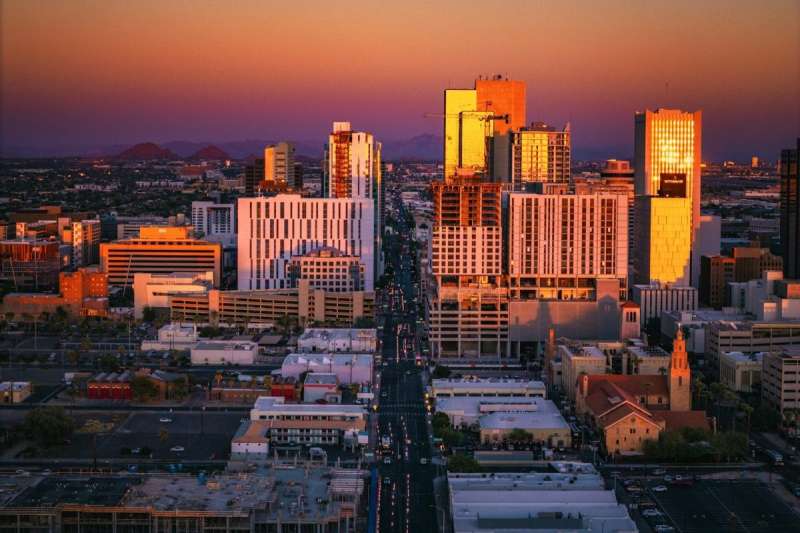
If you live in the Valley, you don’t need a report to tell you that the air isn’t great. You’ve seen the brown haze on summer afternoons, giant haboobs on the horizon, and smelled smoke from fires that are miles and miles away.
A national air quality report from the American Lung Association confirms what people in Maricopa County already know: Our air is among the worst in the country, and it’s getting worse.
The ALA’s latest “State of the Air” report ranked the Phoenix metro area as the fourth-worst in the nation for ozone. That’s the invisible pollutant that most people call smog. Phoenix was also given a failing grade on soot—the fine particles that come from traffic—dust, and wildfire smoke.
The ozone report showed that Maricopa County gets 58 unhealthy days a year, up from 55 in the previous year’s report. Almost two months of the entire year have days where smog climbs up to levels considered unhealthy to breathe.
The particle pollution grades tell another alarming story. For short-term soot spikes, which are driven by dust storms, wildfire smoke, and traffic, Phoenix dropped to 17th worst in the country, down from 28th worst a year earlier. For year-round soot, Maricopa County’s average is above the federal health limit, and fell to 15th worst from 20th.
That’s more days with bad air, and a thicker haze every day.
Two things primarily pollute our air. Ozone forms when exhaust from cars and pollution from power plants and other means bakes in the sunlight. Particle pollution is the soot and dust small enough to get into your lungs when you breathe.
Both get worse in the heat, and there’s a cycle that hits every Arizonan. The same burning of gas and fuel that dirties the air also traps heat over the desert, making summers longer and hotter, which creates even more smog. Arizonans feel the impact in the air they breathe and in the power bill as the air conditioning runs nonstop.
Across Arizona, nearly 1.4 million children grow up while breathing air that’s unhealthy while their lungs are developing.
Unhealthy air affects people who work outdoors like landscapers or deliver drivers. It can cause them to get sick more often and lose a day’s pay.
Older Arizonans with heart or lung conditions have to stay shut indoors on bad air days or risk severe health complications.
The national picture isn’t great, either. The ALA found that around 4 in 10 Americans, over 150 million people, live in a county that failed by at least one measure of air quality they grade.
Rather than tightening the rules Phoenix’s failing marks would normally trigger, the Trump Administration’s Environmental Protection Agency exempted the region from reclassifying air quality from moderate to serious.
The Trump administration’s reasoning was that much of the smog blows in from Mexico, Asia, and distant wildfires.
The Arizona Chamber of Commerce hailed this move as a victory for business.
But changing the paperwork or shifting the blame doesn’t change the air. Your lungs do not care where the smoke came from.
Most of our pollution comes from things that can be changed. From the fuel burned by our cars to the way we power our homes.
Cleaner energy means fewer smoggy days and less of the heat driving up our bills. For now it’s up to us to check the air quality forecast and take it easy outdoors on bad air days, especially for kids, seniors, and anyone with asthma or heart troubles.
But the ALA’s bottom line is clear. In Phoenix, clear air is the difference between a child growing up healthier and the desert being a safe place to live.