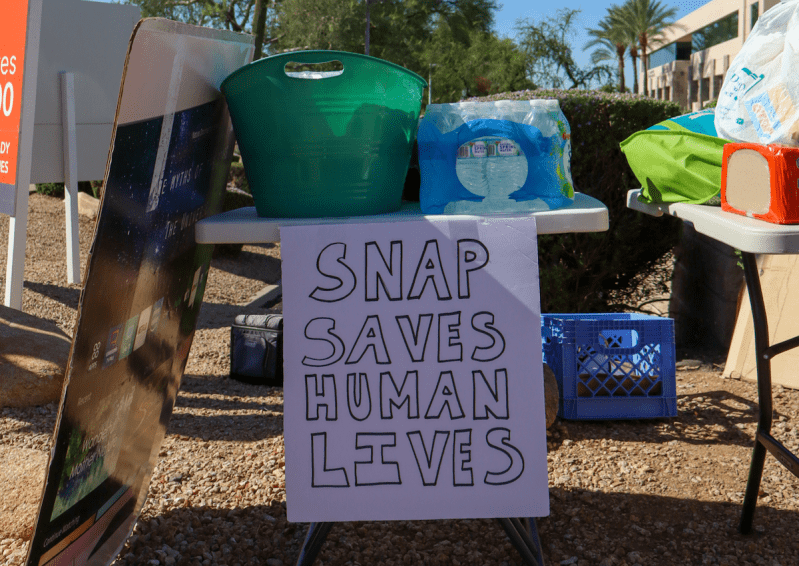
Arizona food banks have been stretched thin before. In 2020, amid the COVID-19 pandemic, local food banks saw a rise in need and relied on state assistance to keep families fed.
This time, however, is different.
After cuts from President Donald Trump’s “One Big Beautiful Bill Act,” (OBBBA) which introduced the steepest cuts to SNAP food assistance in the program’s history, local food banks have been left to pick up the pieces. While the state has directed some funding toward processing SNAP applications faster and toward food banks themselves, the money doesn’t come close to replacing the benefits families lost—leaving food banks largely on their own to offset the impacts.
Things got worse in February, after the US launched a war with Iran that led to higher gas prices, forcing some families to choose between gas and groceries.
Andrea Ariza, public relations manager at St. Vincent de Paul, a food network with more than 80 pantries in the Valley, said the organization has seen roughly double the number of families come in for help since the OBBBA passed last July.
“We were serving about 102 families per month in two food distributions, and now we’re serving about 229 families,” Ariza said.
To address the rise in need, Ariza said the network has increased how much food it distributes to food pantries as it has seen a sharp increase in families calling for box deliveries.
The organization also offers four charity dining rooms at its Phoenix and Mesa locations—held at different times and days—where families can stop in for a hot meal. What’s affecting families isn’t just the loss of SNAP, Ariza explained, but also the high costs of gasoline.
After Trump launched a war against Iran, the country retaliated by closing the Strait of Hormuz, a critical shipping route, disrupting global oil supplies. Arizona has seen high costs of gas since the Iran war, with the state seeing $6-a-gallon gas in some parts of the Valley. By mid-June, the US and Iran had reached a deal to reopen the strait, and gas prices have eased slightly since—Arizona’s average hit $4.42 a gallon that month, according to AAA—but remain well above pre-war levels. For families already struggling, the choice comes down to paying for food that night or paying for gas to attend the weekly dinner.
“Gas is so expensive, so they can’t even get to the resource where we provide the food,” Ariza said. “We’re receiving a lot more calls of people wanting a food box delivery because transportation is such a huge barrier now. It’s a snowball effect.”
High gas costs bleed into other expenses, too, forcing families to choose between electricity, groceries, and fuel. As a result, Ariza said, fewer people are attending the weekly dinners, opting instead for food box deliveries to save on gas.
Ashley St. Thomas, director of public policy at the Arizona Food Bank Network—a coalition that works with five food banks and nearly 1,000 local food pantries across Arizona—said the issue has persisted in Yuma, too, with Yuma’s Community Food Bank seeing an increase in ride-sharing requests, which she attributes to higher gas and utility prices.
“Rising prices for gas, food, and utilities are hitting rural communities especially hard,” St. Thomas said.
Prior to the bill’s passage in July 2025, the Arizona Food Bank Network was publicly opposed to SNAP cuts, warning food banks couldn’t make up for the loss of SNAP money.
“Arizona is already in a hunger crisis, and our food banks are rising to the challenge, adapting to the changing conditions of food insecurity everyday,” April Bradham, president and CEO of the Arizona Food Bank Network said at a July 2025 press conference. “The need for support already cannot be understated. If these cuts go through, the need will be more than we have ever experienced in our network.”
But just a few days later, Congressional Republicans—including Arizona’s Republican delegation—voted in favor of the cuts that, as of this spring, kicked 400,000 Arizonans off food assistance, including 180,000 children. By June, nearly 438,000 fewer Arizonans were receiving SNAP benefits than a year earlier, according to state Department of Economic Security data cited by US Sen. Mark Kelly’s office.
The new law mandated states to reduce their payment error rates—which measures the accuracy of eligibility—to 6%, or else face millions of dollars’ worth of penalties. Despite the law not taking effect in full until 2027, Arizona worked quickly to meet the new requirements, leaving SNAP participants including single mothers, veterans and children, as collateral damage.
Brett Bezio, a spokesperson for DES, told ProPublica in April the state of Arizona could face penalties of $195.4 million in two years—which is more than double the amount it pays to operate the program—if they failed to bring down the error rate.
How food banks are adapting
Arizona’s SNAP participation has been hit with the steepest decline of any state as of this spring, according to the Center on Budget and Policy Priorities. As a result, hundreds of thousands of Arizonans have lost what could be their only food assistance, and food banks have been left to pick up the pieces. Nationally, food banks are bracing for demand on par with last fall’s federal shutdown as they compete with high grocery prices to stretch shrinking supplies, Feeding America CEO Denis McDonough said in July.
To mend the gaps, Ariza said the organization has spent more time on the phones to coordinate delivering and serving as many Arizonans as possible, but can be stretched thin at times as the calls are entirely volunteer-based. The volunteers also step in to deliver the food boxes directly to the homes of residents in need.
For the food distributions—held every second and fourth Saturday of each month— Ariza said the lines have gotten longer, leading them to increase food allotment, too, to ensure nobody leaves empty-handed, as they likely wouldn’t have a fallback now that SNAP assistance has been drastically cut.
“A food bank is not meant to be a replacement, it’s not meant to be the only stop for people to rely,” Ariza said. “We were just meant to be a one single stop when people struggle, so we have to accustom ourselves to try to get more food on the table for people.”
Efforts to bring in more food include organizing food drives and donations. The issue with food drives, Ariza explained, is that they lead to less diversity since people tend to donate canned goods, which can limit protein and other options for families in need.
St. Thomas said her organization is looking for innovative ways to fundraise to bring in more money to feed Arizona families. According to St. Thomas, Arizona’s emergency food network served more than 823,000 people statewide in June—up nearly 20% over the past six months.
“This year has been particularly hard. I would go as far [as] to say devastating for some families, and that’s even with the reference point of the pandemic,” St. Thomas said.
Another benefit of SNAP is that it gives families the dignity of choice, both Ariza and St. Thomas explained. While food banks can step in for gaps, SNAP offers families in need the opportunity to purchase diverse food options. Food banks can attempt to replicate it by offering diverse supplies, but food banks were not designed to replace SNAP—rather, to work alongside SNAP.
“Food banks can’t fill that gap. It’s impossible. Food banks are emergency responders. But at this point, the emergency just doesn’t end,” St. Thomas said. “There’s no replicating SNAP in the sense that there isn’t sufficient amount of food to do that, but also that SNAP provides people choice. People can go to the store and choose what’s best for themselves and their families and food banks are limited in what they have on hand.”