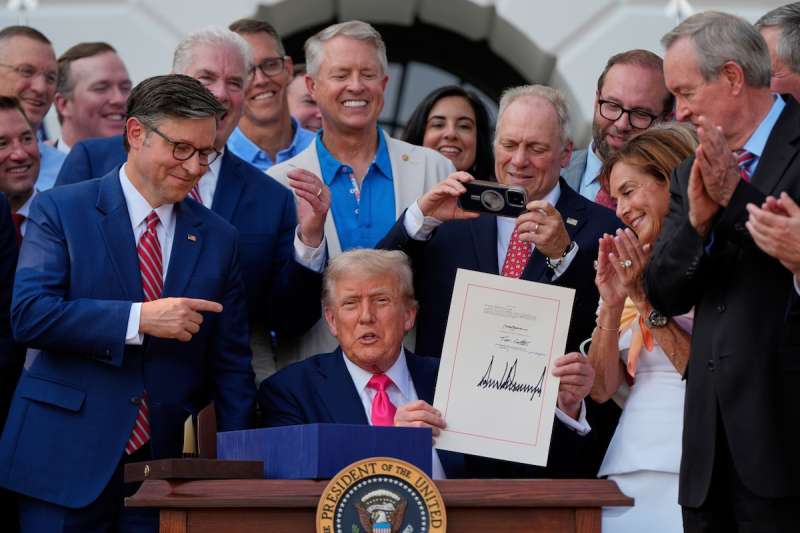
Arizona Republicans voted for steep SNAP cuts in 2025. A year later, the state’s Latino families are feeling the impact most, according to a new analysis.
Arizona has seen the steepest SNAP cuts in the nation since congressional Republicans passed President Donald Trump’s One Big Beautiful Bill Act in July 2025, with more than 400,000 Arizonans kicked off the program, including 180,000 children, according to ProPublica. The state moved quickly to implement the new rules to avoid hefty fines, and Latino families are left feeling the brunt.
A new analysis from Unrig Our Economy and Americans for Tax Fairness, two progressive advocacy groups, shows the toll the law has taken on Latino families: More than 1.5 million Latinos nationwide have lost food assistance in just a year. In Arizona, the report estimates that 48% of people disqualified from SNAP were Latino, even though Latinos only make up about a third of the state’s population.
“The Republican tax law took food assistance away from more than 1.5 million Latinos to pay for tax breaks for billionaires and big corporations,” said Leor Tal, campaign director for Unrig Our Economy. “Families are already struggling with the high cost of groceries and gas thanks to the war in Iran and tariffs. SNAP cuts make it even harder for Latino families to put food on the table.”
Arizona’s Republican delegation voted for the budget that cut SNAP and Medicaid by more than $1 trillion over the next decade—the steepest cuts in the program’s history. Since then, local food banks have worked to fill the gaps, but warned they cannot fully replace the SNAP program.
“A food bank is not meant to be a replacement, it’s not meant to be the only stop for people to rely [on,]” Andrea Ariza, public relations manager at St. Vincent de Paul said. “We were just meant to be a one single stop when people struggle, so we have to accustom ourselves to try to get more food on the table for people.”
SNAP food assistance offers lower-income people government money to purchase groceries. But the new rule expanded work requirements, removed exemptions for veterans, homeless people, and young adults aging out of foster care, along with shifting costs onto the state. The new rules also added more mandatory check-ins and required the state to lower its payment error rate. At the same time, Arizona’s Department of Economic Security laid off about 5% of its workforce in summer 2025, a move the state blamed on other federal cuts. That leaves fewer workers there to verify paperwork.
In Arizona’s 6th Congressional District, represented by US Rep. Juan Ciscomani, local residents have criticized the congressman for voting for the law. While Republicans have framed the cuts as targeting fraud, Angelia Garcia, a single mother of three, confronted Ciscomani at the US capitol for supporting the law that made it harder to put food on the table.
“They’re out of touch because people who are struggling financially, or who don’t have good-paying jobs, or who are homeless need these services,” Garcia said. “They’re not fraud.”
Ciscomani’s district has been hit hard by OBBBA cuts across the board. Arizona hospitals are slated to lose $110 million a year due to Medicaid cuts, and one Tucson hospital has already shut its doors. The impacts will be felt more heavily once the Medicaid cuts go into effect in 2027.
Almost half of Latinos in Arizona live in poverty or low-income conditions, according to research by UCLA. Twenty percent of Latino households live under the federal poverty line, 6 percentage points higher than the state’s average of 14%. While advocates warned that SNAP cuts would hit vulnerable communities the hardest, congressional Republicans still approved the law that hit Arizona families while giving tax breaks to billionaires.
Ciscomani’s Democratic challenger, US Navy and Marine veteran JoAnna Mendoza, has criticized the congressman for voting in favor of the law. If elected, she said reinstating funding would be a top priority should Democrats regain House control this November.
“He voted for HR 1, and we’re seeing costs rise,” Mendoza said. “I’m not running to uphold the Democratic Party’s agenda. I’m running to make sure that people in this district have elected leadership that really does care about them and is going to do everything in their power to make sure they get the things they need to provide for their families.”
Only Texas saw a larger estimated loss of Latino SNAP recipients, according to the report from Unrig Our Economy and Americans for Tax Fairness. After Arizona came Pennsylvania, New Jersey, Nebraska, and Iowa.
“The results are in: Trump and his GOP allies in Congress cut critical nutrition assistance that helps millions of Latinos and working people across the country meet their basic needs—all to deliver historic tax giveaways to billionaires and business elites,” said Jodie Rubenstein, executive director of Americans for Tax Fairness. “As is so often the case, working families and communities of color bear the brunt of Trump’s economic policies. We cannot allow billionaire wealth to grow unchecked while communities go hungry.”