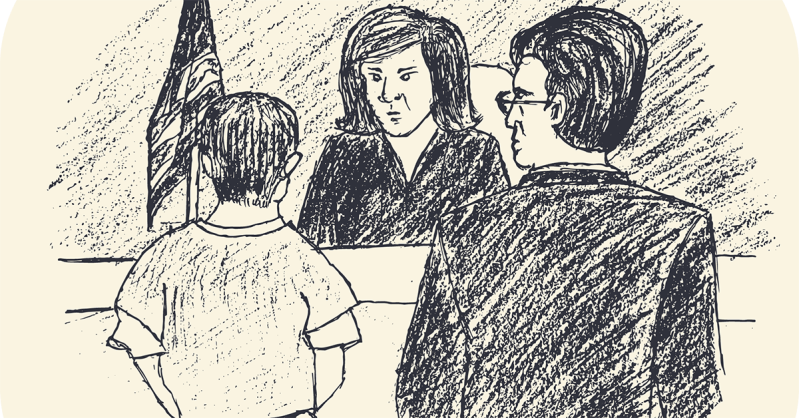
Everything from police interrogation to sentencing and detention facilities can differ from county to country, creating confusion and disparities for juveniles in the criminal justice system.
Warren Williams and his father were watching “Survivor” in their living room when Williams got up, retrieved his father’s 9mm pistol, and returned to shoot him twice. Although he was 14, he was tried for murder as an adult, convicted, and sentenced to 20 years.
One factor in his outcome may have been where he lived: Escambia County, Florida, which has one of the state’s highest rates of prosecuting juveniles as adults.
Warren’s mother, Anne Williams, a nurse of 40 years, attributes her son’s actions to a prescription medication he was taking. She believes that if the killing had taken place in a different county in Florida, he might not be locked up right now.
“Had Warren been in Miami, Warren very well could be married and with kids, which is what he would like to be right now,” she said. “Living the life that he continues to dream of every day that he’s in prison.”
For every child who enters the juvenile justice system, the outcome can vary widely, depending on where the case is heard and the offense is committed.
“Your ZIP code can determine your future,” said Kameron Johnson, the chief juvenile public defender in Travis County, Texas.
An estimated 850,500 juvenile delinquency cases were processed in 2016, the most recent data available, according to the National Center for Juvenile Justice.
But with juvenile court jurisdictions in more than 3,000 U.S. counties, minors can encounter a plethora of legal disparities, including the age of criminal responsibility, access to representation, sentencing outcomes, and the odds of being detained before trial.
Escambia County has one of Florida’s highest rates for juvenile cases transferred to adult court, according to a report by the James Madison Institute, a think tank in Tallahassee. If Williams had been charged in a different county, his chances of being transferred might have been lower, based on the institute’s findings.
Young offenders were four times as likely to be tried as adults than if their cases were tried in Miami-Dade County, the institute said.
“There is a tremendous difference from one court to another, even within one state,” said R. Scott Ryder, an attorney in Michigan with more than 45 years of legal experience, primarily in the juvenile justice system.
The age of criminal responsibility can vary greatly. Vermont allows minors up to age 18 to enter the juvenile court system, whereas most states limit that to ages 16 or 17, according to Juvenile Justice, Geography, Policy, Practice & Statistics. North Carolina has the youngest age: 6 years old – but more than 25 states set no minimum age, meaning a child can be charged for crimes at any age.
Questioning by Police
Many states also do not require that a parent be present when a juvenile is being questioned, according to a report published by Americans for Effective Law Enforcement. But even when law enforcement notifies parents or legal guardians their child is in custody, there’s no guarantee they can be part of the interrogation.
Warren Williams was interrogated immediately after he killed his father 10 years ago.
His mother said she was at a meeting at school when the shooting occurred, and by the time she returned home, Warren already was being questioned – without her or a defense lawyer present. That’s because Florida doesn’t require either to be present during a juvenile interrogation, according to Tamara Gray, an assistant public defender in Miami-Dade county.
“Kids deserve to have their parents in the room when they’re being interrogated, or someone,” Anne Williams said. “They’re minors.”
Every youth going through the court system has the right to a lawyer – as outlined in the Supreme Court’s 1967 decision known as in re Gault – but not everyone receives representation.

Iowa, Missouri, and other states require parental involvement in the questioning process. But other states and counties, such as Winchester County in Virginia, do not.
“A lot of considerations play into juvenile interrogations, even more so than adult interrogations,” said Tim Coyne, Winchester County public defender. “Factors, in terms of the age, maturity, and ability of that child to understand and comprehend what it is they’re giving up. Do they understand their rights?”
But even in Missouri, where state laws require legal guardians to be present before the questioning of a juvenile can begin, attorneys say the statute isn’t always followed.
Sarah Johnson, director of juvenile defense and policy for the Missouri State Public Defender System, said if a child is being held by police or juvenile officers and ready to be questioned, police officers don’t always wait for a parent.
“A kid’s not ever really going to feel like they shouldn’t talk unless their parents are saying, ‘You shouldn’t talk, we want a lawyer,’” Johnson said.
Chris Phillis, juvenile defense attorney in Maricopa County, Arizona, said a child’s initial statements during questioning could be the only evidence the prosecution has, yet it can still lead to a child being charged and sentenced, known as a disposition in juvenile court.
“If they were not confessing, a lot of these charges would not occur,” Phillis said.
In Nebraska, juveniles from counties with a population of 150,000 or more, including Douglas and Lancaster, are automatically assigned a lawyer if none has been hired or the juvenile has waived the right to an attorney.
In smaller, more rural counties, such as Hall and Scottsbluff, no law requires representation to be assigned to those who can’t afford a lawyer.
In some cases, parents or the juveniles end up representing themselves, said Anne Hobbs, director of the Juvenile Justice Institute.
“What happens is when they’re read the charges against them, the parent might say, ‘Just plead guilty, it’s a shorter process,’” Hobbs said. “But the consequences of pleading guilty in juvenile or adult (court) can have long-term ramifications if that court doesn’t get the case sealed. That case is going to follow that youth for their entire life.”
Disparate Use of Detention
Juveniles can be released or detained until their court date. Youth detention typically is a temporary holding facility, similar to a county jail.
Prosecutors in Wyoming use pretrial detention more heavily compared with other states. In 2017, Wyoming was one of the top 10 states with the highest rates of detainment and was the leading the country for commitment rates, according to a 2017 report by the Office of Juvenile Justice and Delinquency Prevention.
Donna Sheen, attorney, and director of the Wyoming Children’s Law Center, said the proximity of a juvenile detention center can determine whether a youth is sent there.
“One of the drivers of the higher placement rates for Wyoming is being very rural and limited access to other resources and very, very little funding for any community-based services,” Sheen said.
That means juveniles in rural states like Wyoming have a greater chance of incarceration because their communities likely have less funding for and limited access to community based alternative services.
Inconsistencies in the use of detention also can be seen in how states handle nonviolent status offenses, such as running away from home, skipping school, violating curfew, or possessing alcohol.
In 2016, Washington, Arkansas, Michigan and Ohio were among the states that used what’s called a valid court order – which gives a court the right to detain status offenders – more than 500 times, according to the Office of Juvenile Justice and Delinquency Prevention.
Craig Fisgus, project director of Volunteers of America, called the valid court order a “loophole to detain status offenders” because it allows an exception to the federal Juvenile Justice and Delinquency Prevention Act, which outlines basic core requirements for juvenile justice.
“The act of being placed in secured detention results in a greater penetration into the juvenile justice system compared to youth who are able to go home prior to the first appearance,” said Jennifer Peck, an associate professor at the University of Central Florida.
Officials in Clackamas County in Oregon said they’re making strides to lower detention rates for kids. Christina McMahan, who directs the county’s juvenile department, said Clackamas County has the state’s only 24-hour risk assessment center, which screens young people to determine whether pretrial detention is necessary.
Since 2016, these efforts have led to a 24% reduction in the number of youth in the regional detention center, she said.
Access to Diversion Programs
At nearly any point in the court process, a judge can divert a child from potential incarceration and sentence the youngster to a diversion program. These service or skill-oriented programs are organized by the jurisdiction or community and are meant to rehabilitate youth. If completed successfully, often no formal charges are filed.
“What really works with kids are not systems that are based on sanctions and punishment,” said Preston Elrod, professor emeritus at the School of Justice Studies at Eastern Kentucky University, “what works for kids are treatments that are based on rehabilitation.”
Diversion programs in Duval County, Florida, have prevented some kids from reoffending.
As of 2016, Florida’s Fourth Judicial Circuit, which includes Duval County, had one of the highest arrest rates and one of the lowest uses of a civil citation as an alternative to arrest, according to a law article written last year by Laura Lothman Lambert, the director of the circuit’s juvenile division.
Since then, Melissa Nelson, who is the county’s state attorney, has tried to better utilize diversion programs to keep young people out of the judicial system by sending 85% of eligible offenders through the programs. According to Lambert’s article, these efforts have produced positive impacts – 96% of youth who complete the program do not re-offend within the following two years.
“We wanted to look at the spectrum and find ways that we could be more effective with front-end intervention so that we prevent kids from continuing to move through the system,” Lambert said.
Rural and less metropolitan counties that have smaller budgets often contract with neighboring counties to provide diversion programs and treatment options.

Limited Options for Sentencing
A young person’s outcome in the juvenile court can vary greatly and include restitution and fines, probation, community service, out-of-home placement at a camp or group home, detention, or foster care.
Rachel Shackelford is county attorney in La Paz County, a 4,500 square mile stretch of western Arizona with a population of just more than 20,000. It’s more difficult for juveniles to receive treatment options than it is for those who live in a more populated area, like Maricopa County with 4.5 million residents, she said.
“The simple fact is that without some of the treatment options out here, there’s only so much we can do,” Shackelford said.
The lack of available placements in La Paz County means detained juveniles often are sent hours away from their families.
New York state has a Close to Home initiative, which prioritizes placing youth from New York City in facilities close to where they live, making it easier for families to visit and participate in the rehabilitation process, according to the New York State Office of Children and Family Services.
Veronica Leventhal, a forensic social worker in the Juvenile Defense Unit at New York County Defender Services, calls the initiative a more “holistic approach.”
“(It) was created because kids in New York (City) were ending up all over the state. And it’s a pretty big state,” Leventhal said. “It’s more designed to set them up for success when they eventually do go home.”
Elsewhere, however, convicted juveniles receive harsh sentences in detention centers or ultimately adult prisons if their sentences extend past age 18.
In 2012, the Supreme Court ruled that states and the federal government must eliminate mandatory life without parole sentences for juveniles, calling them unconstitutional. The possibility still exists for judges in some states to issue a life sentence, but 23 states and the District of Columbia states have banned it.
The Supreme Court’s 2016 decision in Montgomery v. Louisiana applied the ban retroactively, meaning that more than 2,000 children serving life without parole in the U.S. today should be resentenced.
States still are in the process of resentencing those cases.
Fidel Rosales was 16 when he was arrested in 2007 in connection with a gang-affiliated drive-by shooting in California. He was convicted of first-degree murder and initially sentenced to life without parole. After California began policy reforms, his sentence was reduced to 25 years.
Leticia Rosales, Fidel’s mother, said her son has been doing “only positive things” in prison, such as working on his education and staying out of trouble.
“I think he deserves a second chance, a second opportunity to keep his life going,” she said.
Chris Phillis, a juvenile defense attorney in Maricopa County, said “life without parole” depends on how a jurisdiction defines it, meaning some consider a life sentence to be 25 years. Arizona does not.
“Here in Arizona, life without parole does mean your entire life because we don’t have a parole system so you’re never getting out,” Phillis said. “Condemning them to life in prison for the rest of their life at such a young age should only be reserved for the worst of the worst.”
Experts say the juvenile court system was created based on the idea that crime is a local issue, therefore solutions to youth justice also are local.
It’s impossible to determine whether Warren Williams would’ve been sentenced less severely had he been charged and tried in Florida county other than Escambia – or in a different state altogether. But his experience might have differed elsewhere.
“In the United States, there’s 50+ juvenile justice systems,” said Elrod at Eastern Kentucky University. “(They) all have their individual systems with their individual laws and different ways of dealing with these things.”
This report is part of an investigation into juvenile justice in America produced by the News21 program at Arizona State University’s Walter Cronkite School of Journalism and Communications. For the complete Kids Imprisoned project, visit kidsimprisoned.news21.com.