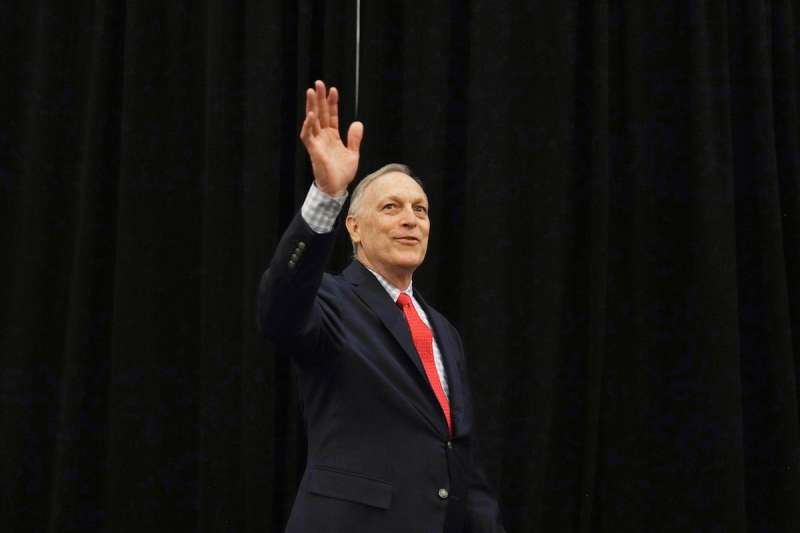
Advocates, including a survivor of domestic violence and sexual abuse, are calling out US Rep. Andy Biggs (R-Gilbert) for what they call his record of being soft on predators.
At an Aug. 20 press conference, a group of Arizona advocates and survivors denounced Andy Biggs’ record of protecting sex predators as Biggs’ attempts to convince Arizonans on his vision for the state.
The group focused specifically on Biggs’ efforts in 2013 to kill legislation that would have stripped power from the local police force, the Colorado City Marshal’s Office, for protecting a religious group—widely considered a cult—accused of sexually assaulting girls in rural Arizona.
That year, the Fundamentalist Church of Jesus Christ of Latter-day Saints (FLDS) was accused of abusing girls in rural Arizona. The group’s then-leader, Warren Jeffs, had spent time as a fugitive on the FBI’s Ten Most Wanted Fugitives list prior to his arrest, and a jury convicted him in 2011 on charges tied to sexually assaulting two girls, ages 12 and 15, both of whom he had forced into marriage.
By 2012, Jeffs was behind bars and the US Justice Department had sued FLDS, claiming religious discrimination against non-members. Jeffs was in prison, and in 2013 Republican-sponsored legislation backed by Arizona’s then-Attorney General Tom Horne (R) would have stripped power from the local police force, the Colorado City Marshal’s Office, arguing it acted as an arm of the group rather than protecting the public. That effort stalled once Biggs stepped in.
Then-Senate President Biggs killed the legislation that could have ended the abuse a few years sooner, according to the bill’s sponsor, then-state Rep. Michelle Ugenti-Rita (R-Scottsdale).
“Women and children suffered three years longer than they should have because he protected the bad guys,” she said in 2016.
At the press conference, former state legislator Debbie McCune Davis (D), who served alongside Biggs at the time, said some of the victims had spoken directly to the lawmakers at the time the bill was under consideration, giving firsthand accounts of what they endured and asking for help.
“Why would anyone stand in the way of legislation meant to protect women and children from that kind of abuse?” McCune Davis asked.
McCune Davis added that Biggs’ move was not “an isolated vote or a single lapse in judgment,” but “part of a pattern.” McCune pointed to Senate Bill 1040 in 2005, which would have implemented tougher penalties for spousal rape. Biggs was one of five state lawmakers to vote against the measure. It passed 52-5 and made its way to the Senate before being signed into law by the governor that same year.
Lauren Easter, a paralegal and domestic violence survivor and victim advocate, said she survived an abusive relationship rife with physical, mental, and sexual abuse. After leaving, she pursued a law degree and works with multiple organizations to support victims of sexual and domestic violence. Easter said the support of loved ones helped her escape—support she believes the girls in Colorado City were denied due to Biggs’ moves.
“I know what it means to make the decision to leave an abuser. I know how much courage it takes to walk away, and I know how desperately you need to believe that when you finally get out, there will be someone on the other side willing to help you,” Easter said. “I was fortunate to eventually have people who helped me get out. The girls and women in Colorado City needed people with power to help them get out too, and that is why this history matters so deeply to me. “
Drew Sexton, Biggs’ campaign spokesperson, told The Washington Post that Biggs opposed the “poorly-written legislation” for being too broad and opposed by the Arizona Police Association.”
The advocates say that’s not good enough.
“Andy Biggs owes Arizona an answer for why he chose to protect the people enabling abuse instead of the children who needed his protection,” said Stephanie Miller, a Tucson social worker. “Arizona’s children deserve leaders who understand that protecting the vulnerable is not optional. It is a duty. Andy Biggs had that duty. He had the power to act, and when vulnerable children needed him to use it, he failed.”
A ‘bizarre history’
Biggs’ record has been in the spotlight for weeks. On Aug. 17, the Democratic Governors Association (DGA) accused Biggs of having a “bizarre history” when it comes to predators, pointing to a 2007 vote.
At the time, state lawmakers were considering Arizona Senate Bill 1268, a bill that would have increased criminal penalties for sexual predators who targeted children. The bipartisan bill had already passed the state Senate, but stalled after Biggs objected to it in committee. After the objection, it never received a full vote in the House, nor became law.
The DGA, along with advocates at the press conference, also criticized Biggs for standing in the way of the full release of the files related to the now-deceased and disgraced financier Jeffrey Epstein, who faced federal trafficking charges for preying on girls as young as 14.
In 2025, calls to release the “Epstein files” grew, but Biggs was one of just two lawmakers on a House subcommittee who voted against releasing records tied to Epstein after a number of reports suggested President Donald Trump was in the files. A year prior, however, Biggs was in support of releasing the files.
Later in 2025, once Trump encouraged the release of the files amid public pressure, Republicans—including Biggs—voted for the files to be released.
For the advocates, Biggs’ vote to protect the files’ full release isn’t an anomaly. They point to a broader and concerning pattern.
“Why did he vote against releasing the Epstein files?” McCune Davis asked. “After 20 years of choices like these, Andy Biggs does not get to hide from those questions, and if he cannot answer them, he has no business asking Arizonans to make him their governor.”